1996 Music winner George Walker died following a fall at Mountainside Hospital near his home in Montclair, N.J. on August 23. He was 96.
The first African American to receive the Music Prize, Walker was a pioneer in many facets of his life. After graduating from the Oberlin Conservatory of Music in 1940 at age 18, he took artist diplomas in piano and composition from the Curtis Institute of Music, becoming the distinguished conservatory's first black graduate in 1945. Within weeks, he became the first black musician to perform at New York's Town Hall and the first black soloist to perform with the Philadelphia Orchestra.
In 1950, he became the first black instrumentalist to be signed by a major classical artist management agency. Six years later, he became the first black doctoral graduate of the Eastman School of Music at the University of Rochester, where he also earned a second artist diploma in piano.
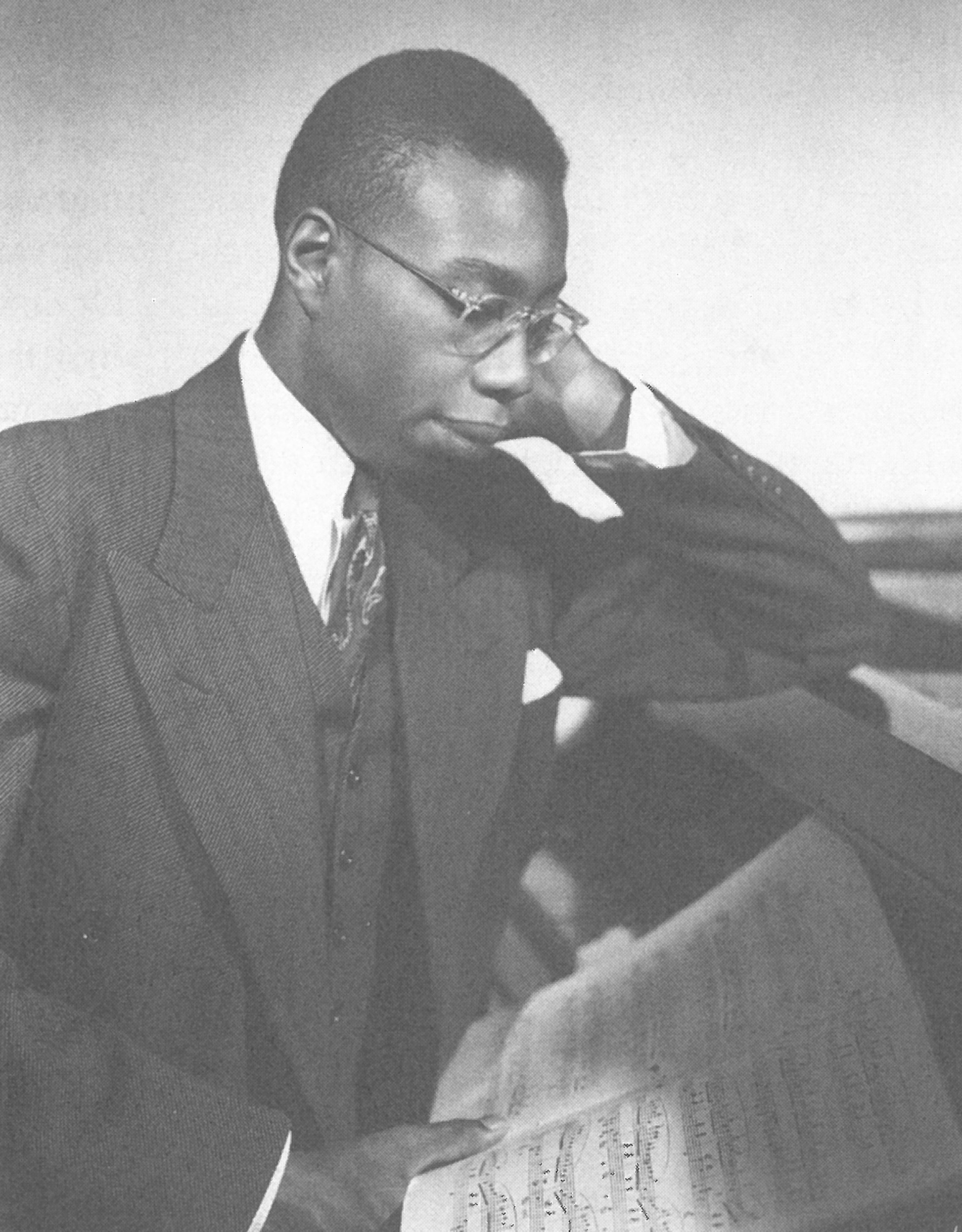
Walker studies a score at the Curtis Institute, 1941 (New Music USA)
While studying with Nadia Boulanger on a fellowship after receiving his doctorate, the eminence grise of 20th century music pedagogy — who trained such disparate talents as Aaron Copland, Philip Glass and Quincy Jones — "was so impressed with his musicianship that she waived the regular requirements she made of students," allowing Walker to bring pieces of his choice to their tutorials.
He then began his academic career in earnest at Smith College in 1961. Shortly after becoming the Seven Sisters institution's first tenured black professor, he moved to Rutgers University in 1969, where he remained for the rest of his career and served as chair of the music department.
Despite enjoying a successful academic career at a major research university, Walker endured systemic racism. Although he eventually toured Europe in 1954, his career as a concert pianist largely stalled after his historic 1945 performances, while incidents that would be characterized today as microagressions were not uncommon.
"I never listened to jazz until I went to college," he wrote in 1991. "Imagine my puzzlement when Rudolf Serkin, my piano teacher, instructed me to play an accompanimental passage in Beethoven’s Opus 101 Sonata 'like jazz.'"
Following a transformative experience at a 1968 symposium in Atlanta, Walker began to incorporate themes and motifs from jazz and spirituals "in atonal pieces that utilized complex time signatures and nontraditional chord progressions."
In an interview with The Washington Post, violinist and composer Gregory Walker reflected on his father's singular style. "He took these simple, elemental melodies and abstracted them so that only someone who knows what to listen for can perceive they’re buried in the fabric of the music. You could think of that as a metaphor for his life. There he is working in this white, classical European idiom and mastering it. But he has a grandmother who was a slave, and is part of [African-American] culture."
Walker worked with a variety of art music forms, ranging from symphonies to string quartets to solo piano pieces. While his works were performed by the New York Philharmonic and the Boston Symphony and several commissions were in progress at the time of his death, the Music Prize did little to enhance his career.
"I got probably more publicity nationwide than perhaps any other Pulitzer Prize-winner," he told The Washington Post in 2015. "But not a single orchestra approached me about doing the piece or any piece. My publisher didn’t have sense enough to push. It materialized in nothing."
Composer Jeffrey Mumford, who teachers Walker's music at Lorain County Community College in Ohio, concurred with his assessment. "We have a great deal of work to do regarding orchestra programming of composers of color," Mumford said to NPR. "Walker deserved many more performances than he has received thus far. Sad to say that even the work that earned him the Pulitzer has not graced the concert hall nearly enough."
Many of Walker's official recordings are available on his YouTube channel, while his Prize-winning "Lilacs" may be heard here. Listen to "Lyric for Strings" (1990), his most often-performed work, below.