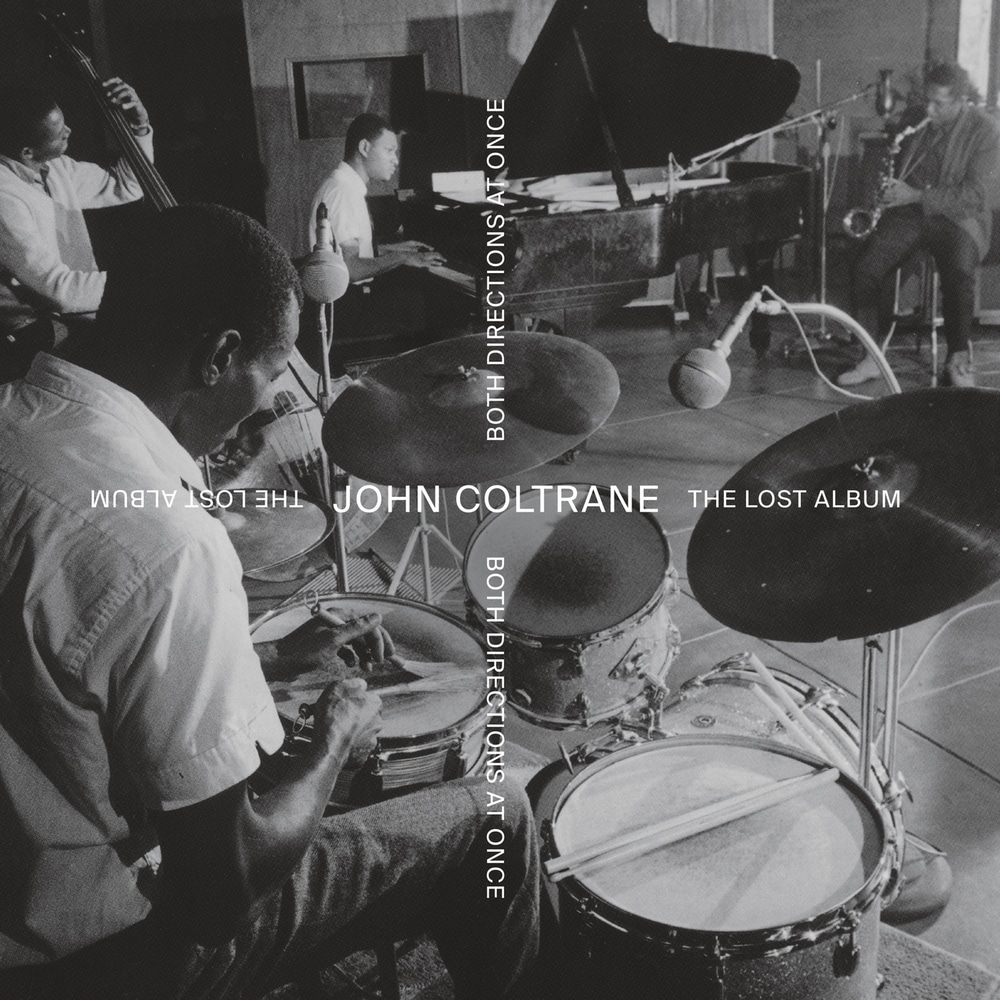
'Both Directions at Once: The Lost Album' (Impulse! Records) cover.
After a decade of speculation, Impulse! Records released jazz performer and composer John Coltrane's "Both Directions at Once: The Lost Album" on June 29.
In March 1963, Coltrane was at a musical and personal crossroads. Increasingly influenced by Eastern philosophy and the avant-garde stylings of saxophonist John Gilmore and multi-instrumentalist Eric Dolphy, he also sought to build upon the crossover success of his 1961 interpretation of Rodgers and Hammerstein's "My Favorite Things."
While an adventurous suite of pieces (including "India," "Africa" and "Impressions") laid the groundwork for the improvisational rock revolution of the late 1960s, Coltrane kept an eye on potential chart success, recording a "straight-ahead" session with fellow posthumous Pulitzer winner Duke Ellington in September 1962 and a short, elegaic album of pop standards with crooner Johnny Hartman in the winter of 1963. Two years earlier, he offered a cryptic reflection on his oppositional influences in an interview with Ralph Gleason in 1961:
"I can’t get in the woodshed like I used to. I’m commercial, man."
A day before the Hartman album was recorded, Coltrane and his "classic quartet" (including pianist McCoy Tyner, bassist Jimmy Garrison and drummer Elvin Jones) recorded at one of their usual haunts — the acclaimed Van Gelder Studios in Englewood Cliffs, N.J. However, in stark contrast to the the majority of the bandleader's meticulous catalog, the music recorded that day would not be released for decades due to a variety of circumstances, including the destruction of the master tape for storage purposes.
Although Coltrane made a personal copy, he soon separated from Juanita Naima Coltrane after initiating a relationship with pianist Alice McLeod. McLeod (who became known as Alice Coltrane following their 1966 marriage) shared Coltrane's philosophical interests and encouraged his move into free jazz after the acclaimed "A Love Supreme" (1964). They remained close musical partners until Coltrane died from liver cancer on July 17, 1967.
Abandoned in his abrupt move from their home, the tape was retained by Naima Coltrane, who remained on amicable terms with her ex-husband and had previously taped his performances. The recording was re-acquired by Impulse! Records after it was nearly auctioned in 2005. The album's release was co-supervised by Ravi Coltrane, who previously accepted his father's posthumous special Pulitzer Prize in 2007.
While it is impossible to ascertain if the session would have been released as an album in its own right (many of Coltrane's albums from the period, including July 1963's "Impressions," were derived from multiple sessions over two-year periods), the hitherto unreleased "Untitled Original 11383" is an important addition to Coltrane's catalog that serves as a virtual signpost to the breakthrough of "A Love Supreme."
The tape also includes a rare (and concise) take on the eden ahbez standard "Nature Boy." Largely framed as a duet between Coltrane and Jones, it is the only recording that anticipates his collaboration with Hartman and later saxophone/drum duets with Rasheid Ali (collected on the posthumous "Interstellar Space") following the dissolution of the quartet.
Listen to the full album on YouTube here. "Untitled Original 11383" is available below.