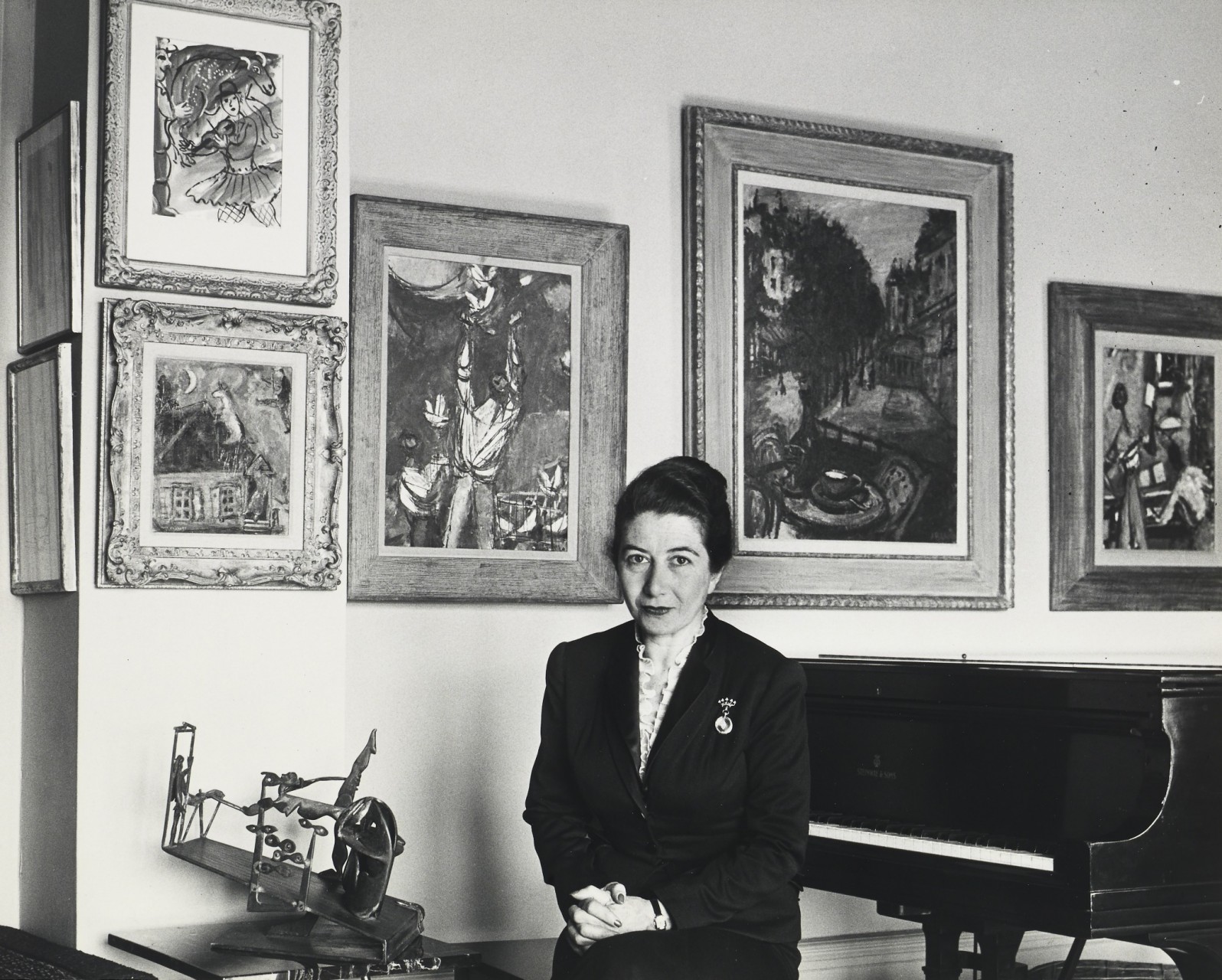
Emily Genauer at home, 1956. (Sidney and Abraham Waintrob/Albright-Knox Art Gallery)
"Now, clearly, artists of a still younger and more atavistic generation are turning back to their grandfather, Picasso. This, too, is a familiar behavioral pattern — Pop art and the new realism growing our of it project a need not only to paint recognizable images again but also to make social statements."
In honor of International Women's Day, Emily Genauer's Pulitzer-winning art criticism has been made available for the first time on Pulitzer.org.
A lifelong resident of New York City, Genauer was born on Staten Island in 1911. Her father, a delicatessen owner who pursued sculpting as his avocation, helped cultivate her interest in art.
"I could do it for 60 years because I'd rather look at art than anything else," she recalled in 1992, "because I love the art world and because every day was different than every other."
After graduating from Curtis High School in her native borough, she briefly attended Hunter College before transferring to the then-undergraduate Columbia Journalism School, where she received a B.Lit. in 1930.
While Genauer's presence at the school was far from atypical (90 women graduated from the institution in 1923), a degree in journalism seldom translated to a career beyond the society and "women's pages" that endured until the social revolutions of the post-World War II era.
Nevertheless, at the height of the Great Depression, she was hired as the art critic of the New York World-Telegram, where she would remain until 1948. Having contributed to the publication as a freelancer since 1929, she was surprised when her weekly income — which often neared $100 — was reduced to $35 after joining the staff.
During this period, Genauer embraced the modernist vanguard — notably Diego Rivera, Marc Chagall and Pablo Picasso — while enthusiastically covering emergent artists.
As the locus of the city's art world shifted to the then-ungentrified neighborhoods of downtown Manhattan, Genauer remained an indefagitable force, once serving as New York Herald Tribune owner John Hay Whitney's sherpa on a Bowery avant-garde art shopping spree.
Although modern art enjoyed a cachet among some of the nation's most patrician — and dependably Republican — individuals (exemplified by Nelson Rockefeller), Genauer moved to the Herald Tribune in 1949 after Rep. George A. Dondero (R-Michigan) alleged that she was a Communist sympathizer and World-Telegram owner Roy W. Howard asserted that she popularized "Communists and left-wingers."
While she successfully evaded blacklisting and "greylisting," Genauer's critical voice largely was elided from the emergence of abstract expressionism, a movement that embodied a hypermasculine aesthetic in both its praxis and in an equally myopic critical discourse centered around the figures that Tom Wolfe would condemn in 1975 as "the kings of Cultureburg": Clement Greenberg, Harold Rosenberg and Leo Steinberg.
In an explication of the legacy of Chaim Soutine included in her Pulitzer entry, she barely contained her contempt for the era: "Soon we saw no feeling in Pollock at all, only a rich 'curtain' of sensuous pigment and form. Always the desideratum for the museum people who chose our shows was bloodless, arm's-length cool. Anything more revealing seemed somehow in bad taste, 'illustrational.' We were forgetting that art is passion, revealed and projected in ordered shapes, colors, lines. If it’s a passion only for technical means, it’s pretty thin stuff."
Yet Genauer persisted. Moving to Newsday's syndicate in 1968 with a weekly column (alongside regular appearances on NET and PBS), she explored new paradigms, including the emergence of op art, photorealism (which she condemned) and neo-expressionism. Largely retired by 1980, Genauer died following a long illness in 2002. She was 91.
In a 1939 piece on the World's Fair, Genauer wrote, "We cherish individuality [...] we cherish the democratic principle." This essential mandate of her criticism remains compelling nearly a century after the beginning of her pioneering career.
Related
Read about 1970 Criticism winner Ada Louise Huxtable here.