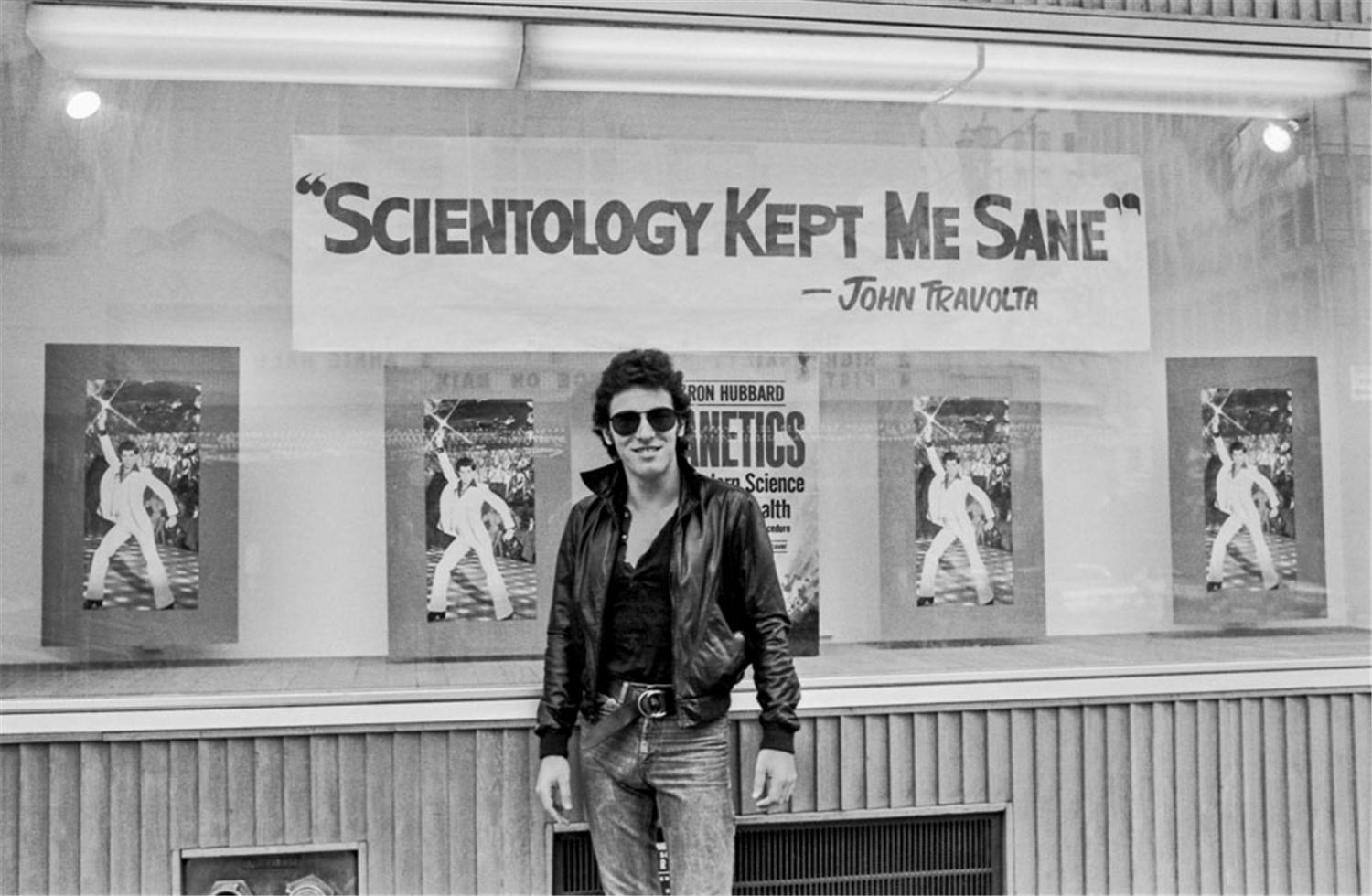
Bruce Springsteen was photographed in front of a Scientology window case in 1978. Although Springsteen was not involved with the new religious movement, it has drawn attention for its recruitment of various celebrities, including John Travolta, Tom Cruise and Chick Corea. (Lynn Goldsmith/Morrison Hotel Gallery)
"Poynter is a millionaire: Does he have a butler, maid, cook, shofer [sic], gardener, etc. Put an FSM onto one of these things and get the low down on he and his wife."
— From a Scientology memorandum reported by Charles Stafford
Bette Orsini and Charles Stafford's 1980 National Reporting Prize-winning portfolio on the Church of Scientology is now availabile in its entirety for the first time on Pulitzer.org.
From a recent measles scare on a training vessel to a new lawsuit accusing the group of "engaging in child abuse, human trafficking and retaliatory activities against former members," the Church of Scientology looms large in the popular imagination despite flagging membership and widespread scrutiny of its practices.
But when representatives of the "Southern Land Sales and Development Corporation" — ostensibly representing the "United Churches of Florida," another front organization — first attracted attention from the Tampa Bay press corps by purchasing Clearwater's historic Fort Harrison Hotel for $2.3 million in late 1975, the story could not have been more different.
Then primarily confined in influence to California and Britain, where founder L. Ron Hubbard, fleeing the inquisitive eye of various federal agencies, resided for much of the 1960s, the organization enjoyed a largely innocuous reputation as one of the era's many new religious movements.
Criticism, including a factual evisceration of Dianetics (an antecedent organization that employed Hubbard's foundational text) in Martin Gardner's "Fads and Fallacies in the Names of Science" (1952; 1957) and Paulette Cooper's "The Scandal of Scientology" (1971), was scant.
Hubbard — who first attained notability as a writer of pulp sci-fi and adventure stories — kept up appearances in that field by never missing Christmas cards to A. E. van Voght and other cronies from the Golden Age of Science Fiction.
By the turn of the 1970s, what may have been mistaken for something along the lines of George Adamski's "Space Brothers" movement ten years prior had taken a sinister turn.
Under investigation by the FBI and IRS for private inurement (leading to the revocation of Scientology's religious tax exemption in 1968) and the FDA for misleading medical claims, Hubbard spent most of the early 1970s on the run, triangulating between various European, African and Caribbean ports of call as "commodore" of the Church's paramilitary Sea Org.
With Hubbard further shielded by a guard of teenaged "messengers" drawn from the families that converted en masse to Scientology — including his eventual successor, David Miscaviage, a defendant in today's lawsuit — the organization reveled in bureaucratic obscurantism. Clipped, paranoid, acronym-laden memos, many from Hubbard's hand, routinely traversed the pre-Internet international telex network.
Had he succeeded in obtaining refuge abroad, as he briefly sought in Morocco in 1972, Scientology's low-key evangelism may have continued indefinitely.
But the Flag Ship Apollo's disembarkation in Florida put the mercurial leader on a collision course with three newspapers that exemplified the vibrant, post-Watergate press, including editorial input from Pulitzer Board members Mike Pride, Andy Barnes and Gene Patterson.
It was not until 1979 that the full scope of the organization's malfeasance — initially highlighted by St. Petersburg Times reporter Bette Orsini's pathbreaking 1976 coverage of the Clearwater incursion — became known.
Spanning 30 countries and overseen by Hubbard's wife, Mary Sue, Operation Snow White encompassed the infiltration of 136 government agencies, foreign embassies and consulates. The targets ranged from the vexatious (although Scientology maintained a stringent opposition to psychotropics from its inception, the Drug Enforcement Agency was targeted) to the predictable (the IRS).
Following a circus-like Washington trial that included the attempted removal of the judge and the issuance of subpoenas to 150 federal agents, Mary Sue Hubbard and her deputies served several years in prison. After completing her sentence, Hubbard was quietly installed in a comfortable home in the Hollywood Hills, where she died in 2002.
Designated as an unindicted co-conspirator, the man known to his adherents as "LRH" feared indictment and retreated to a trailer on a ranch near San Luis Obispo in central California. He devoted much of his energy to musical projects and two science fiction epics before dying in 1986.
Armed with the bedrock of Orsini's 1976 reportage, Times Washington correspondent Charles Stafford employed newly-released documents from the case to assemble the definitive history of Snow White and the Clearwater incursion in December 1979.
The mass suicide of Jim Jones's Peoples Temple on November 18, 1978 and the Unification Church's alleged involvement in the contemporaneous Koreagate scandal had cast profound public circumspection toward new religious movements, and their work earned the 1980 Pulitzer Prize for National Reporting.
Although much of the subsequent coverage of Scientology (including former Village Voice Editor-in-Chief Tony Ortega's scrupulous beat reporting and 2007 General Nonfiction winner Lawrence Wright's "Going Clear") has taken its mission to new heights, the Times's series remains potent on two fronts.
Anticipating the later insights of biographer Russell Miller and Paul Thomas Anderson's "The Master," a 2012 filmic roman a clef in which Philip Seymour Hoffman portrayed the thinly disguised Lancaster Dodd, the reader is first introduced to Hubbard's ardent charisma.
His academic and professional ineptitude (culminating in a disastrous stint as a World War II Navy officer) was often belied by his friendships with credulous intellectuals, including longtime editor John W. Campbell and autodidactic rocket engineer Jack Parsons. In these relationships, the predations of psychological vampirism continually fed illusions of competence.
The series also is suffused with the organization's legacy of anti-press rhetoric, much of which originated from Hubbard himself.
"We do not want Scientology to be reported in the press, anywhere else than on the religious page of newspapers," the newspaper reported Hubbard as writing in an internal publication. "It is destructive of word of mouth to permit the public presses to express their biased and badly reported sensationalism. Therefore we should be very alert to sue for slander at the slightest chance so as to discourage the public presses from mentioning Scientology."
This hostility would permeate the Clearwater affair and nearly all of Scientology's interactions with the media until the 2010s, serving as a cautionary harbinger of recent threats to press freedom.
Nearly 40 years later, the legacy of the Times's investigation remains uncertain. Scientology's ecclesiastical center has expanded to many buildings in Clearwater's revived downtown, coexisting with beachfront resorts and nightlife. Following 25 years of litigation and a relatively modest settlement, the IRS restored the organization's tax exemptions in 1993.
The controversial death of Scientologist Lisa McPherson in 1995 would inspire a groundswell of early Internet activism that ultimately precipitated a resurgence in investigative reporting, itself leading to the long-awaited leak of Hubbard's pulpy "Operating Thetan" cosmology and the key departures of several celebrity Scientologists and church leaders, including Leah Remini and Mike Rinder.
Alongside other works in the Pulitzer archives — including Robert Caro's "The Power Broker" and The Boston Globe Spotlight team's investigation of sexual abuse in the Catholic Church — Orsini and Stafford's series ultimately offers a revelatory glimpse into the workings and corrosion of power.
Related
Read a piece from the portfolio republished for the Pulitzer Centennial here.