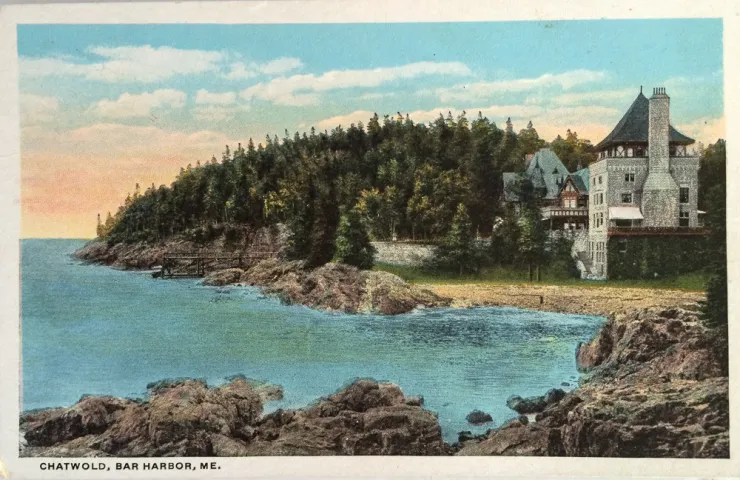
Many of the centennial celebrations kindled around the country by this year’s Pulitzer Prize Campfires Initiative have highlighted local connections: a famous winner, a moment in Pulitzer lore memorable in a particular area. Bar Harbor, Maine, was special to me. It is where Joseph Pulitzer lit the match for all that followed. It deserved a program of its own.
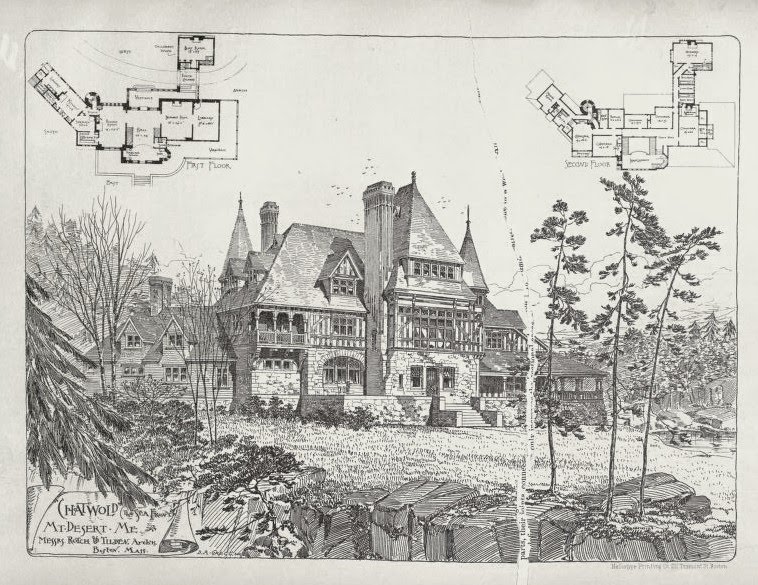
Chatwold
It was at his Chatwold estate near Bar Harbor in 1902 where Pulitzer dreamed up the idea of bestowing annual awards in American journalism and letters. Eventually, he inserted a bequest for the prizes in his will. Six years after his death in 1911 the first Pulitzer Prizes were announced by Columbia University, which he had chosen to administer them.
In the spirit of the Pulitzer Campfires, James McGrath Morris, Pulitzer’s biographer, and I appeared together last month in “Bar Harbor: Birthplace of the Pulitzer Prize,” a program at Bar Harbor’s Jesup Memorial Library. Morris examined the remarkable impact J.P. and his newspapers had on journalism. I focused on the influence of the awards he created, and on a Maine-Pulitzer connection that continued for decades, in part through Joseph Pulitzer II. As longtime Pulitzer Board chairman and publisher of his father’s St. Louis Post-Dispatch, Pulitzer’s son spent many summers at the Chatwold family compound before its demolition after a fire in the 1940s.

Roy Harris and James McGrath Morris
For Jesup library director Ruth Eveland, the Campfire event made the library “the connection point for people” on a matter of local history — the Bar Harbor origin of the prizes and the story of “one of our most famous long-term seasonal residents.” An hour-long Maine Public Radio broadcast on the topic extended the program’s reach.
I stumbled onto Bar Harbor’s little-known place in Pulitzer Prize history more than a decade ago while researching for my book Pulitzer’s Gold, a study of the Public Service award. Columbia librarian Bernard Crystal helped guide me through the first Joseph Pulitzer’s papers in the university’s Rare Book and Manuscript Library. There I found a 1902 memo noting J.P.’s “germ of an idea,” as he put it. He saw a need to “recognize that journalism is, or ought to be, one of the great and intellectual professions; to encourage, elevate, and educate in a practical way the present and, still more, future members of that profession, exactly as if it were the profession of law or medicine.”
In the will he later drew up, $2 million went to Columbia to establish a journalism school, with $500,000 of that set up for prizes –one of the first annual national awards of any kind. The global prizes created in the will of Swedish arms maker Alfred Nobel were first awarded in 1901, a year before Pulitzer’s germ of an idea.
For the Maine program, Morris, the author of Pulitzer: A Life in Politics, Print and Power, traveled from his New Mexico home to Mount Desert Island, where Bar Harbor is situated. As the September date approached, my wife Eileen and I drove up the coast from our home near Boston. We stayed with my Mount Desert-based nephew Jim McKenna and wife Anne. Their precocious kids, sixth-grader Caroline and fourth-grader Jake, knew of Pulitzer from the musical Newsies and happily shared thoughts about him.
After coordinating our slides via e-mail, building on the natural segue from Morris’s knowledge of Pulitzer’s life to mine about the awards, he and I finally met at a library-sponsored reception the evening before our talk. The next morning Ruth Eveland drove us to WPBN in Bangor for our “Maine Calling” interview. Callers to host Jennifer Rooks not only asked about Pulitzer family history and the prizes but also noted individual Pulitzers won by Mainers over the years.
Back in Bar Harbor, Morris and I perused library records and photographs of the Chatwold property, finding a town chart that showed the footprint of the old house. We considered making a trip the next day to view the property from the road.
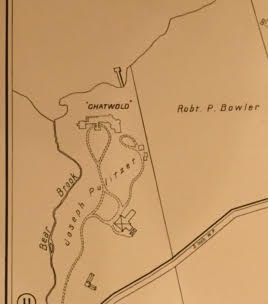
The Chatwold property as seen on a town chart.
That evening, as an audience of nearly 100 filled the library, we were amazed that more than a dozen introduced themselves to us as “Pulitzer people.” They were proud that their homes were on or near what once was Chatwold, now accessible from the Schooner Head Road just south of town. Homeowner Barbara Knowles invited us to visit the next day to see what remains from the Pulitzer estate.
Other welcome guests at our presentation included 98-year-old Richard Dudman, a retired star Post-Dispatch reporter, and his wife Helen, longtime Mainers. The Dudmans were also present 14 years ago in St. Louis for my very first talk about the prizes. That presentation about the five Public Service Pulitzers won by the Post-Dispatch marked the start of my research into the Pulitzers.
Morris started our program with Joseph Pulitzer’s story. He recounted the Hungarian-born publisher’s breakthrough approach in designing his New York World to reach the growing audience of average workers and immigrants. He also spoke of Pulitzer’s reader campaign to raise money to build a pedestal for the city’s new Statue of Liberty.
Then I took over with the prize saga, starting with that 1902 Chatwold memo. While now just as famous for their recognition of America’s top arts and letters and music, I noted, Pulitzer mainly designed his prizes to elevate U.S. journalism by associating it with an American literature which was held in much higher esteem. After mentioning some of the best known journalism winners, I explained how vital it was for early Pulitzer Prizes to identify models of exemplary journalism where few then existed. Such early winners included Pulitzers that recognized the exposure of fraud artist Charles Ponzi (Boston Post, 1921), unmasked Ku Klux Klan activity (New York World, 1922) and uncovered an Ohio mob (Canton Daily News, 1927). The Daily News stories had led the mob to murder its editor, Don R. Mellett.
The final prize I mentioned, the Post-Dispatch’s 1941 Public Service Medal for its campaign to clean up the industrial air pollution that then plagued St. Louis, had another Bar Harbor connection. Post-Dispatch editor Joseph Pulitzer II had kicked off the investigation after flying out of Mount Desert’s pristine skies and contrasting them with clouds of St. Louis filth that he couldn’t explain. The resulting stories explained the effects of cheap high-sulfur coal and persuaded some St. Louis companies to turn to cleaner energy sources. Eventually, other cities followed suit.
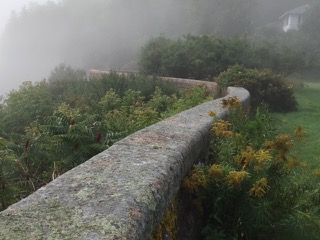
What remains of Pulitzer's Chatwold estate.
The next morning, as promised, Barbara Knowles gave Morris and me a tour of the old Chatwold property that revealed remnants of the estate that we didn’t know existed. These included stone foundations, walls and concrete footings of the old dock from which the original J.P. boarded his yacht Liberty. It was on the Liberty, while docked outside Charleston, S.C., that he died, 105 years ago.
Morris and I left the Campfire with great memories. Our visit to Chatwold suggested to Morris that a plaque should mark the spot where Pulitzer conceived the idea of the Pulitzer Prize. As it happens, we learned, a plan is underway to add a sign — part of the town’s “Museum in the Streets” program — to note the location of the Pulitzer family’s Chatwold property. Its planners are now considering adding a note about Chatwold as the place where the idea of the Pulitzer Prizes originated.