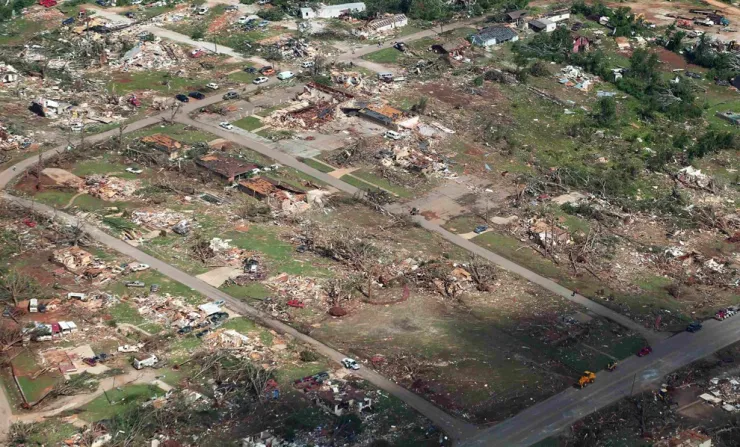
To celebrate our 2016 centennial, the Pulitzer Prizes partnered with America’s state and territorial humanities councils as part of the Pulitzer Campfires Initiative. Each participating council took up the challenge in its own way.
Students at Missouri Journalism School created a project celebrating Pulitzer wins by small-circulation news outlets. Titled 'No Small Pulitzers,' the proect was guided by professor and 1988 Pulitzer winner Jacqui Banaszynski.
Here, student Jacob Scholl writes about The Tuscaloosa News (circulation 35,000) staff that won the 2012 Breaking News prize for its coverage of a deadly tornado in Alabama. The full project can be found at nosmallpulitzers.com.
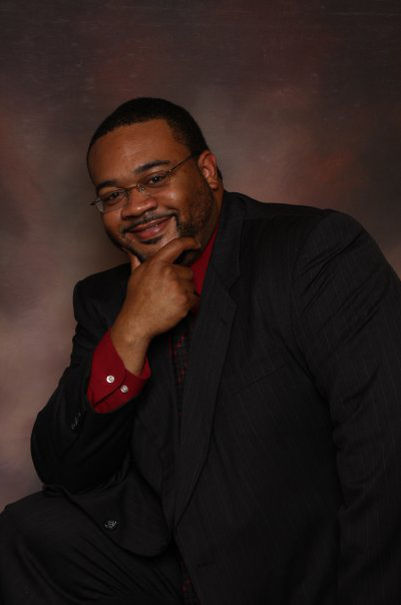
Jamon Smith
When Jamon Smith was a high school student, he wasn’t very clear about his future. So he took a career aptitude test.
“The options it gave me were artist, journalist and trash man,” Smith said. “I didn’t feel too partial to being a garbage guy, no offense to anyone who does that.”
He didn’t want to be an artist either; the idea of the “starving artist” kept popping into his head.
“I guess journalism is what I’ll look into,” he concluded.
Fast forward several years, when Smith was working as a reporter at The Tuscaloosa (Alabama) News. On a violently stormy day in late April 2011, he found himself surrounded by his wife and colleagues in the basement of the news building, praying for the skies to clear.
“We knew it was coming,” Smith said. “We were warned.”
Smith’s wife originally thought to stay at home and wait for the storm to pass. Then she heard a voice telling her it was time to go, and drove to the newsroom to join Jamon.
“Fifteen minutes later, the tornado hit and blew down where we lived,” Smith said.
The tornado, one of a cluster that tore through a wide swath of the southeast, destroyed portions of Tuscaloosa and Birmingham and caused more than $2 billion in damage to the area. When it was over, the storm was blamed for as many as 60 deaths and 1,500 injuries; tens of thousands more were left without shelter, food or electricity.
After the storm had passed their immediate area, then-city editor Katherine Lee knew what had to be done. She immediately sent reporters and photographers out to areas they heard on the radio had been hit.
“We had some experience covering tornadoes, but we never had devastation right in the middle of town like we did then,” Lee said.
When Smith was sent out and discovered that his apartment building was gone, he texted Lee.
“He couldn’t call me, the phones weren’t working, but he could text me. He essentially said ‘my apartment building is gone’ and I was a little bit shell-shocked,” Lee said.
“But I’m out here, I might as well stay out here and report,” Smith added.
Smith and his wife began driving around Alberta City, a neighborhood in Tuscaloosa where they lived, and witnessed the carnage firsthand. They saw people trying to leave the area covered in dust and blood.
“They were like the walking dead, walking wounded, all headed to the hospital,” he said.
Smith saw a man trapped in the second floor of a building, and an overwhelmed fireman frantically chopping away at a wall to save him. He saw body bags piled by the road.
“The police couldn’t worry about people who were dead. They had to worry about the people who were alive,” he said.
Smith came across a man crying on the curb and asked if he was hurt. The man told him that the empty lot behind him used to be his house. He had just paid it off after 30 years.
“It looked like we got bombed,” Smith said. “It looked like something you’d see watching news about ISIS.”
Through all of the destruction and pain, Smith was able to capture much of what he saw on social media, specifically Twitter. He tweeted constantly, collecting video and photos of what he was seeing.
“Katherine (Lee) kind of had a plan already in her head,” Smith said. “We had just done some training on using social media to do real-time reporting, and she sent us out to different directions where the tornado had hit.”
Lee added: “In a crisis like this, people did learn that we were the first place to go for news. We were told that by members of the National Guard that they were following our tweets to figure out where they needed to deploy.”
When Smith came back to the newsroom, reporters and editors collected what they had and posted the stories online. Then they were told to go home and get some sleep.
“I can’t go home,” Smith replied. “ I don’t have anywhere to live.”
He and his wife stayed in eight places over the next six days, but he kept coming to work every morning because it kept his mind off everything else going on.
“It’s just work, man,” Smith said. “People weren’t getting news any other way. It was our responsibility to inform the people.”
Lee agreed: “It was like instinct took over, they just knew what they had to do.”
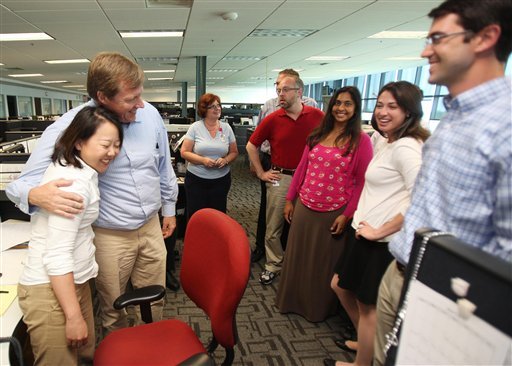
Katherine Lee is congratulated by colleagues the day the staff learned of their Pulitzer win.
The newsroom’s efforts were rewarded with the 2012 Pulitzer Prize for Breaking News. Smith and Lee were two of the three members sent to the award ceremony at Columbia University in New York.
Lee’s advice for young journalists is to be aware that it’s not your typical nine-to-five job.
“Being a journalist is knowing a whole lot of stuff about a whole lot of topics and every day is completely different,” Lee said. “There are some down days, but then you’ll have days where you’re running on adrenaline and it’s so great. If that’s what you’re looking for, there’s nothing better.”
Lee has spent the last four years as the city editor at The Portland Press Herald in Maine. She said that events like the tornado have the ability to remind readers that local newspapers are there to be the community’s voice and can be applied to anywhere in the country.
“As long as readers are willing to appreciate and pay for good local journalism, that’s what we’re here for,” Lee said.
Smith had similar guidance to pass on, and advises young journalists to keep their heads up when things get tough.
“Prepare to work longer hours and hope you love what you do,” Smith said. “If you don’t love it, you shouldn’t do it.”
Smith now works as a communication specialist at the University of Alabama, and cited how the benefits and pay were his main reasons for leaving the News. After almost 12 years as a reporter, Smith still holds his old profession in high regard.
“Without journalists, this world would be ignorant,” he said. “It’s a difficult job, but it’s a noble job.”