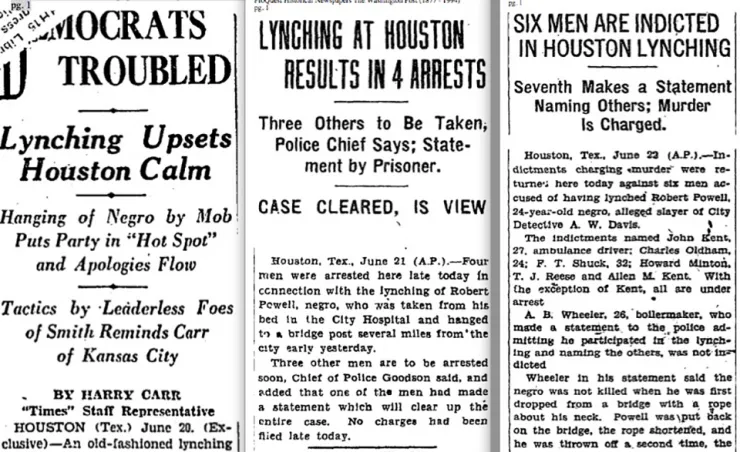
On March 14, 1928, Virginia’s governor signed an anti-lynching law. The journalistic crusader behind this triumph was Louis Isaac Jaffe, editor of the Norfolk Virginian Pilot. But victory in his own state did not still Jaffe’s voice. He called for lynching bans in other states as well as a federal anti-lynching bill that had been killed repeatedly by Senate filibusters.
Jaffe won the 1929 Pulitzer Prize for the editorial below. Its impetus was a lynching in Houston, Texas, where the Democratic National Convention was scheduled to begin four days after the editorial ran. While acknowledging that lynching had decreased since the 1890s, Jaffe noted sadly that Americans “have not yet arrived at that social abhorrence of this crime that must precede its practical extinction.”
The federal anti-lynching bill never passed Congress. A Senate resolution in 2005 expressed remorse over this failure.
An unspeakable act or savagery
By LOUIS ISAAC JAFFE
As the Democratic hosts prepare to rededicate themselves anew to fairness and justice, the bustling Southern city in which they are to meet is disgraced by an unspeakable act of savagery. There is no other way to describe the performance of the eight armed white men who yanked Robert Powell, 24-year-old Negro, from a hospital cot on which he lay with a bullet in his stomach, and hanged him from a bridge just outside the city. Powell was under the charge of killing a detective in a shooting match from which he himself emerged with an apparently mortal wound. In the event of his recovery, he was headed for the courts. But to this Texas mob neither Death nor Justice was an acceptable arbiter. Nothing would satisfy them but a loathsome act of murder carried out against a human being while he lay in agony with a bullet in his entrails.
Houston, which is said not to have had a lynching in fifty years, is understandably stirred by this foul thing laid on its doorstep just when it was most anxious to show itself to the world at its cleanest. The City Council made an immediate appropriation of $10,000 for an investigation to be carried out by a committee representative of both races. A grand jury has been ordered to drop all other business to conduct an immediate inquiry. The Governor has offered a reward for the capture of each participant in the lynching and sent a special detail of Texas Rangers to assist the Houston police in the hunt.
Apparently the spotlight that beats on Houston at this particular time has something to do with the energy with which the authorities have acted. Ordinarily, Texas proceeds in these matters with considerably less dispatch and excitement. But this is no time to inquire too closely into motives. One of the proudest cities in Texas has been polluted by one of the foulest forms of mob murder, and it is a matter for general satisfaction that the authorities are moving so energetically to repair the damage to Texas’ good name. If the perseverance of the authorities is in keeping with their initial burst of energy, one or more of the group that bravely did to death a crippled man lying on a hospital cot may see the inside of the Texas penitentiary.
The year that saw four months pass without a single lynching has now accumulated five of them. Five lynchings in six months represent a proportional reduction in savagery from last year’s record of sixteen lynchings in twelve months, but this year is only half gone and no one may be too confident. We have come a long way from the dark days of 1892 when America celebrated the 400th anniversary of its discovery with 255 lynchings, but we have not yet arrived at that social abhorrence of this crime that must precede its practical extinction.
When eight presumably decent and rational beings can gain the consent of their conscience to rob a hospital bed for the purpose of executing summary vengeance, and when, as was the case a few days ago in Louisiana, two Negros are torn from their guards and lynched because they were brothers of another Negro who was accused of murder, it must be recognized that the rise and fall of the lynching curve is governed by racial passions that remain still to be brought under civilized control.Source: Pulitzer Prize Editorials: America’s Best Writing, 1917-2003 (Third Edition), William David Sloan, Laird B. Anderson (eds.), Iowa State Press, 2003, pp. 39-41