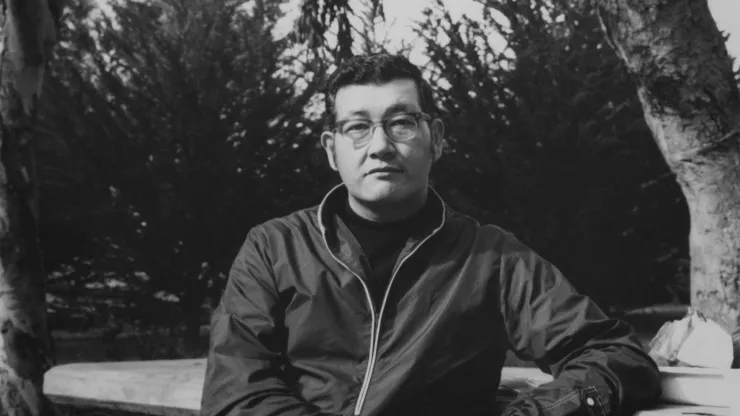
In honor of Native American Heritage Month, we are proud to present the 1969 Fiction jury report recommending N. Scott Momaday's groundbreaking "House Made of Dawn" on Pulitzer.org.
Primarily of Kiowa descent, Navarre Scott Momaday was born in the regional center of Lawton, Oklahoma in 1934. A year later, his artistically inclined parents moved the family to a reservation in Arizona, where they pursued teaching careers alongside their avocations. (Decades later, his father’s illustrations would be featured prominently in "The Way to Rainy Mountain," Momaday's 1969 melange of Kiowa folklore, history and memoir.) This decision enabled Momaday (who also was of partial Cherokee descent through his mother's family) to absorb the traditions of various Southwestern cultures, influences that would later permeate the narrative arc of "House Made of Dawn." In 1946, the family relocated once again to Jemez Pueblo, New Mexico, a rustic hamlet approximately 45 miles north of Albuquerque. There, Momaday would complete much of his secondary education and continue to absorb cultural influences of the local population, including ceremonial running.
After completing his final year of high school at Augustus Military Academy in Fort Defiance, Va., Momaday returned home to the University of New Mexico, where he enrolled as a political science major from 1952 to 1956. He then attended the prestigious University of Virginia Law School during the 1956-1957 term. As a member of the school's venerable Jefferson Literary and Debating Society, Momaday became acquainted with two-time Pulitzer winner William Faulkner, who served as the university's first writer-in-residence during this period. The encounter played an integral role in steering Momaday away from law. He finished his undergraduate degree at New Mexico in 1958 and followed his parents into teaching, spending a year at the Dulce Independent School on the impoverished Jicarilla reservation in northern New Mexico.
Shortly thereafter, Momaday received one of only a handful of fellowships to the Stanford University Creative Writing Center in the spring of 1959. Established by 1972 Fiction winner Wallace Stegner in the aftermath of World War II, the non-degree Stanford program emphasized diverse perspectives over academic rigor for its own sake. In addition to such iconoclastic figures as environmentalist Edward Abbey and countercultural progenitor Ken Kesey (who was rejected for the institutional fellowship but still permitted to attend on a separate Woodrow Wilson Fellowship), the program helped to foster the careers of such disparate figures as pioneering feminist Tillie Olsen, fantasy writer Peter S. Beagle and two-time Fiction finalist Raymond Carver.
While it is tempting to draw a connection between Stegner’s similarly heterogeneous oeuvre and Momaday, the two writers were collegial but not overly close, with Momaday only discovering Stegner later in his career and consulting him intermittently as he began to explore the craft of fiction. Instead, Momaday -- who was admitted as a poetry fellow -- was primarily mentored by Yvor Winters, a modernist poet-critic known for his contrarian interpretations of American Romanticism, instead championing the heretical likes of Herman Melville, Emily Dickinson and Frederick Goddard Tuckerman. Winters (who later characterized Momaday as a canonical American poet in his final monograph, "Forms of Study" [1967]), implored the younger writer to take advantage of Stanford's resources instead of returning to his teaching career after completing his fellowship year, ultimately shepherding him through an M.A. in English and a Ph.D. on Tuckerman in 1963. After accepting a tenure-track post at the University of California, Santa Barbara, Oxford University Press published his first book (an edited volume of Tuckerman's poetry based on his dissertation) in 1965.
During this key inflection point in American history, Momaday continued to work on his magnum opus. First envisaged as a collection of poems and then refashioned as a short story collection before finally evolving into a novel, "House Made of Dawn" primarily drew upon the cultures of Momaday's adolescence in New Mexico while also foregrounding a panoply of voices, including a prominent Navajo character and a duplicitous Kiowa spiritual leader ("Reverend John Big Bluff Tosamah, Priest of the Sun") rendered as a self-parody of Momaday. By positioning a Native World War II veteran (Abel, characterized by Momaday as "a composite of the boys I knew at Jemez") as its flawed protagonist during the transitional years of the late 1940s and early 1950s, it serves as a visceral riposte to G.I. Bill-era quiescence. From a fatalistic liaison with an affluent woman to a drunken binge while living in Los Angeles after his release from prison, Abel is unable to share in the postwar prosperity enjoyed by some of his old colleagues. In the end, Momaday posits, only the immemorial folkways can offer any solace.
Published by Harper & Row in 1968, Momaday's taut novel (coming in at about 200 pages) initially received little attention against the year's revolutionary tableaux. Writing for The New York Times, Marshall Sprauge conceded that it was "superb in its own right" while asserting that "the mysteries of cultures from our own cannot be explained in a short novel, even by an artist as talented as [Dr.] Momaday." Similarly, William James Smith of the liberal Catholic journal Commonweal characterized the novel as "disappointing... it makes you itch for a blue pencil to knock out all the intensified words that maintain the soporific flow."
Nevertheless, Harper submitted "House Made of Dawn" alongside other titles for the 1969 Fiction Prize. That year, longtime Administrator John Hohenberg assembled a characteristic jury of the era, including chair P. Albert Duhamel, a mainstay of the Boston College English faculty familiar to local residents as the book editor of the Boston Herald and as the host of "I've Been Reading," a public television show; Edmund Fuller, a novelist, popular historian and reviewer for Saturday Review and The Wall Street Journal; and Raymond Walters Jr., who held a Ph.D. in history from Columbia and was a longtime editor at The New York Times Book Review.
Reflecting standard practice, the report, authored by Duhamel, was dated December 20. While today's juries are asked to make three recommendations without specifying a preference, this rule had yet to be imposed, with many juries electing to do so. The Fiction jury’s first choice would be a portent of the future:
"Our first choice is N. Scott Momaday's 'House Made of Dawn,'" Duhamel wrote, "because of its [...] 'eloquence and intensity of feeling, its freshness of vision and subject, its immediacy of theme' and because an award to its author might be considered a recognition of 'the arrival on the American literary scene of a matured, sophisticated literary artist from the original Americans,'" he continued, invoking insights from the other jurors. With the Advisory Board yielding to the jury's assessment, Momaday received the 1969 Fiction Prize on May 5, 1969 in an illustrious class that also included Howard Sackler's "The Great White Hope," Norman Mailer's "The Armies of the Night" and Moneta Sleet Jr.'s striking photo of Coretta Scott and Bernice King at Martin Luther King's funeral.
Never a prolific writer by his own admission, Momaday continued to teach at various institutions (including the University of California, Berkeley, Stanford and the University of Arizona) while pursuing his multifaceted interests in various disciplines, including journalism, memoir, visual art, folklore and the ever-omnipresent poetry. During the détente phase of the Cold War, he became one of the few Americans to teach behind the Iron Curtain, spending the 1973-1974 academic year at Moscow State University as a Fulbright lecturer. As he would famously recall in 1981, "One of the things about Russia that I could not have anticipated was the amount of time I would spend in my mind in the Southwest." Momaday remained an active literary figure (publishing three volumes of poetry in the early 2020s) until he died at his home in Santa Fe on January 24, 2024. He was 89.
In 1983, critic Kenneth Lincoln would assert that the publication of "House Made of Dawn" instantiated a Native American Renaissance in American literature, inspiring the likes of 2021 Fiction winner Louise Erdrich, incumbent U.S. Poet Laureate Joy Harjo and influential anthologist Duane Niatum. "Momaday was the one we all looked up to," Harjo said in a 2019 interview with Russell Contreras of the Associated Press. "His works were transcendent. There was always a point where despite the challenges and losses ... there was some moment that imparted beauty."