
Of the poets who have won the Pulitzer Prize in years past, it is George Oppen who speaks to me most directly, especially perhaps his long “Of Being Numerous,” the title poem of his Pulitzer-winning collection. It’s a poem in 40 numbered sections, each of which explores the same question or problem in various ways without resolving it.
The question the poem addresses might be described as follows: how can we (or one) find community in modern “mass” society? Is there a healthy way to be one of “the people?” Is there a positive way to be a solitary thinker? Is a person always already part of a group or is he (sic) inherently alone?
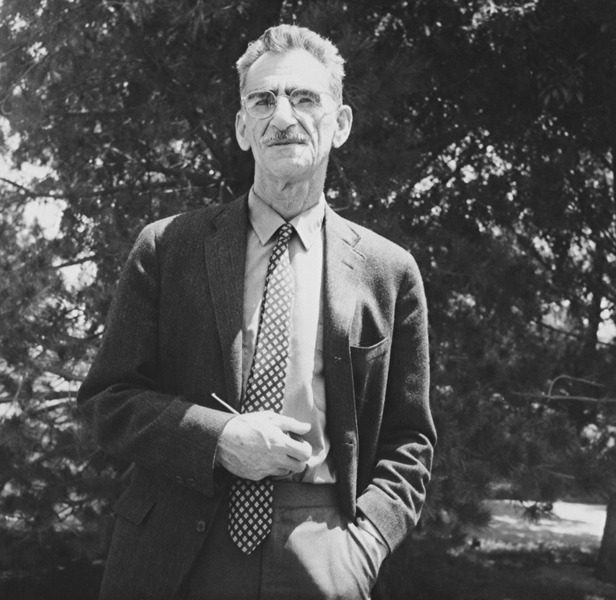
George Oppen
Once home, according to Michael Davidson's introduction to Oppen's New Collected Poems, Oppen enjoyed reconnecting with poets friends such as Louis Zukofsky but, as time went on, found himself alienated from new forms of sociality and specifically from (what he may have perceived as) the narcissism of the “hippie” movement and the New Left.This is an especially vexed question for Oppen, a Marxist and an iconoclastic artist. He seems to be drawn instinctively to the “lonely, meditative man,” yet is never comfortable in that position. He and his wife Mary had been active in workers’ causes in the 1930s and ’40s, then fled to Mexico in the early 1950s to avoid persecution in the McCarthy era. They didn't return to the States until 1958.
One motif that pervades the poem is shipwreck. It is associated with singularity – “the singular//which is the bright light/of shipwreck.” To be alone, singular, is a disaster, but one that brings light with it – a painful light perhaps but one in which, it appears, truth may be revealed. It is the mad, after all, “who speak only of conspiracy/And people talking – //And if those paths/Of the mind/Cannot break//It is not the wild glare/Of the world/Even that one dies in.”
Here Oppen seems to privilege the singular and its connection to the real, but, nonetheless, humanity, and he always acknowledges himself to be part of humanity, has rejected it. (“Crusoe//We say was/‘Rescued.’/So we have chosen.”)
If we decide at this point that Oppen has unequivocally taken the side of the lonely individual, however, we are premature. Elsewhere in the poem he indicts the helicopter pilots alone in their cockpits above the battlefields of Vietnam (visible on the evening news in the 1960s when the poem was written) in these terms:
Now in the helicopters the casual will
Is atrocious
Insanity in high places,
If it is true we must do these things
We must cut our throats
The fly in the bottle
Insane, the insane fly.
This indictment may apply to the pilots or to the president who sent them, but in either case the insanity comes from their isolation from others, specifically the others below them. The populace at home, however, is just as mad – “They await//War, and the news/Is war//As always//That the juices may flow in them/Tho the juices lie.”
I may have made Oppen seem like a misanthrope – but to believe that would be to simplify his position. He remembers fondly and respectfully the soldiers with whom he served in World War II and he likewise asserts that people, “if they cannot find their generation/wither in the infirmaries.” At times the isolated singular appears benign, peaceful, a “Brick/In a brick wall/The eye picks//So quiet/Of a Sunday.” But it is also that pilot, the “insane fly” in the cockpit. The pull toward the two poles, solidarity and withdrawal, is almost painfully constant throughout the poem.
What I admire so much in Oppen’s work is the contrast between the near simplicity and directness of his language and the thorny complexity of his feelings and ideas. In section 26, “We want to say/‘Common sense’/And cannot,” presumably because no such thing exists, and yet we have been warned of the dangers of isolation and arrogance; we know that those who “cannot find their generation/wither.”
The only thing in which Oppen takes unequivocal pleasure here is the physical world, what he calls “mineral fact.” I admire and have learned from the way Oppen sets things, incidents, statements, side by side as mineral facts, without attempting to actively mediate between them. He leaves that to us, if we want to take it on. This poem is a complex, sustained meditation in which motifs (war, shipwreck, madness) circulate through changing contexts without coming to rest.
The poem ends with a quotation in which Walt Whitman sets out to praise the new capitol in Washington but ends simply by describing it with the word “curious” followed by an ellipsis.
I am a very different writer from George Oppen – a woman of a different time. I am not as attracted to certainty (or the tones of certainty) as he is. His emphasis on the dignity of the solitary man feels (must feel) alien to me. And he never plays. Still some of his concerns and obsessions are close to my own and the fairness with which he doubts (in places) what he asserts and acknowledges what we can't know, the way he lets puzzlement have the last word in the poem, resonate strongly with me.
Three poems by Rae Armantrout
UNBIDDEN
The ghosts swarm.
They speak as one
person. Each
loves you. Each
has left something
undone.
*
Did the palo verde
blush yellow
all at once?
Today’s edges
are so sharp
they might cut
anything that moved.
*
The way a lost
word
will come back
unbidden.
You’re not interested
in it now,
only
in knowing
where it’s been.
THE CRAFT TALK
So that the best thing you could do, it seemed, was climb inside the machine that was language and feel what it wanted or was capable of doing at any point, steering only occasionally.
The best thing was to let language speak its piece while standing inside it – not like a knight in armor exactly, not like a mascot in a chicken suit.
The best thing was to create in the reader or listener an uncertainty as to where the voice she heard was coming from so as to frighten her a little.
Why should I want to frighten her?
IT
1. The Ark
How we came to be
this many
is the subject
of our tale.
One story
has been told
in many ways.
It the beginning
there was just one
woman
or one language
or one jot
of matter,
infinitely dense.
It must be so,
but who can believe it?
2. The Hook
"But what about...?"
she asks
and stops,
shrunken
to the impulse
to formulate
some doubt.
Body a question mark,
soul a wire hook.