The space race and the missile gap entered the national vocabulary in the late 1950s. They were buzzwords of the Cold War — the political standoff between the United States and the Soviet Union that dominated American foreign policy for more than 40 years after World War II.
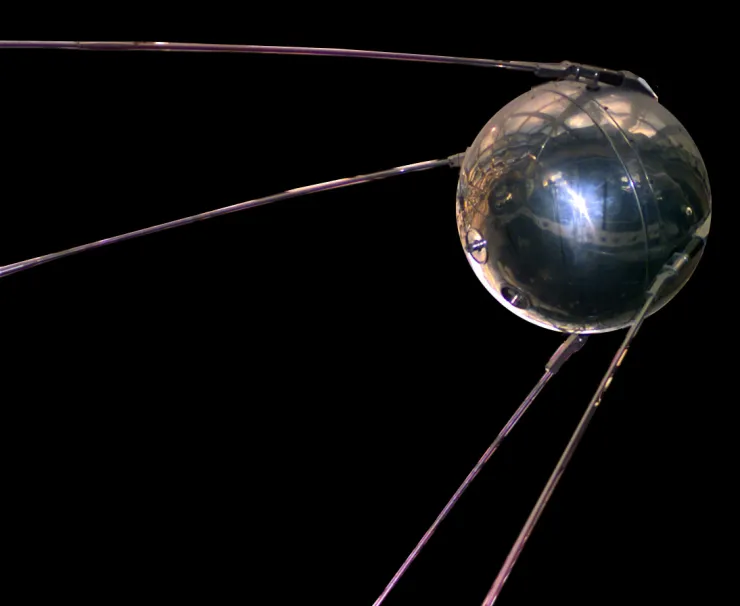
A critical moment in the space race occurred on Oct. 4, 1957, when the Soviet Union launched Sputnik-1, a 184-pound sphere 23 inches in diameter, into space. It orbited Earth 1440 times over three months.
Given the ideological standoff between the Soviet Union and the United States, this great success caused soul-searching about the demise of U.S. dominance as a world power. It was a national embarrassment.
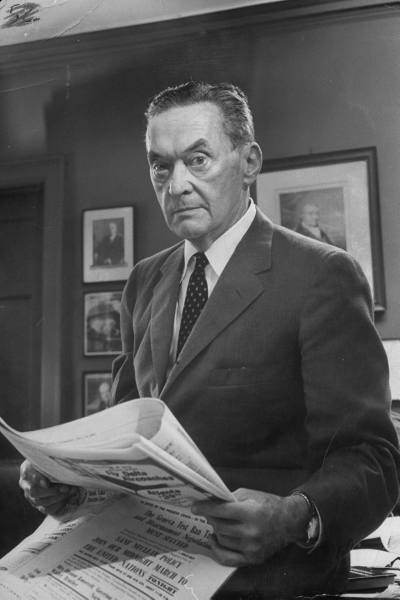
Walter Lippmann
Lippmann’s career began after his graduation from Harvard in 1910. He reported first for the Boston Common, a social reform weekly, then for Everybody’s Magazine. He took a break to write books and work for the secretary of war during World War I. After writing a heralded book called Public Opinion, he returned to journalism, working for the New York World until its demise in 1931 and the New York Herald Tribune thereafter.
Lippmann won a second Pulitzer Prize in 1962 for International Reporting. Ronald Steele’s Walter Lippmann and the American Century was a finalist for the 1981 Biography Prize.
Lippmann died in 1974 at the age of 85.
A society cannot stand still
By WALTER LIPPMANN
The few who are allowed to know about such things, and are able to understand them, are saying that the launching of so big a satellite signifies that the Soviets are much ahead of this country in the development of rocket missiles. Their being so much ahead cannot be the result of some kind of lucky guess in inventing a gadget. It must be that there is a large body of Soviet scientists, engineers, and production men, plus many highly developed subsidiary industries, all successfully directed and coordinated, and bountifully financed.
In short, the fact that we have lost the race to launch the satellite means that we are losing the race to produce ballistic missiles. This in turn means that the United States and the Western World may be falling behind in the progress of science and technology.
This is a grim business. It is grim, in my mind at least, not because I think the Soviets have such a lead in the race of armaments that we may soon be at their mercy. Not at all. It is a grim business because a society cannot stand still. If it loses the momentum of its own progress, it will deteriorate and decline, lacking purpose and losing confidence in itself.
The critical question is how we as a people, from the President down, will respond to what is a profound challenge to our cultural values — not to the ideal of the American way of life but to the way in fact we have been living our life. Our response could be to think of it all in terms of propaganda, and to look around for some device for doing something spectacular to outmatch what the Russians have done. The other response would be to look inward upon ourselves primarily with our own failings, and to be determined not so much to beat the Russians as to cure ourselves.
The question then might be defined in this way: why is it that in the 12 years that have passed since the end of World War II, the United States which was so far in the lead, has been losing its lead to the Russians who at the end of the war were so nearly prostrate? Mr. Khrushchev would say, no doubt, that this is because communism is superior to capitalism. But that answer really begs the question, which is not why the Soviets have moved ahead so fast but why we, who had moved very fast, have not been moving fast enough. For while our society is undoubtedly progressive, it has not in the postwar years been progressive enough.
I do not pretend to know the whole answer to what is for us and for our future so fateful a question. But I venture to think that even now we can discern certain trends that since the world war have appeared in American life and must be taken into account.
We must put first, I think, the enormous prosperity in which, as the politicians have put it to the voters, the private standard of life is paramount as against the public standard of life. By the public standard of life I mean such necessities as defense, education, science, technology, the arts. Our people have been led to believe in the enormous fallacy that the highest purpose of the American social order is to multiply the enjoyment of consumer goods. As a result, our public institutions, particularly those having to do with education and research, have been, as compared with the growth of our population, scandalously starved.
We must put second, I think, a general popular disrespect for, and even suspicion of, brains and originality of thought. In other countries, in Germany and most of Europe and Russia, it is an honor, universally recognized, to be a professor. Here it is something to put a man on the defensive, requiring him to show that he is not a highbrow and that he is not subversive.
What McCarthyism did to the inner confidence of American scientists and thinkers has constituted one of the great national tragedies of the postwar era. It is impossible to measure the damage. But the damage that was done was very great. It was done in the kind of thinking where the difference between creation and routine lies in the special courage to follow the truth wherever it leads.
With prosperity acting as a narcotic, with Philistinism and McCarthyism rampant, our public life has been increasingly doped and without purpose. With the President in a kind of partial retirement, there is no standard raised to which the people can repair.
Thus we drift with no one to state our purpose or to make policy, into a chronic disaster like Little Rock. We find ourselves then without a chart in very troubled waters.