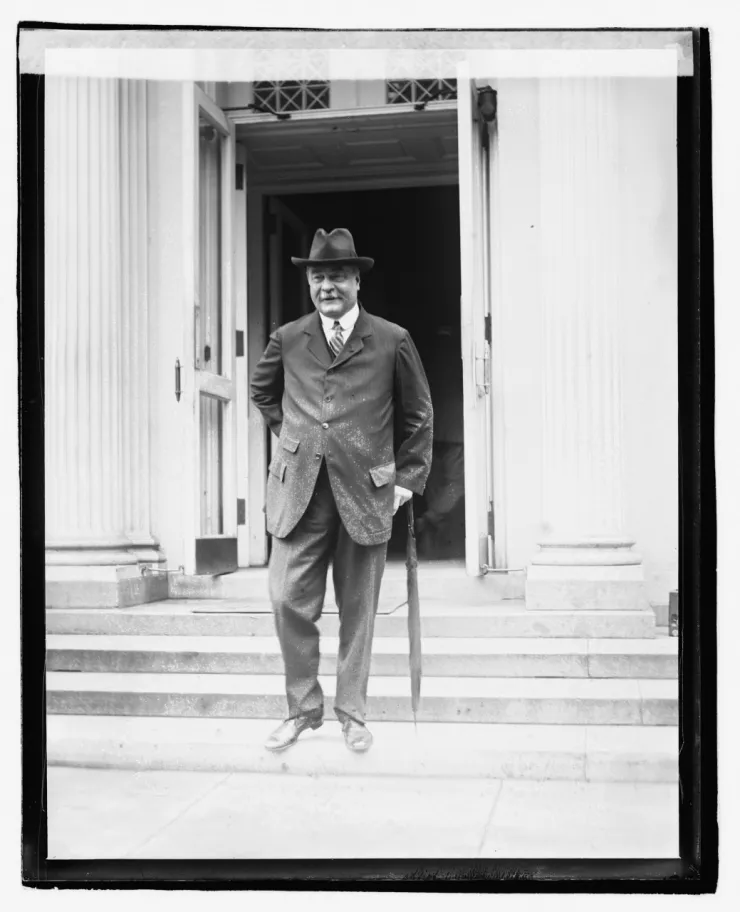
In commemoration of the anniversary of the announcement of the first Pulitzer Prizes, we are proud to present the 1917 journalism jury report for the first time on Pulitzer.org.
Read the report here.
The spring of 1917 was a tumultuous season for the United States and Columbia University. On April 6, Congress issued a declaration of war against the German Empire at the request of President Woodrow Wilson, formally marking the nation's entrance into World War I.
Amid virulent Germanophobia, Columbia President Nicholas Murray Butler — who previously had been a Republican vice presidential nominee and in 1931 won the Nobel Peace Prize — declared an unprecedented moratorium on academic freedom for the duration of the conflict, leading to the dismissal of two faculty members for activities that "tended to produce disloyalty."
The University's School of Journalism, envisaged and funded by Joseph Pulitzer, suspended classes for the duration of the spring term and established a Washington news service.
It was in this environment that several members of University's Advisory Board on the School of Journalism — Solomon B. Griffin of the Springfield (Mass.) Republican, John L. Heaton of The New York World, Charles R. Miller of The New York Times and Samuel C. Well of the Philadelphia Press — met at Low Library on May 24, 1917, to decide the recipients of an awards program that fell under their purview: the Pulitzer Prizes.
Much of the groundwork for the Prizes, which were established alongside the School in Pulitzer's will, had been approved at the Advisory Board's 1915 meeting from a proposal devised by Butler and the University secretary, Frank Fackenthal. (Beginning in the 1918 cycle, Fackenthal, who ultimately served as acting president of the University from 1945 to 1948, became the de facto administrator of the arts and letters Prizes.) Talcott Williams, the director (equivalent to a contemporary dean) of the School of Journalism, became the administration's primary liaison on the journalism Prizes.
With little involvement from the Advisory Board (which elected not to meet in 1916) and few submissions because of the war effort, there was an improvisatory and reactive air to the first prize cycle. For instance, the Fiction Prize was withheld after only five entries were submitted. The History Prize was awarded to Jean Jules Jusserand, the celebrated French ambassador to the United States who had lobbied the Wilson administration to enter the war for several years.
Led by Williams, the journalism jury failed to identify suitable candidates in the Public Service category. But the New York Tribune's editorial on the anniversary of the sinking of the Lusitania was declared worthy of the Editorial Writing Prize, while Herbert Bayard Swope's comprehensive reportage of life in wartime Germany was put forward for the first Reporting Prize.
Without a formal quorum and over the course of two hours, the Advisory Board rubber-stamped the juries' choices and conducted other administrative business, including approval of honoraria.
Following secondary approval from the University's Trustees (which maintained final oversight of the awards until 1975), the Prizes were announced on June 4, 1917, and awarded at the University's commencement on June 6 of that year.
"Except for the Pulitzer newspapers and a few others," wrote former Pulitzer Prize Administrator John Hohenberg, "little public notice resulted."
Today, the autonomous Pulitzer Prize Board confers at least 21 awards in mid-April after months of reading and two days of debate that draw upon the expertise of more than 100 jurors.
Related
Read the 1917 Editorial Writing Prize-winning New York Tribune editorial here.
Read an article from Herbert Bayard Swope's 1917 Pulitzer-winning entry here.