What if you were invited to a discussion about freedom of speech and part of your presentation was censored?
Sounds like a joke, but that’s exactly what happened recently at a forum for high school students. Sponsored by New Hampshire Humanities, the event was part of the Campfires Initiative, a yearlong series of programs celebrating the centennial of the Pulitzer Prizes. It gave teenagers an unexpected object lesson in how censorship works – and how best to respond.
A terrific panel of experts on editorial cartooning had gathered at the University of New Hampshire to talk to an enormous crowd of students about their work; about the importance in a free society of skewering government, religion, and other institutions; and about the dangers of politicians (and publishers) who squelch such expression.
Each of the participants had prepared slides with provocative images to help illustrate their points. Editorial cartoonists Signe Wilkinson and Joel Pett, both Pulitzer winners, brought some of their own work: cartoons about abortion, religious fanaticism, guns, even Republican presidential candidates comparing their relative . . . size. Jytte Klausen, a scholar at Brandeis University, showed the infamous Danish cartoons of Muhammad, images that had been excised from her book on the subject by her publisher. And Victor Navasky, former editor and publisher of The Nation, brought what he described as the most controversial cartoon his magazine had ever published.
That’s where the teacher sponsors of the event drew the line.
Navasky, they said, couldn’t show the cartoon because it was inappropriate for high school kids, particularly some as young as 14.
Well. How does a group convened in part to warn against censorship respond to censorship – and with just a few minutes to figure it out?
Navasky pondered a few courses of action. He could refuse to participate. He could acquiesce. He could show the offending cartoon anyway, in defiance of the hosts. In the end, here’s what happened:
Navasky told the story of the cartoon, a 1984 caricature of Henry Kissinger, drawn by artist David Levine. Kissinger, the former secretary of state, then serving on the President’s Foreign Intelligence Advisory Board, is – quite literally – shown screwing the world. The world, in this case, is a woman with a globe for a head, with Kissinger on top of her. An American flag blankets their otherwise naked bodies, but there is little ambiguity in what’s going on here.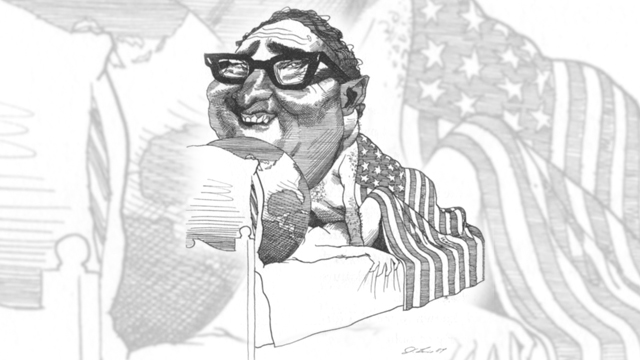
As he was considering whether to publish the image, Navasky said, he received a petition from his staff urging him not to. The petition led to a meeting in which journalists argued about the merits of the image and whether it was too offensive to publish. Offensive to whom? How far was too far?
Talking about art without looking at art is difficult, but Navasky explained to his young audience that their teachers didn’t want them to see the cartoon he had just described. However, he said slyly, it was easily found on the Internet; just Google “David Levine Kissinger.”
Hundreds of high school students whipped out their phones, typed in the words, and – voila! – there was Kissinger, screwing the world. Needless to say, the kids cheered in appreciation.
An old story about Henry Kissinger might not be the most obvious way to hook a crowd of 21st-century teenagers. A cartoon depicting rape might not be the most obvious choice of material for kids, at least the youngest ones in the crowd.
But the event provided many urgent lessons: Censorship can happen easily – sometimes you might not even know it’s happening. The victims are not just the writers and artists whose work is kept from the public, but also the public itself. On the other hand, here in the digital age, censors have an increasingly difficult time practicing their craft.
The day was rich in irony. The students, their teachers, and no doubt the panelists themselves got more to think about than they anticipated. And for David Levine, the caricaturist who died in 2009, perhaps an unlikely new crowd of young fans.