Jeffery Gerritt won the 2020 Pulitzer Prize in Editorial Writing for his series on the horrific deaths of pre-trial detainees in the small Anderson (Texas) County Jail, the court and law enforcement officials on whose watch those deaths happened and the rising tide of people dying in jails across the state.
What follows is his abridged conversation with Katti Gray about reporting the series and the critical need for strong journalism in small towns.
PULITZER PRIZES: How does a world traveler from Wisconsin land in rural East Texas?
JEFFERY GERRITT: I consider Detroit my hometown. It forms my adult view of the world. I worked there 20 years, then made the very difficult decision to leave the Free Press and become deputy editor of The Toledo Blade, which was offering me $25,000 more a year. Toledo was right down the road, which meant I could keep my place on the Detroit riverfront.
Towards the end of my four-year tenure at The Blade — a company privately owned by two brothers — there was a tussle about which way the editorial page would go. It took a really hard right. We had been left of center before. The editor who hired me got fired. I left a month later. I spent a year freelancing, and making good money but doing things like editing an insurance company’s health blog. I’d been used to getting people out of prison, that type of thing. I wanted to get back to that work. That’s how I ended up in a little town in East Texas in the summer of 2017. It was a real switch for me. I decided I would do the best work I can do.
PP: How is working in a small town the same and different than working in larger cities, in Anywhere, America?
JG: The Palestine Herald-Press is a very, very small paper that doesn’t have the resources that Detroit has. But all the same issues that are there in Detroit are here in Palestine. Dying in [pre-trial jail] custody, even though you’re not convicted? That’s about as American as apple pie right now. These same problems are all over the country. They manifest themselves a little differently. So, the work here has been the same as in Detroit or Toledo — just harder and for less pay.
PP: Which of your sources were most critical to your reporting?
JG: My office is six blocks from the county jail. Just released detainees would often walk straight from the jail to my office. They knew what I was doing. I had to corroborate what they said, but they pointed me in the right direction, helped me prove that this death I was asking about was not an aberration. It was systemic in that jail and with how it operated, day in and day out.
As far as official sources, in the end, the Texas Rangers turned out to be extremely helpful. By law, they didn’t have to — but they did — give me their investigations of deaths in the jail. The investigations showed jail corrections officers making fun of addicted detainees detoxing or of ones who had mental health issues. The Texas Rangers reports gave details, names of officers who were falsifying records of their rounds of the daily checks of detainees that they were supposed to make, but weren’t. The Rangers proved that by watching the jail’s surveillance videos. Without access to the Rangers' investigations, I could not have written a real authoritative series.
PP: What aspects of your reporting are suggestive, perhaps, of East Texas and culture, of jail culture? What aspects of it most surprised you?
JG: The jail’s corrections officers are not bad people. They go home, love their kids, probably give to a charity. But their indifference to a detainee’s death is what should strike everyone — the fact that they don’t check on people because they don’t feel like getting up and doing it. It was startling to me that their superiors said, "You’ll have to fudge these surveillance time-clocks." The Texas Rangers would ask the corrections officers, "Do you know that tampering with government property is a felony?" They’d say, "No. We didn’t have enough officers to make those checks, to make those rounds every 15 minutes or 30 minutes," or whatever was required. So, they just didn’t do it. There were a few cases when that was an officer’s defense for what they had done.
When I first started reporting this, the sheriff — in what was my only interview with him — said a person dying in a jail isn’t news. To me, that’s incredible. That really pissed me off.
Another surprising thing is that you’d come across people who were mentally ill and were in jail for non-violent offenses like disorderly conduct, who had been locked up in segregation for three years. How he got there, I don’t know. But that’s unacceptable under any circumstances.
PP: What was Texans’ response to your reporting?
JG: Politically, on the state level, the response was pretty good.
Locally, we got some but not a lot of people saying, "This is great." We actually got some people who were saying, "Lay off the sheriff. These are prisoners, so what?" That was a disappointment. This is a very tough-on-crime state and region. There’s a tendency to think that anyone locked up deserved what they got. To people who think like that, it doesn’t matter that these people who died had not been convicted of anything. They were in the county jail based on allegations, and just too poor to pay to bail themselves out.
PP: What do you hope this Prize-winning project will achieve?
JG: Two things: That these state legislative hearings, ordered as a result of my reporting, raise awareness on what’s bad in these jails.
Also, there are 250 jails in Texas — all operating however they want to operate — but just four inspectors from the Texas Commission on Jail Standards. I hope for greater oversight, either through hiring more inspectors or, better yet, an independent ombudsman who is not part of the state’s jail system.
PP: You say that, today, the Herald-Press doesn’t have the same level of newsroom staffing that it had when you reported and wrote those Pulitzer-winning columns, while also running the newsroom. How large is the Herald-Press staff now?
JG: Right now, I have a sports editor and a city editor and me. The sports editor, I hired a year ago. The city editor is longstanding; she’s been here five years. Our staff has a lot turnover.
During the time I was reporting about death in custody, I had six people, including two reporters. Because of a hiring freeze, right now, we can fill only one of the positions we lost.
PP: What happens when a small place like that loses journalists?
JG: There is no one to tell these stories.
They had me speaking recently before the Rotary Club: "You don’t necessarily love your local paper. But imagine if it wasn’t here. Who would go to city council meetings and pore over a budget? To cover county commission meetings? To report on medical neglect that’s killing people jails? Where would you get that information?"
Where there is no transparency, there is no accountability. You can’t change what you don’t see.
PP: Did a light bulb go off?
JG: Yes, I saw people shaking their heads and nodding in agreement. I think the community is better because of this series and other reporting we’ve done. Before I came here, the reporters sent their stories over to the city manager, so they could be reviewed, pre-publication. I took a much harder approach. I think the community is better for it, and they better understand what a newspaper does.
Before the Pulitzer, you’d won a slew of prizes.
All the top national awards, I’ve won. These other competitions are just as competitive. But the Pulitzer is in a class by itself.
With the other awards I’d pump my fist: "Yeah!" With this, I just fell to my knees and cried.
You’re leaving Palestine. Where to next?
Western Pennsylvania, the Pittsburgh area. For CNHI — the chain I work for that owns about 120 media properties — I’ll be running two smaller dailies and a weekly, with about 25 to 30 people. It will still very much be community journalism.
'The jail’s corrections officers are not bad people. They go home, love their kids, probably give to a charity. But their indifference to a detainee’s death is what should strike everyone,' Gerritt said of his Prize-winning work on deaths of pre-trial detainees in Texas.
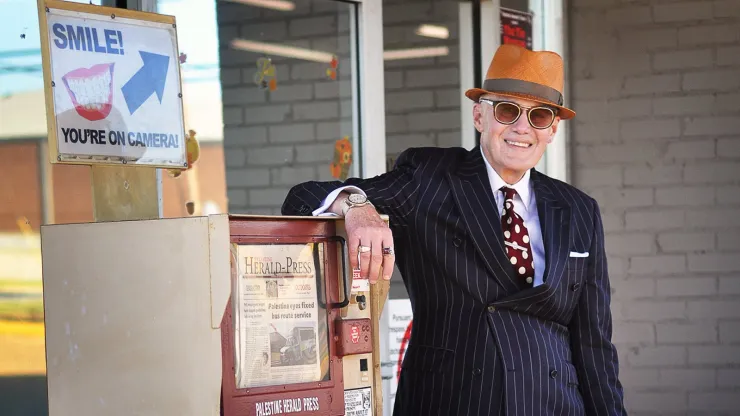
Jeffery Gerritt