From Moneta Sleet's image of a grieving Coretta Scott and Bernice King to the St. Louis Post-Dispatch staff's "powerful images of the despair and anger in Ferguson, MO," following the August 9, 2014 fatal police shooting of Michael Brown, the Pulitzer Prizes for Photography have chronicled important moments in the history of African Americans, and have celebrated the work of influential African-American photojournalists. Take a look at some of the stories behind the lens.
Moneta Sleet
Feature Photography, 1969
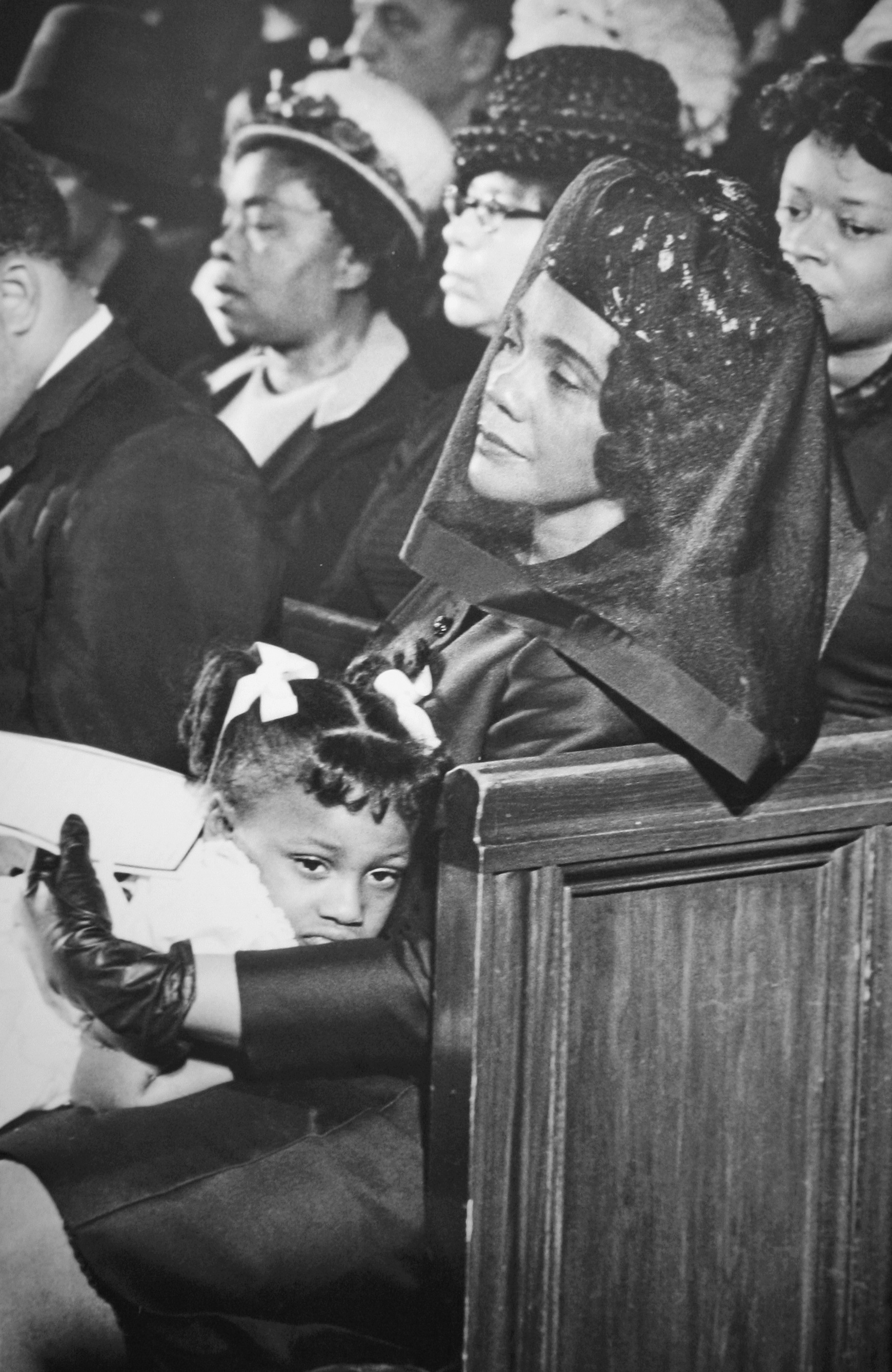
Moneta Sleet's Prize-winning photo of a grieving Coretta Scott and Bernice King. (File)
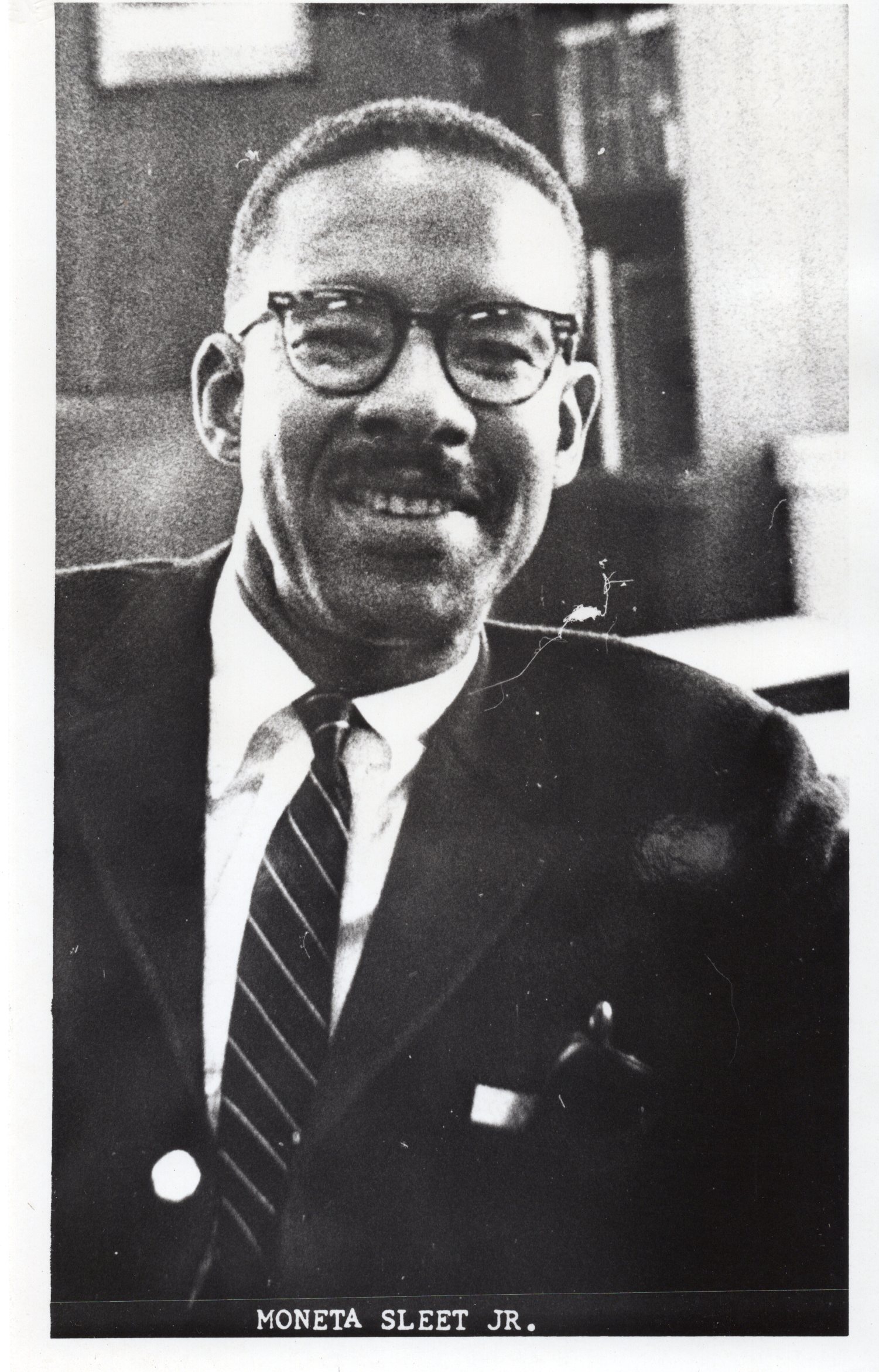
Publicity photo of Sleet included in 1969 Pulitzer press packet. (File)
Throughout his 40-year career at Ebony magazine, Moneta Sleet Jr. was the photographer of choice for generations of musicians, athletes, civil rights leaders and heads of state. After experimenting with a box camera as a child, Sleet rediscovered the discipline while working for a faculty member’s commercial studio as a student at Kentucky State College. Following a brief stint as a sportswriter for the New York Amsterdam News, Sleet transitioned to photojournalism at Our World, a pioneering African-American lifestyle magazine founded by Harlem Renaissance veteran John P. Davis.
Upon moving to Ebony in 1955, Sleet was assigned to cover the Montgomery bus boycott. Over the next decade, he was a witness to the some of the most pivotal events of the era, including the Selma to Montgomery march (Sleet quipped that he walked 100 miles in his attempt to document the entire assembly), the funeral of Malcolm X and Martin Luther King’s Nobel Peace Prize ceremony.
When Coretta Scott King discovered that Sleet was excluded from the press pool at King’s funeral on April 9, 1968, she took action, threatening to ban press coverage of the event if the photographer wasn’t included. In documenting the grief of King’s widow and his youngest child, Bernice, Sleet’s professionalism obscured his own grief: "Professionally, I was doing what I had been trained to do, and I was glad of that because I was very involved emotionally. If I hadn’t been there working, I would have been off crying like everybody else."
While magazines were not permitted to compete for Pulitzer Prizes until 2015, then-administrator John Hohenberg was not averse to bending the eligibility rules, often permitting entrants to include dozens of items beyond the standard category limits. Due to incomplete recordkeeping, it is not clear who submitted Sleet’s photo in the Spot News Photography category, where it was ranked fourth by the jury among five recommendations submitted to the Advisory Board. The jury lauded the demonstration of King’s "dignity in the face of deep, personal grief" and noted that the photo had been concurrently published in many newspapers.
Similarly, it is not clear who among the Advisory Board motioned for Sleet’s photo to be moved to the Feature Photography category — and ultimately receive that Prize. However, on May 5, 1969, he became the first African-American male to receive a named Pulitzer Prize in any category.
Sleet worked for Ebony for the rest of his life. Shortly after covering the 1996 Olympics, he suddenly succumbed to cancer on September 30, 1996.
Steve Starr
Spot News Photography, 1970
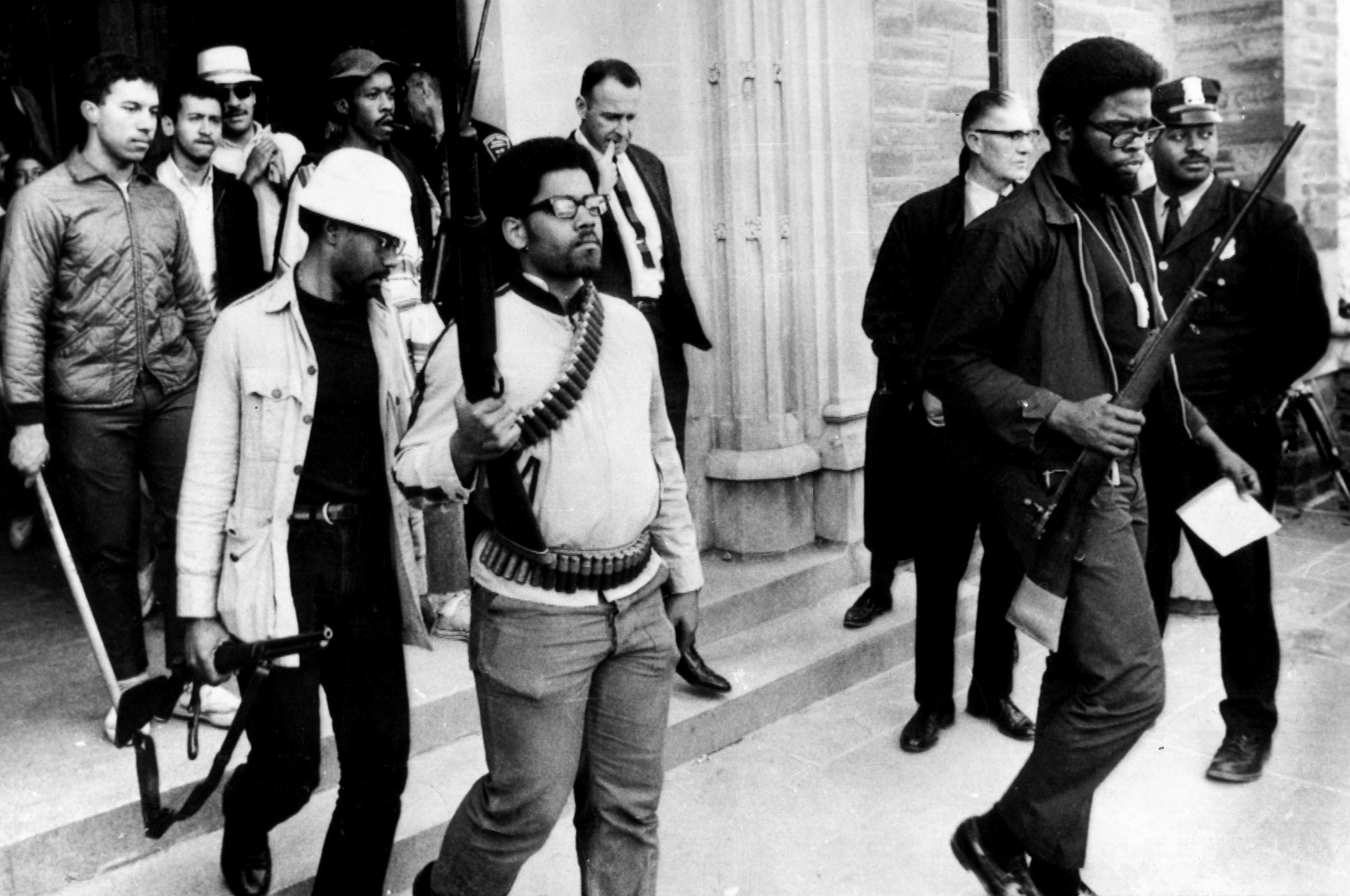
Steve Starr's "Campus Guns." (Courtesy of Steve Starr)
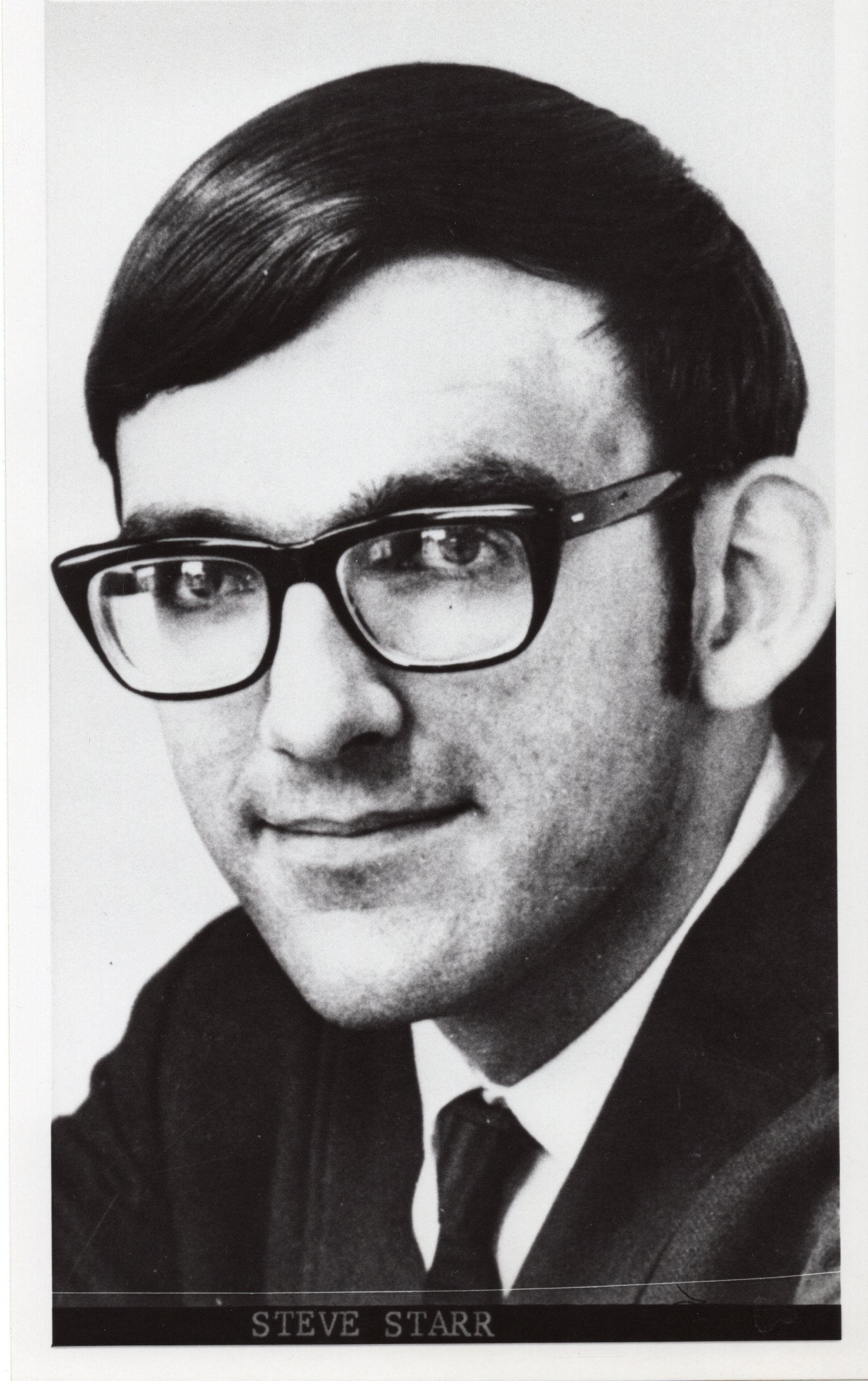
Publicity photo of Starr included in 1970 Pulitzer press packet. (File)
Following a semester of escalating tensions at Cornell University (including disciplinary action for African-American students who participated in a demonstration and the burning of a cross on the lawn of the African-American women's dormitory), a group of black students occupied Willard Straight Hall during the University's annual "Parents Weekend" in April 1969. Like many campus demonstrations of the era, the Cornell occupation sharply divided the University community. When the Delta Upsilon fraternity attempted to retake the building, several students (supported by the local Students for a Democratic Society chapter) left to retrieve firearms.
After the Cornell administration brokered an end to the 35-hour occupation, AP Albany bureau photographer Steve Starr documented the departure of the protestors. His "Campus Guns" received the Spot News Photography Prize on May 4, 1970 — just as Valley Daily News stringer John Paul Filo commenced his coverage of the Kent State shootings.
The demonstrations led to tangible reforms, including the formation of Cornell's University Senate, a streamlined judicial process and the University's Africana Studies and Research Center. Demonstrator Thomas W. Jones went on to become a leading financial executive, while fellow protestor Homer "Skip" Meade earned an Ed.D. from the University of Massachusetts and currently teaches English at the Berkshire School.
Stanley Forman
Spot News Photography, 1977
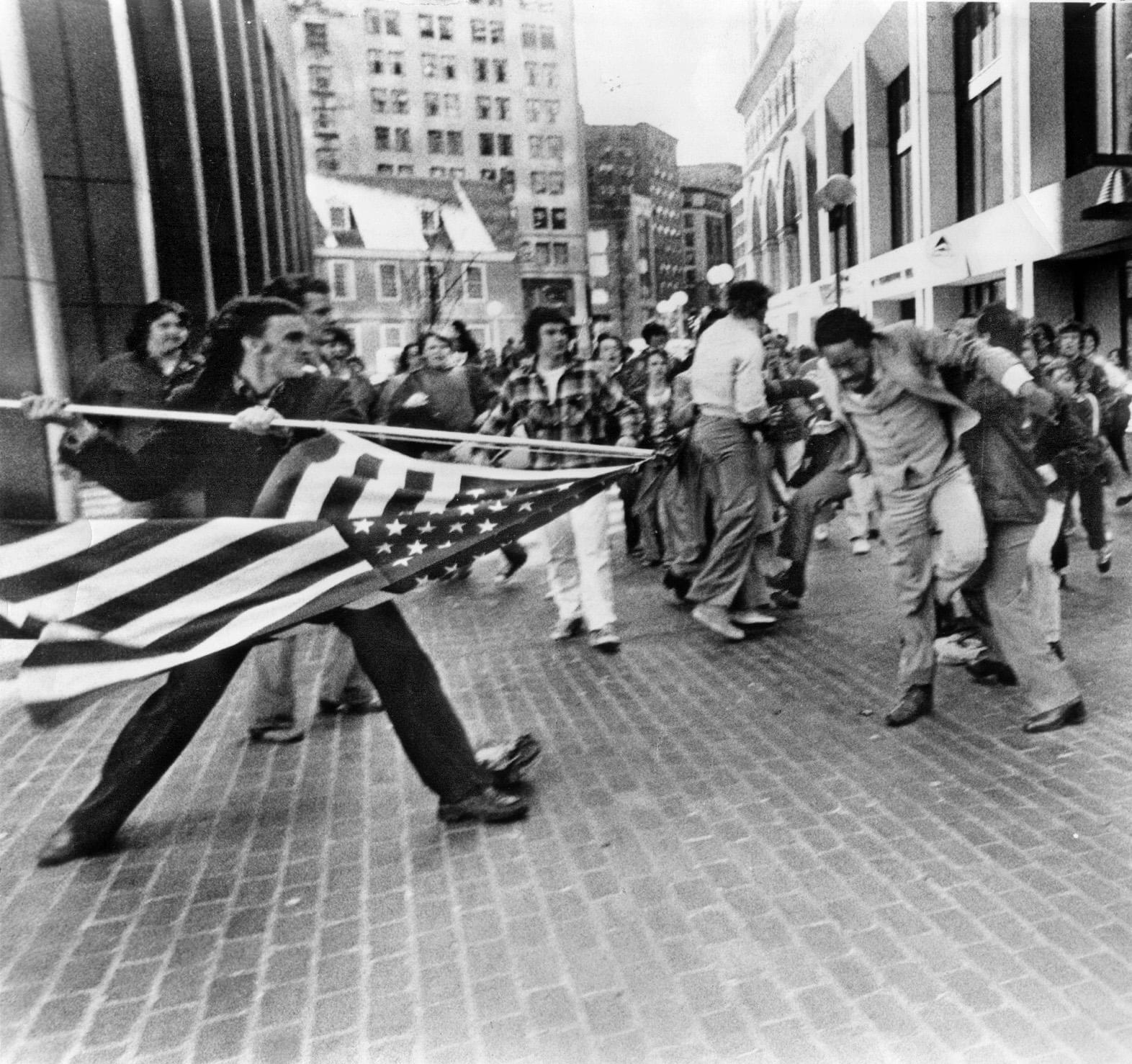
"The Soiling of Old Glory," Forman's 1977 Prize winning photo. (Courtesy of the Boston Herald)
Following the gains of the Great Society era, the reaction to the Supreme Court's unanimous decision to permit desegregation school busing in Swann v. Charlotte-Mecklenburg Board of Education (1971) brought the state of America's racial consciousness into sharp relief, highlighting the barely suppressed discriminatory attitudes and de jure segregation that persisted even in liberal enclaves such as Boston and Los Angeles.
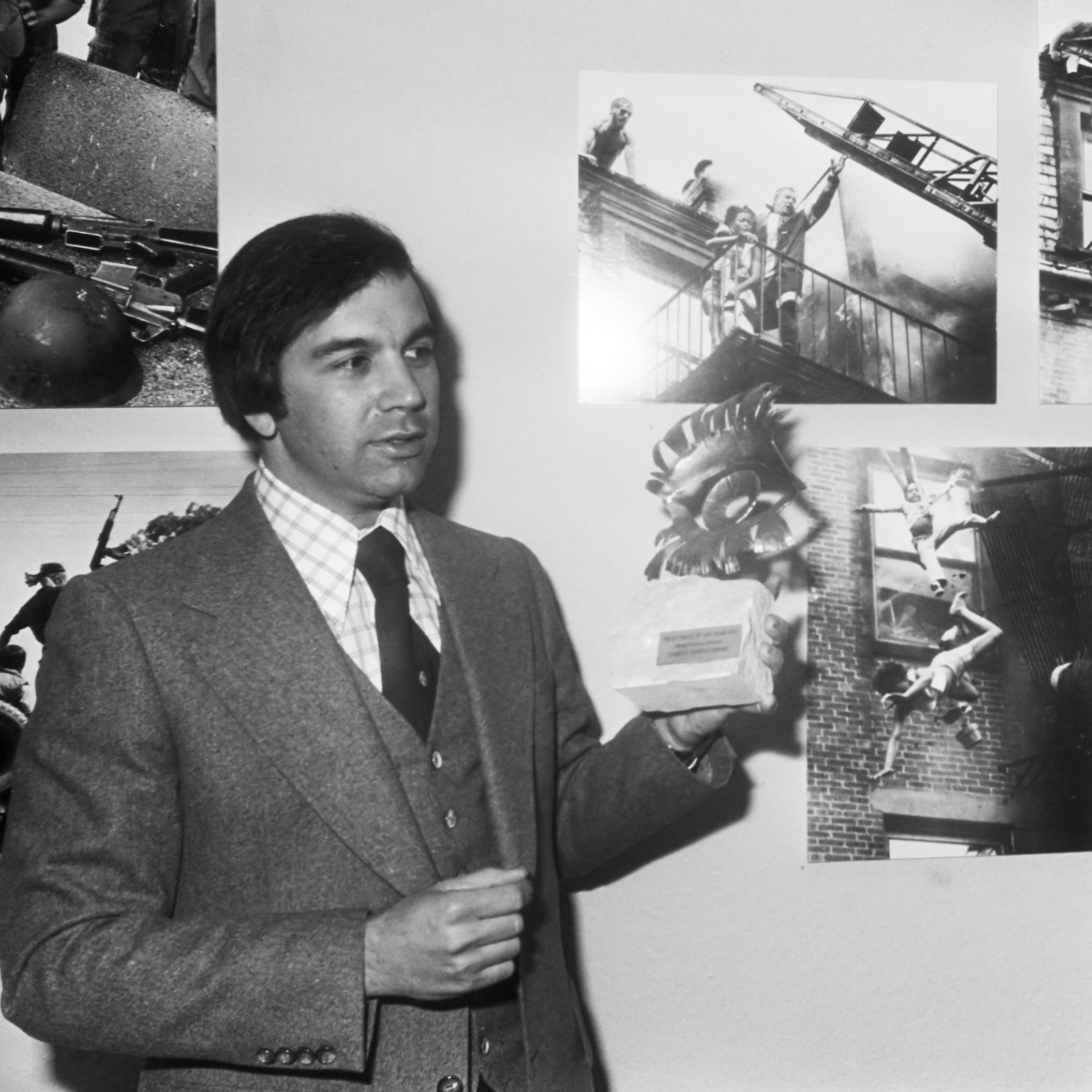
Stanley Forman accepts the World Press Photo Award in Amsterdam, 1976. (Hans Peters/Wikipedia)
The anti-busing movement was the lynchpin of a larger social trend that also encompassed the backlash against John Lindsay's plan to build a low-income housing project in upper middle class Forest Hills, Queens and the failure of former CORE director Floyd McKissick's utopian Soul City community in North Carolina.
According to journalist Rick Perlstein, by the spring of 1975, urban working- and middle-class white "parents agitating against busing and coed bathrooms and secular humanist hokum" had become an integral part of the New Right coalition that helped to elect Ronald Reagan five years later. While "white flight" and the increased prevalence of private and parochial education had attenuated the busing issue by the 1980 presidential campaign, for much of the 1970s, anti-busing demonstrations were the front lines of the civil rights movement.
Fresh off his first Pulitzer (for a striking portfolio chronicling a July 1975 fire), Boston Herald-American photographer Stanley Forman photographed an anti-busing demonstration at Boston's City Hall in the summer of 1976. When the demonstrators came upon an empty City Council chamber, 20 agitators split off from the main group to attack an African-American attorney, yelling, "Get the nigger, kill him." Forman's photo of one agitator attacking the attorney with a flagpole received the 1977 Spot News Photography Prize.

Photographic Staff of the Louisville Courier-Journal and Times
Feature Photography, 1976
A year earlier, Louisville Courier-Journal staff received the Feature Photography Prize for their coverage of the city's busing initiatives.
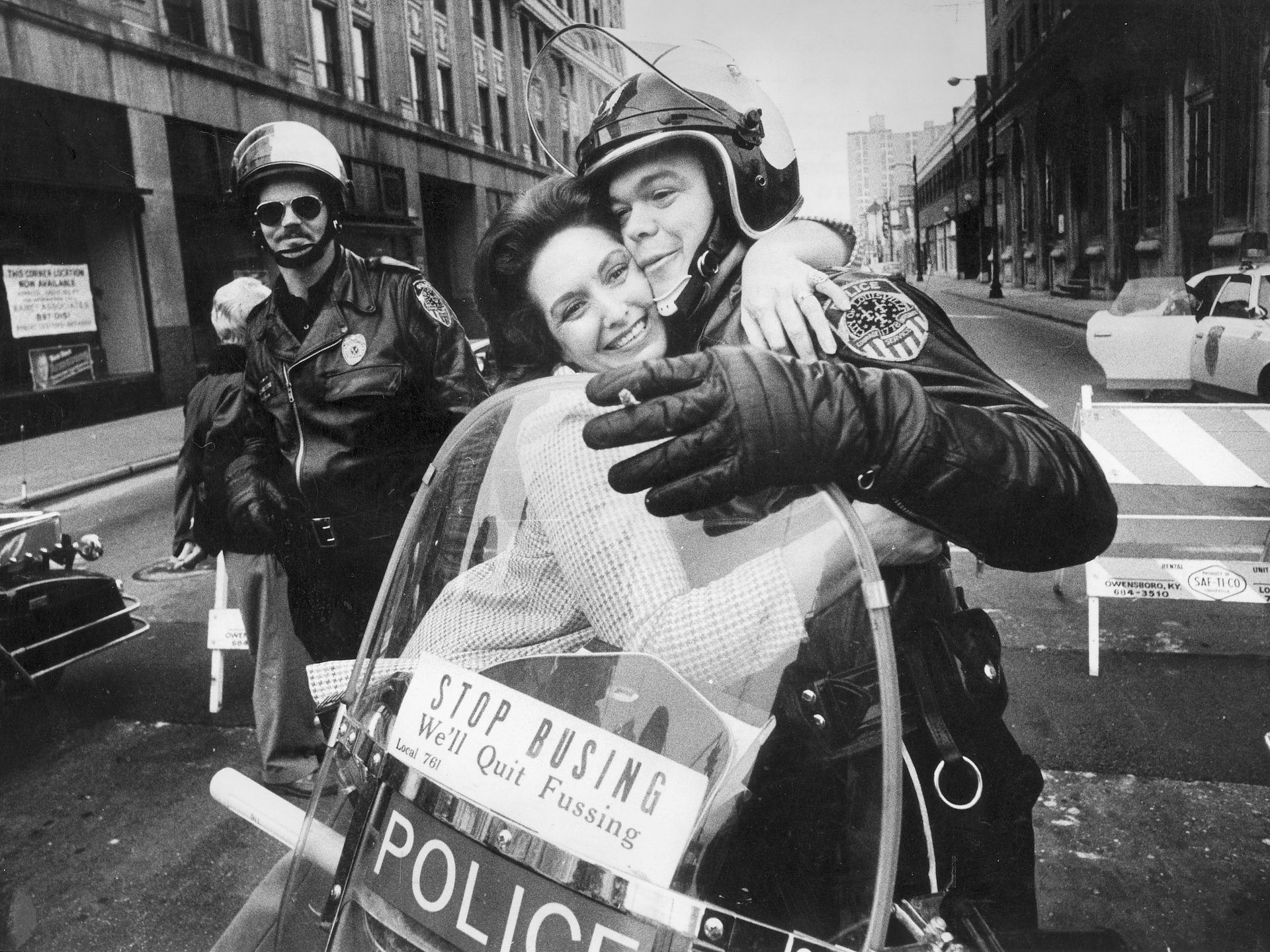
"Sue Connor hugs Louisville policeman Gerald Metzmeier, whose motorcycle displays a 'stop busing' sticker. The two meet during a protest march in downtown Louisville. Mrs. Connor is head of Concerned Parents, Inc., the anti-busing group that organized the march." (By Paul Schuhmann, The C-J. Courtesy of The Courier-Journal)
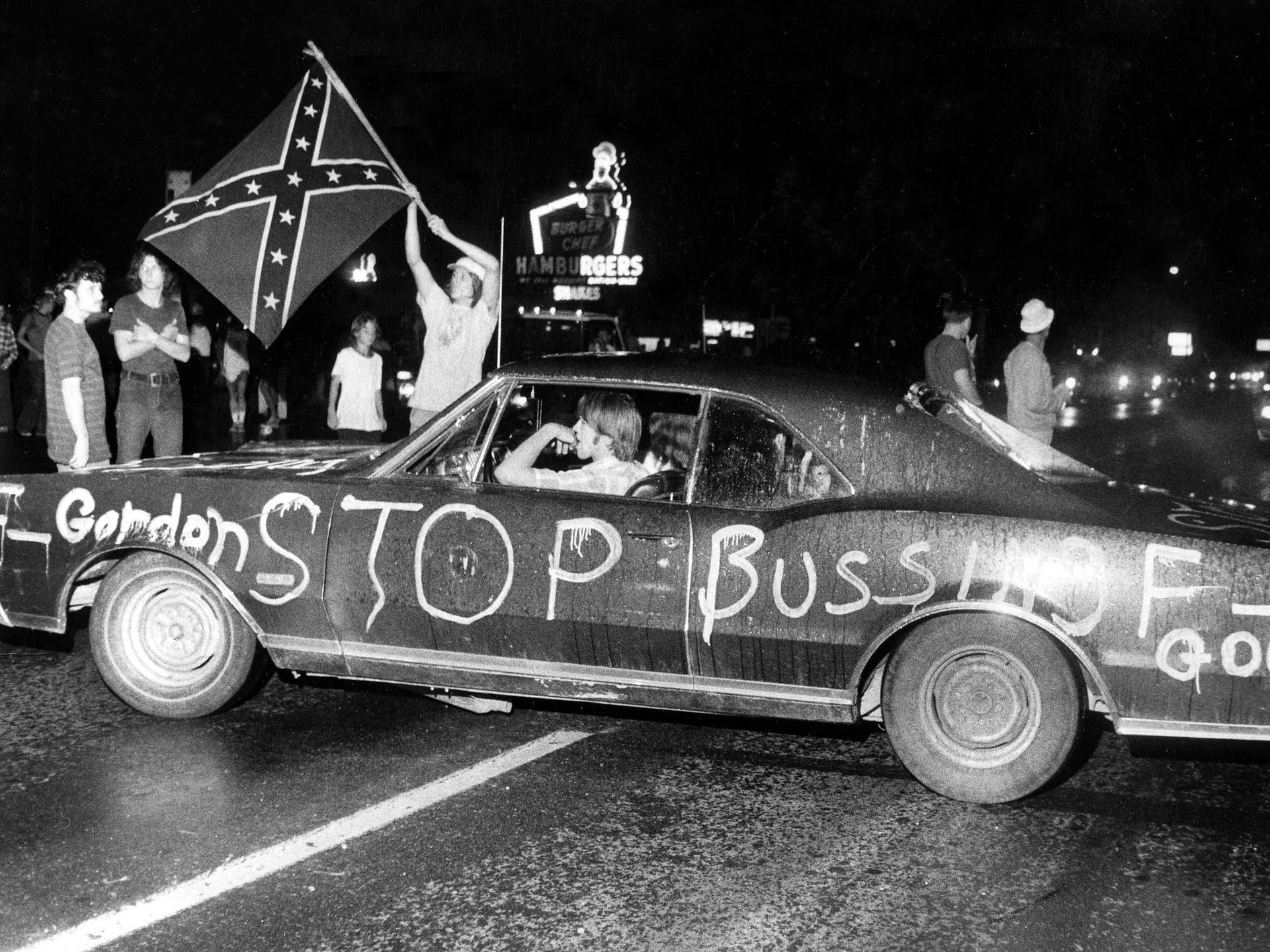
"Some demonstrators parked their cars across Dixie Highway in Valley Station last night [September 4, 1975], snarling traffic so badly that it had to be rerouted by police. The driver of this car, stopped in the middle of the highway, later tore off the auto's hood. (By Melissa Farlow, The C-J. Courtesy of The Courier-Journal)
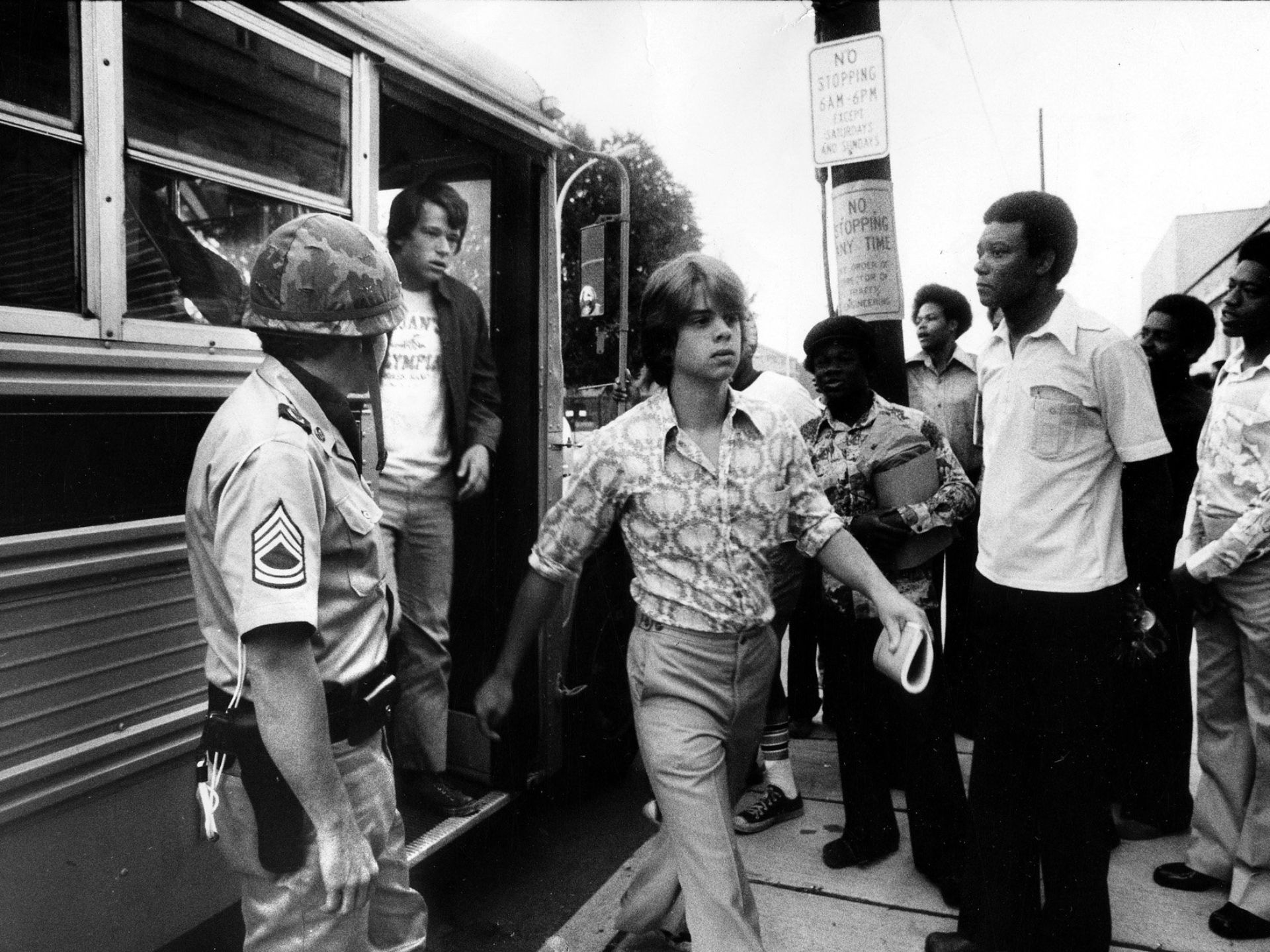
"Students from Jeffersontown High School unload as Central students wait to reload a bus." (By Larry Spitzer, The C-J. Courtesy of The Courier-Journal)
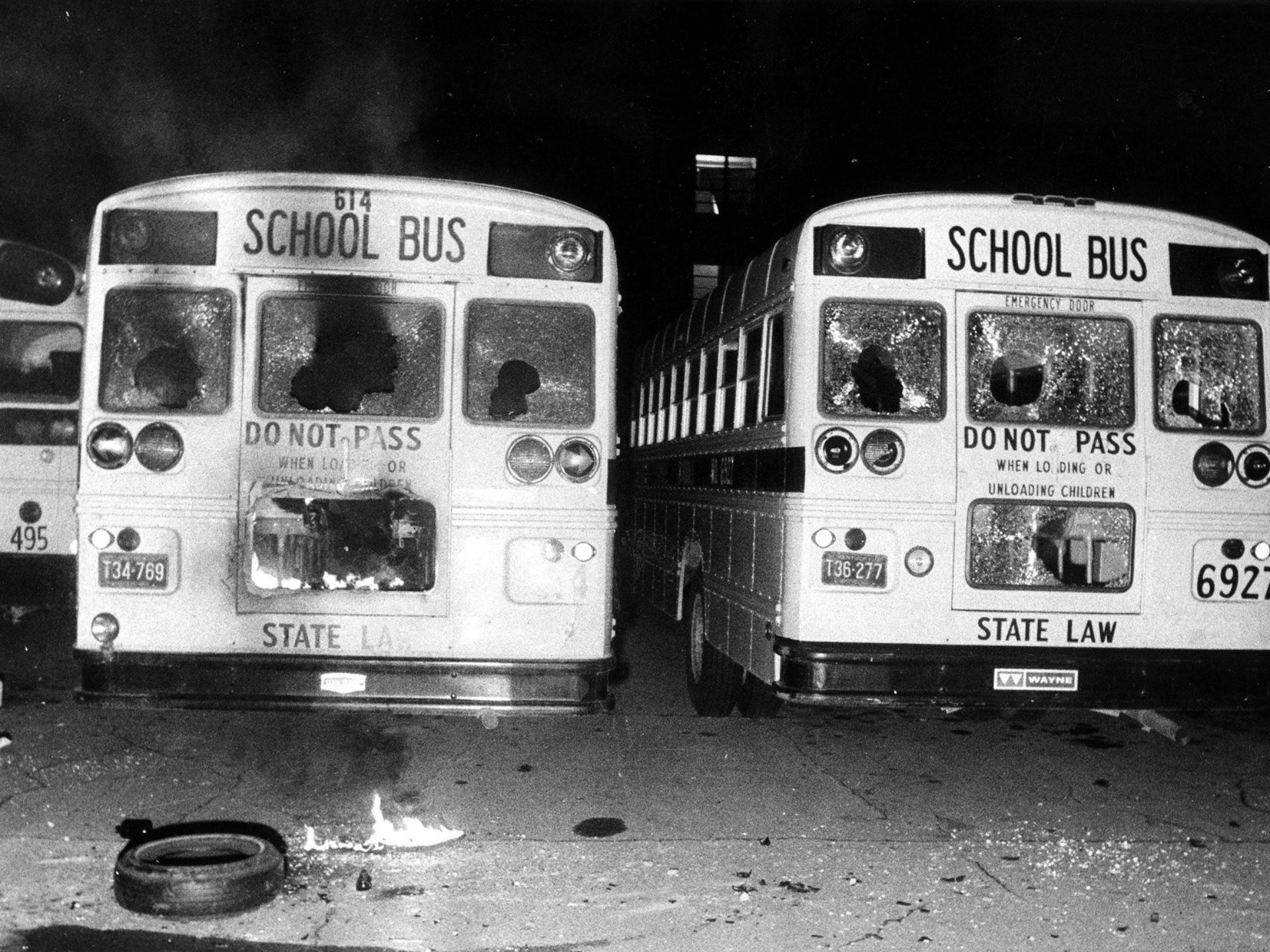
"School buses damaged by protesters stand in the parking lot at Southern High School." (Unattributed. Courtesy of The Courier-Journal)
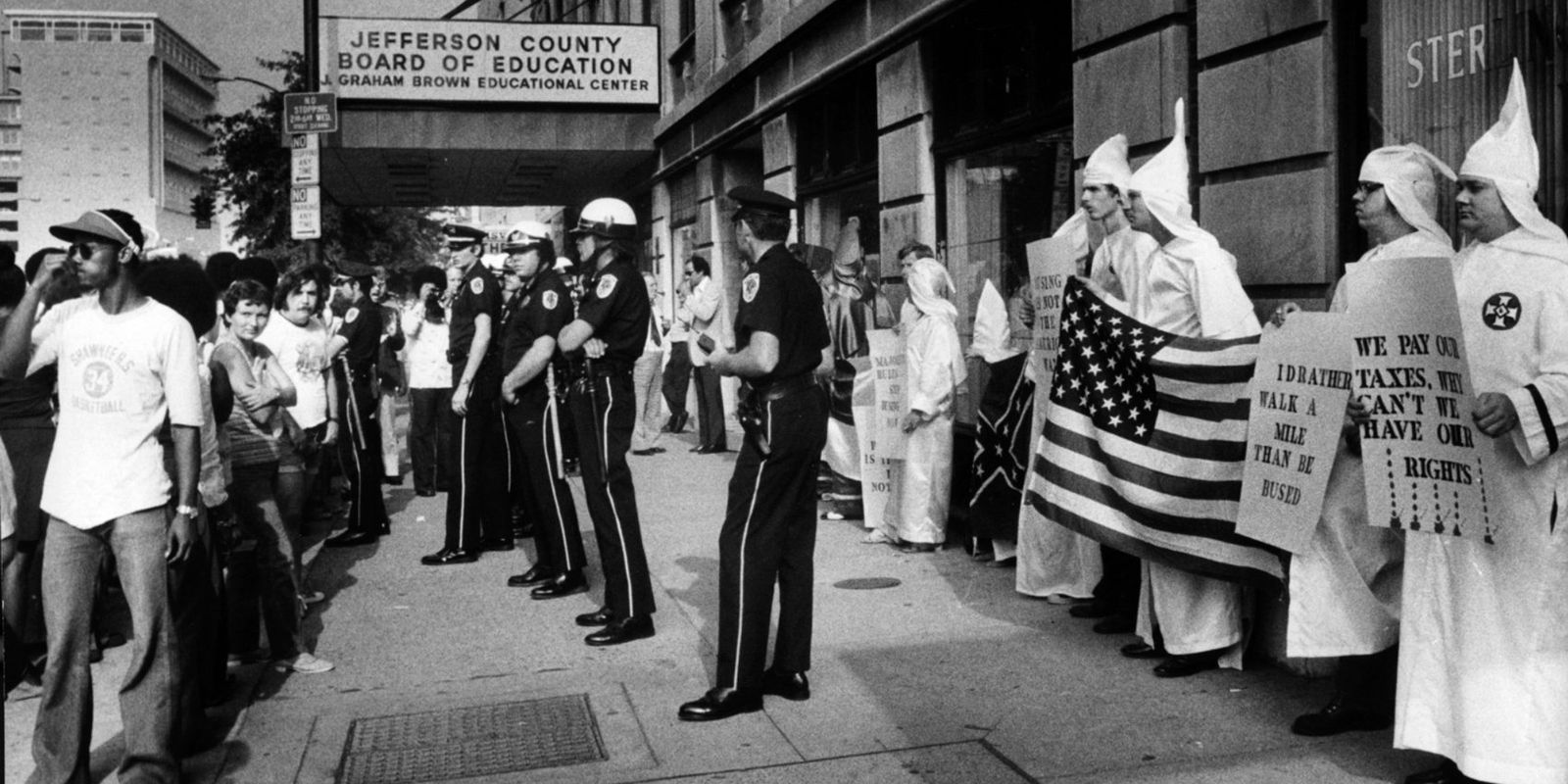
"An anti-busing demonstration by Ku Klux Klan members in front of the county Board of Education building, Aug. 22, 1975, sparked some heckling, but no other incidents. Police arrived at the end of the 65-minute demonstration and stood between Klan members and a crowd composed mainly of curious bystanders. The 12 robed Klan demonstrators included Kentucky Grand Dragon Phillip Chopper, his wife and five children. Klan members were silent." (Bud Kamenish/The C-J. Courtesy of The Courier-Journal)
While the series included the requisite images of shattered bus windows and police interventions, contributor Michael Coers found a different perspective.
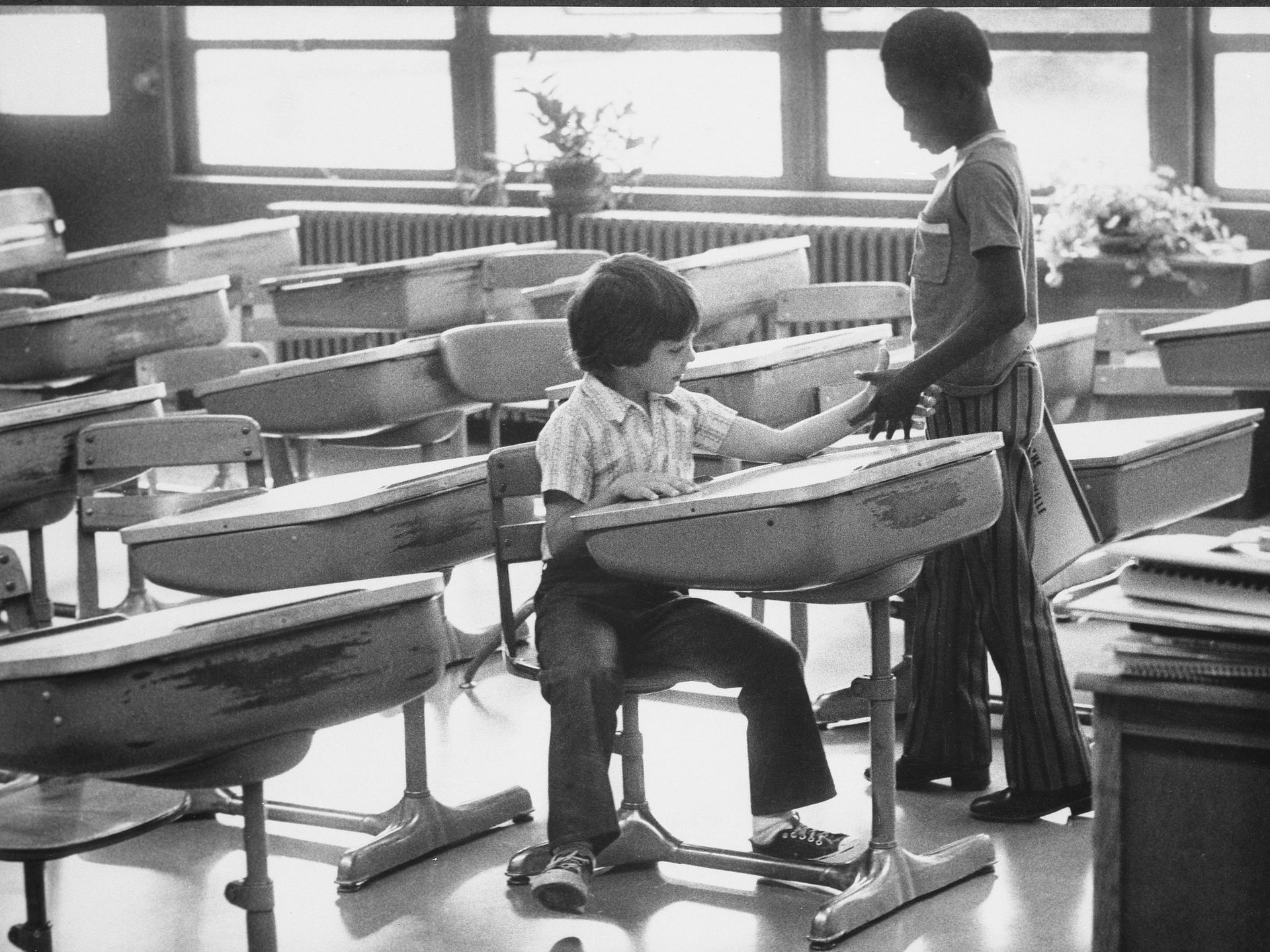
"At Greenwood Elementary, Mark Stewart, 8, seated, exchanged introductions with a new classmate, Darrel Hughes, also 8." (Photo by Michael Coers. Published in the Louisville Times on 9/4/1975. By Michael Coers, The C-J. Courtesy of The Courier-Journal)
Then-director of photography C. Thomas Hardin remarked in a 2015 retrospective that the photo documented "[an] iconic moment with great context. I will never forget seeing that photograph in a strip of negatives on the light table that first busing morning." (According to a 2017 report, Stewart became the head custodian at a school in Louisville, while Hughes worked in construction throughout the South and has not commented publicly on the matter in more than 20 years.)
John H. White
Feature Photography, 1982
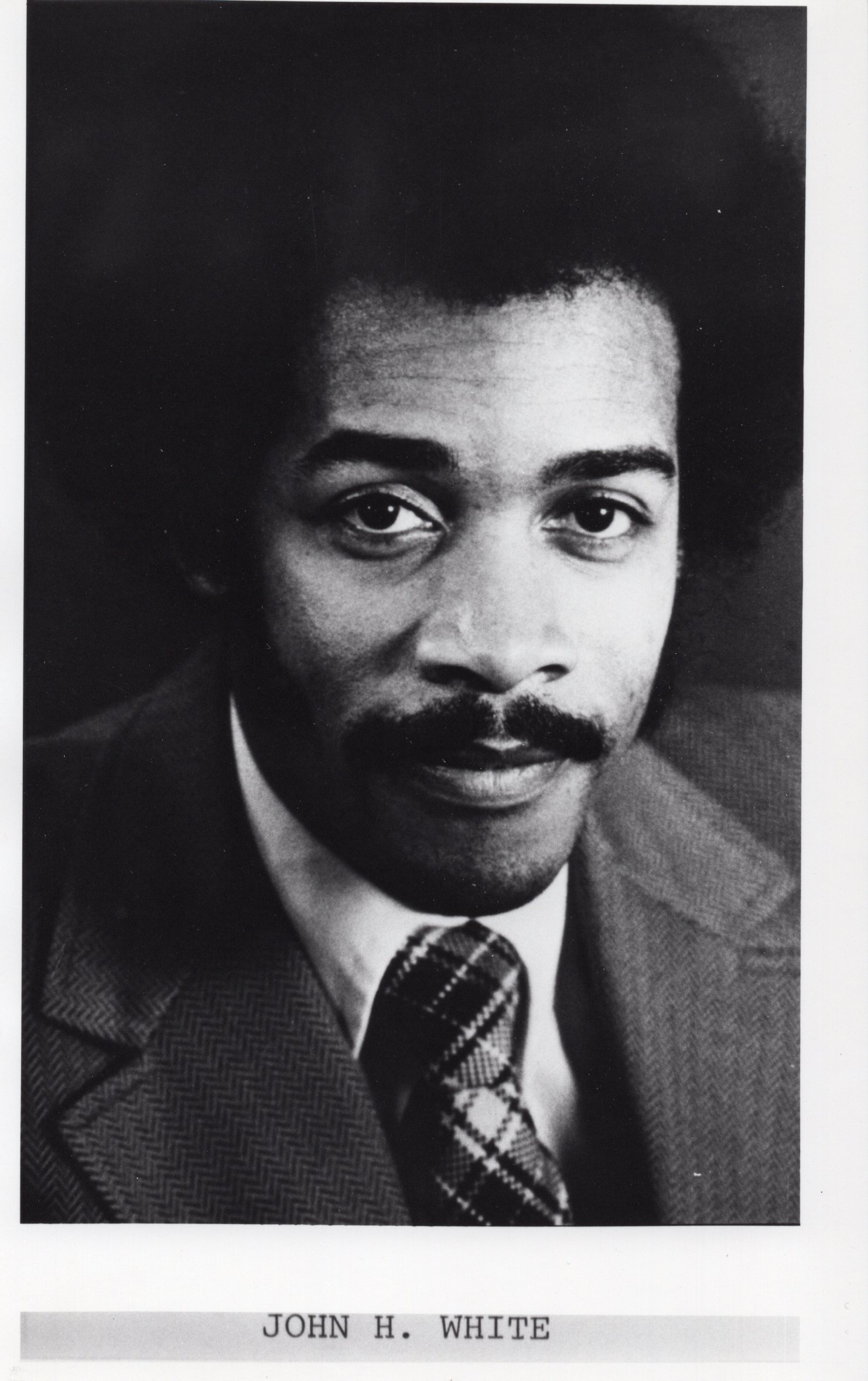
Publicity photo of White included in 1982 Pulitzer press packet. (File)
Lauded by former AP photographic director Hal Buell as a "marvelous photographer ... a very sensitive fellow, and just a beautiful human being," the streetscapes of John H. White's Chicago are indelible.
A grade school teacher once told White he was bound to work on a garbage truck due to his difficulties with math, but he found his calling when his father asked him to document the reconstruction of his family's church as a teenager. This led to a 35-year career with the Chicago Sun-Times, the 1982 Feature Photography Prize — and, in the ultimate refutation of his long-ago teacher, academic posts at Columbia College Chicago and Northwestern University.
An early flowering of White's vignette-oriented approach may be found in his 1973-1974 work for the Environmental Protection Agency's DOCUMERICA initiative. Like his Prize-winning portfolio, they evince what Buell has characterized as "[White's] eye for that kind of thing. Some photographers have that, and some don’t. Many don’t. It’s a much more difficult kind of journalism to practice on a day-to-day basis, a lot of times you just stumble into it. Talk about serendipity, that’s where serendipity becomes the governing factor as just one of several factors."
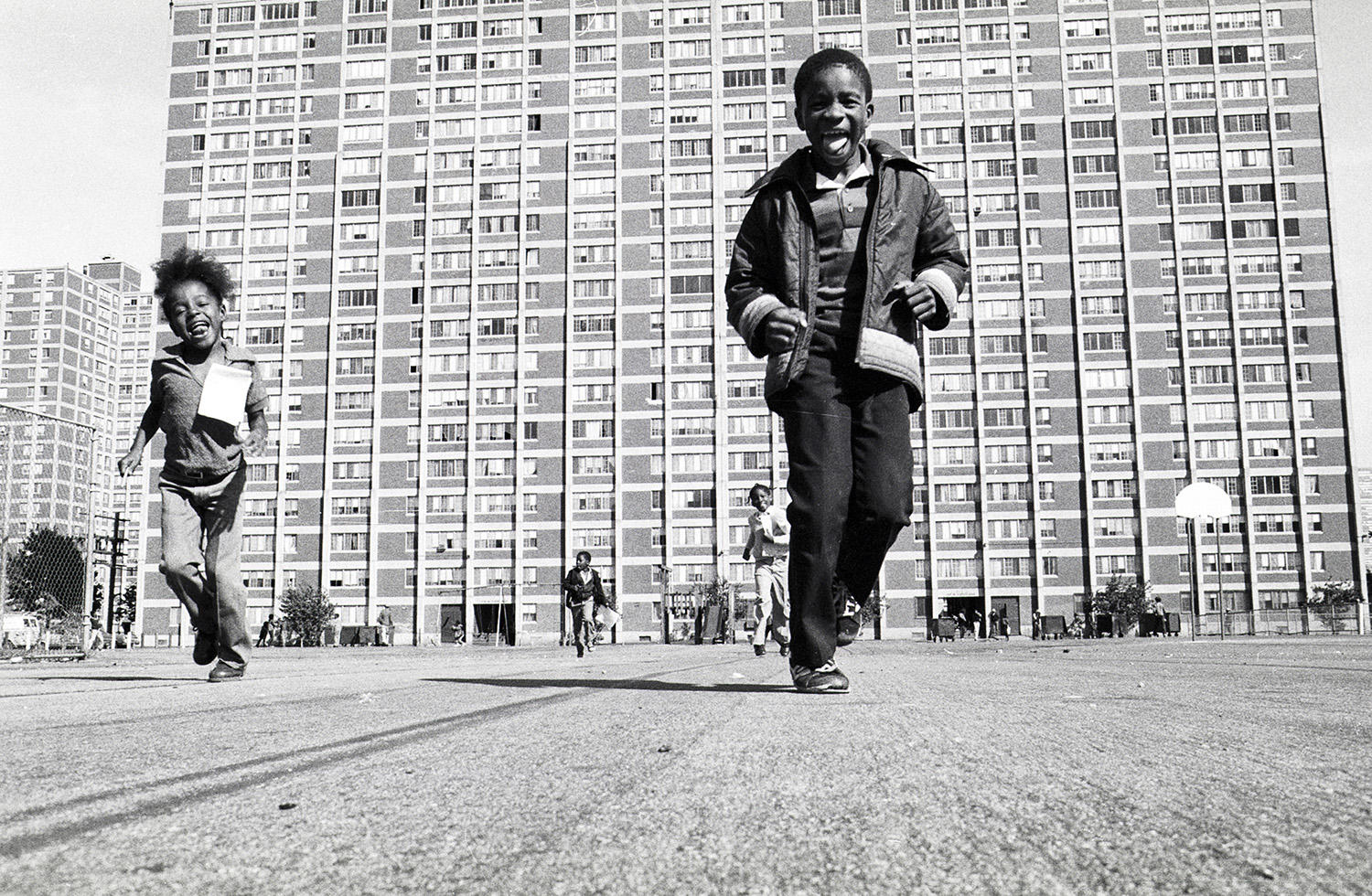
Children play at the Cabrini-Green public housing project in this photo from White's Prize winning entry. (Courtesy of Middlebury College)
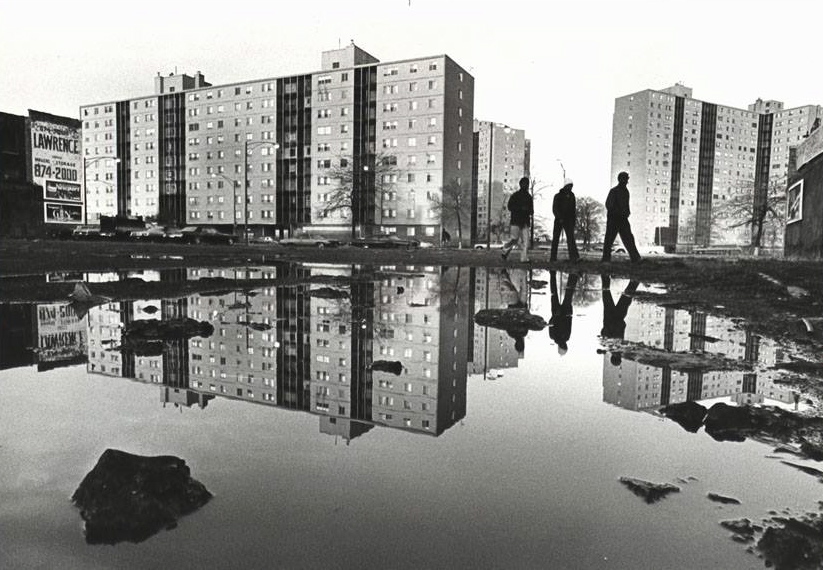
In another photo from the entry, three men walk near a puddle in a lot adjacent to the Stateway Gardens housing project. (File)
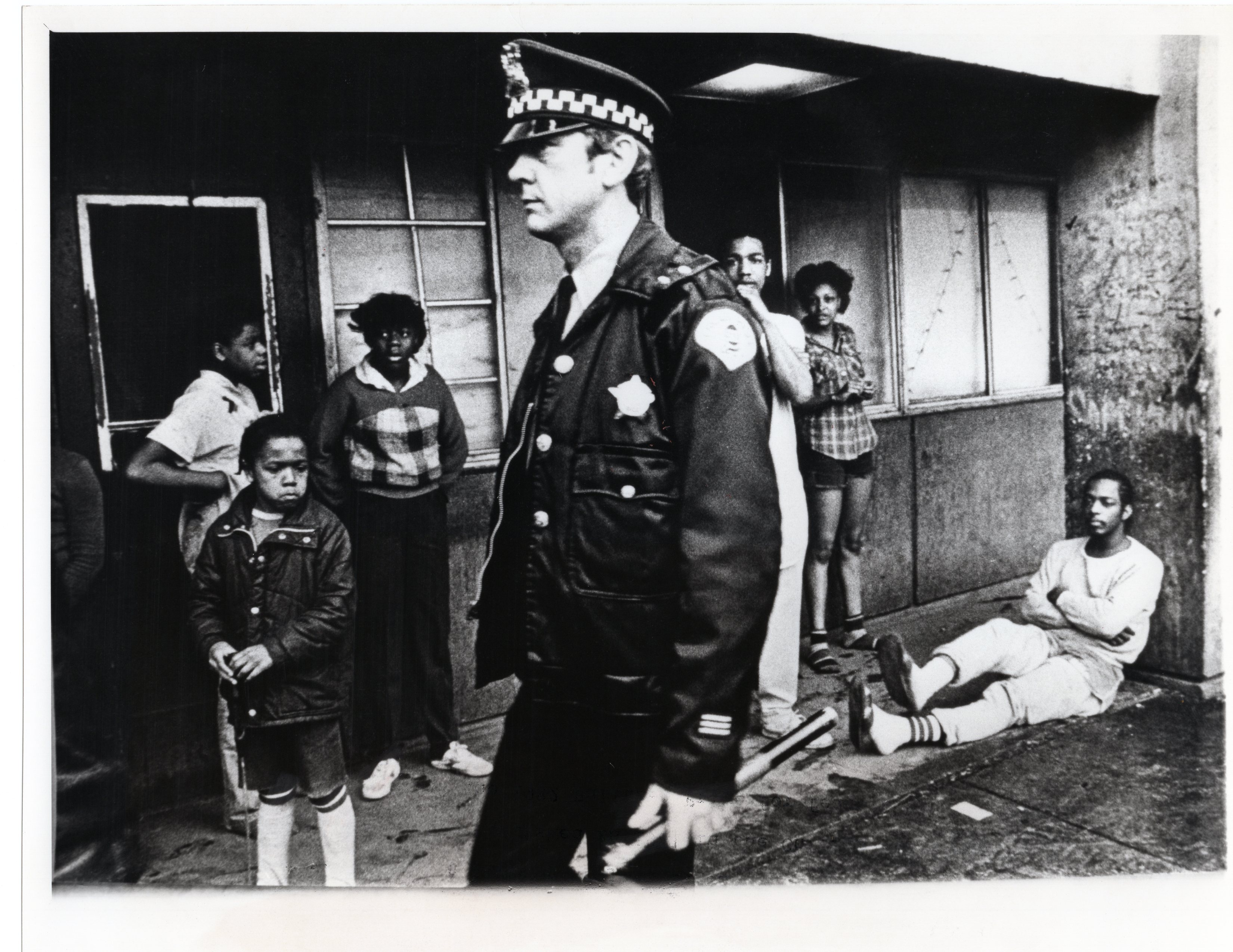
A police officer patrols an unspecified Chicago housing project. This photo was included in the 1982 Pulitzer Prize press packet.(File)
Michel duCille
Feature Photography, 1988
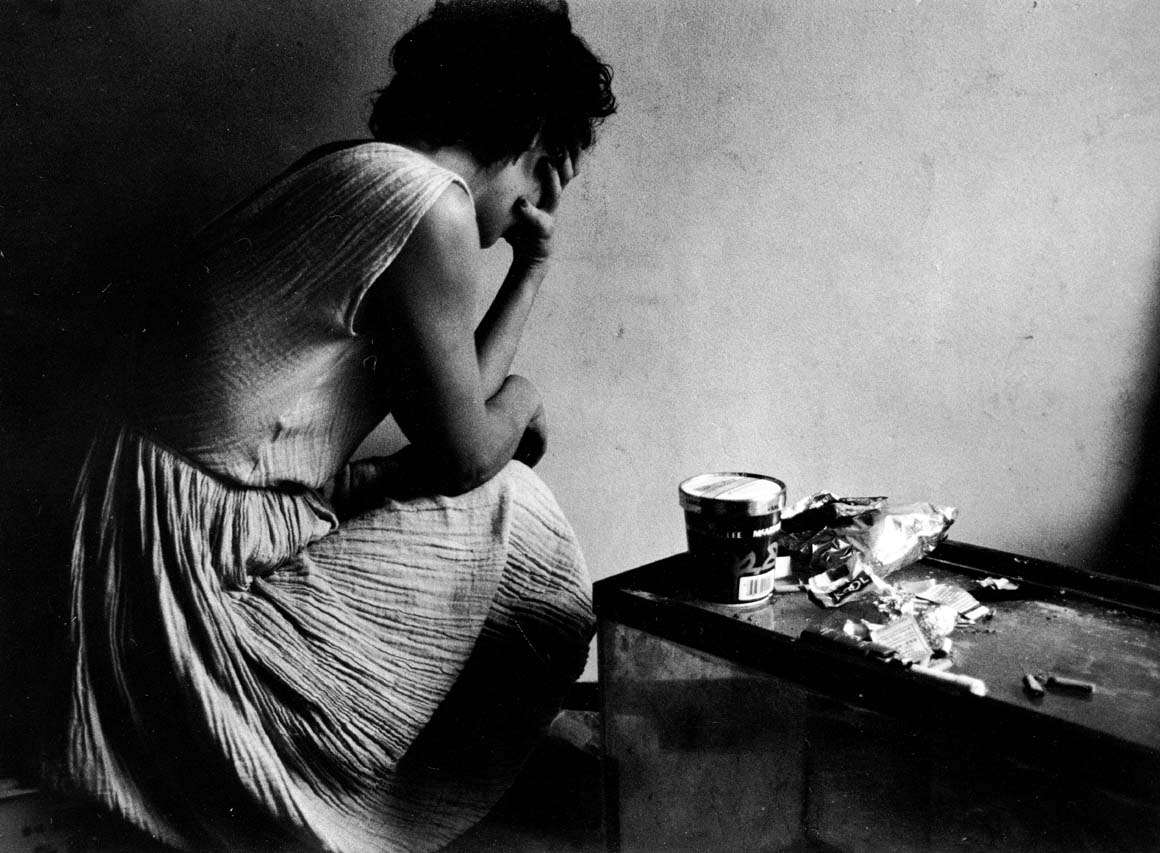
A woman burrows her head into her hand amid drug paraphernalia and detritus. (Courtesy of the Miami Herald.)
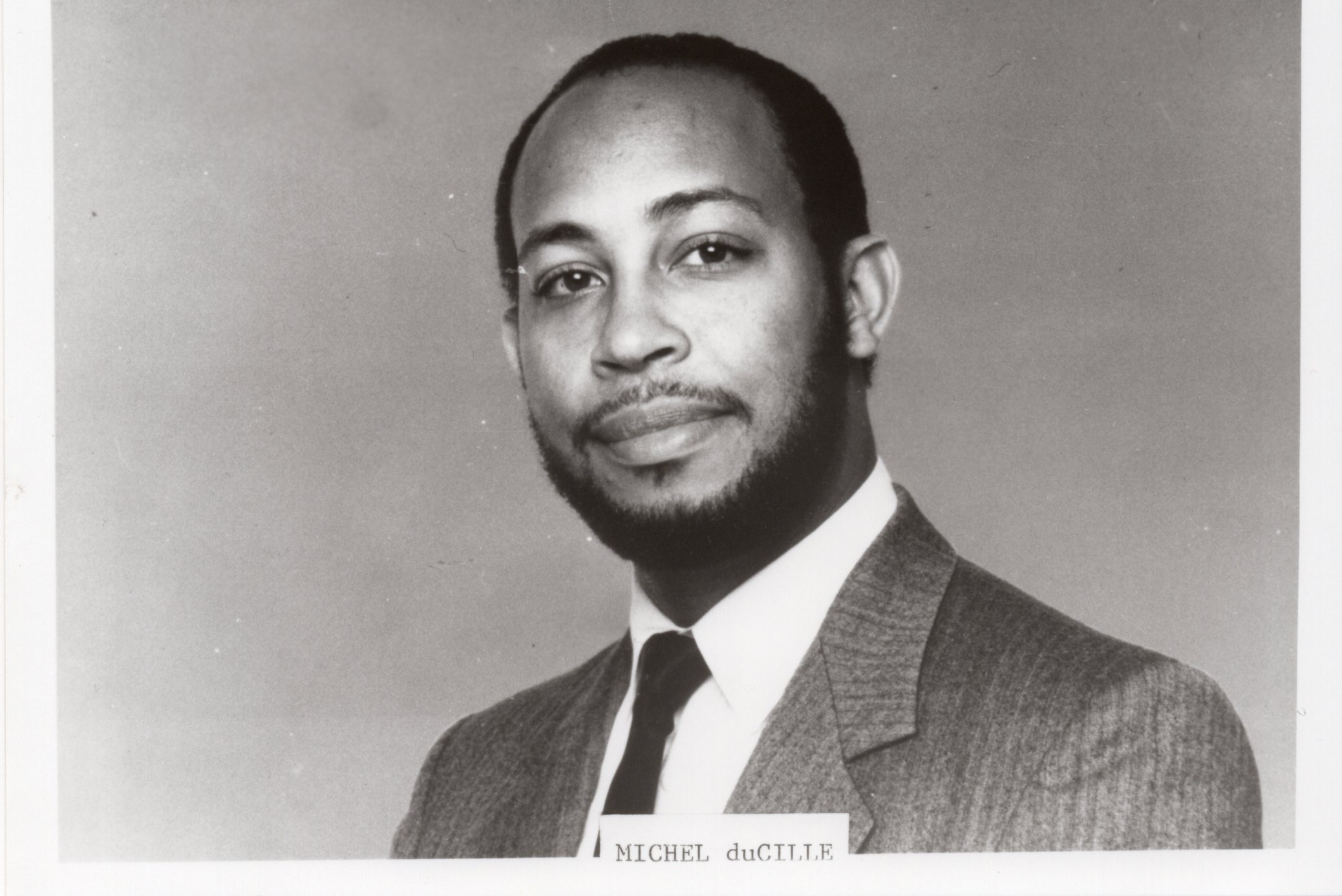
Publicity photo of duCille included in 1988 Pulitzer press packet. (File)
Born in Kingston, Jamaica in 1956, the late Michel duCille emigrated with his family to Georgia as a teenager. While studying at Indiana University, he held internships at the Louisville Courier-Journal and the Miami Herald, ultimately joining the latter publication as a staff photographer after graduating in 1981. Five years later, he and four-time winner Carol Guzy received the 1986 Spot News Photography Prize for their coverage of the Nevado del Ruiz eruption in Colombia.
DuCille’s long-germinating photo essay on a crack-laden apartment complex in Miami received the Feature Photography Prize in 1988. Eulogized by the Washington Post’s Joel Achenbach as "an old-school photographer who knew you had to get close to your subjects — and then get closer still," project editor (and two-time Feature Writing Prize winner) Gene Weingarten later recalled duCille’s methodical process: "After a couple of weeks, I asked him how the shoots were going. He said, 'No pictures yet. I haven’t taken my camera. First comes trust, then the work.'"
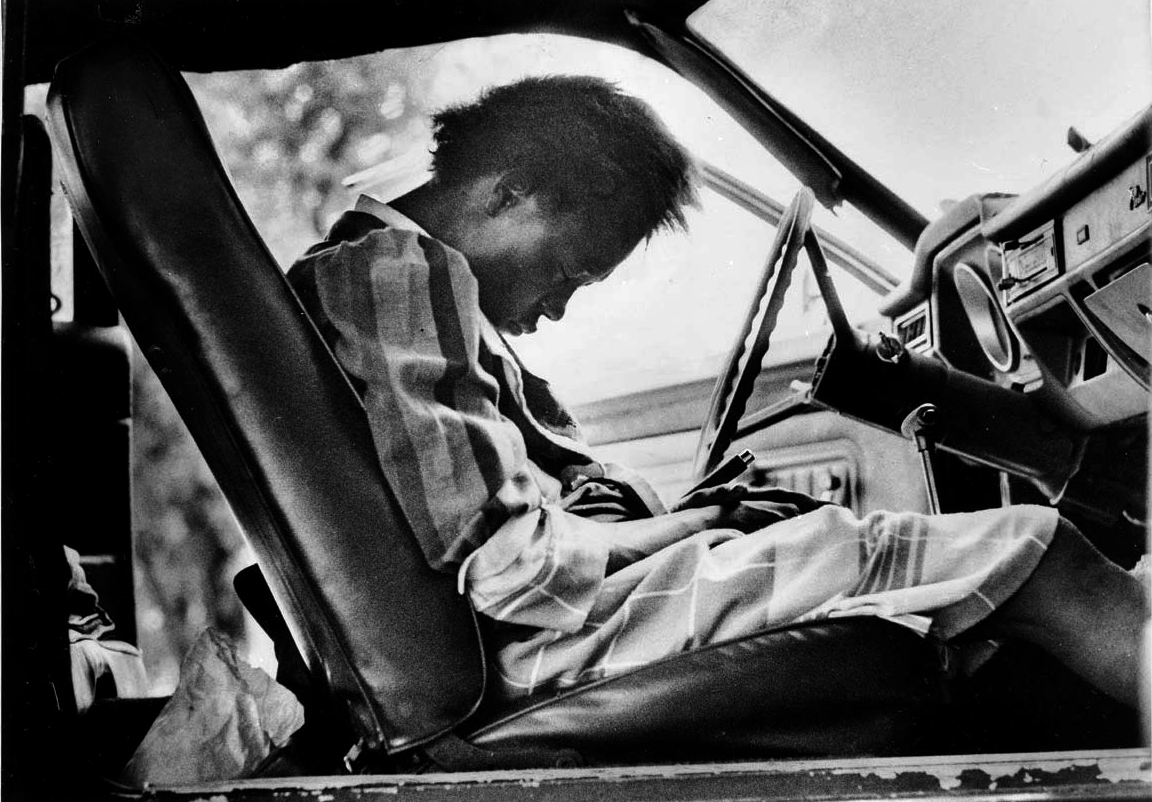
In another photo from duCille's entry, a woman sleeps in an open car. (Courtesy of the Miami Herald.)
After earning a master's degree in journalism from Ohio University in 1995 and ascending to the Washington Post's masthead as the newspaper's assistant managing editor for photography, duCille eventually returned to daily shooting. In 2008, he shared a third Pulitzer with Dana Priest and Anne Hull as a rare Public Service named contributor for coverage of the mistreatment of Iraq and Afghan War veterans at Walter Reed Medical Center. He continued working in some of the world's most dangerous locales until 2014, when he suffered a fatal heart attack while on assignment in Liberia in the aftermath of the Ebola outbreak.
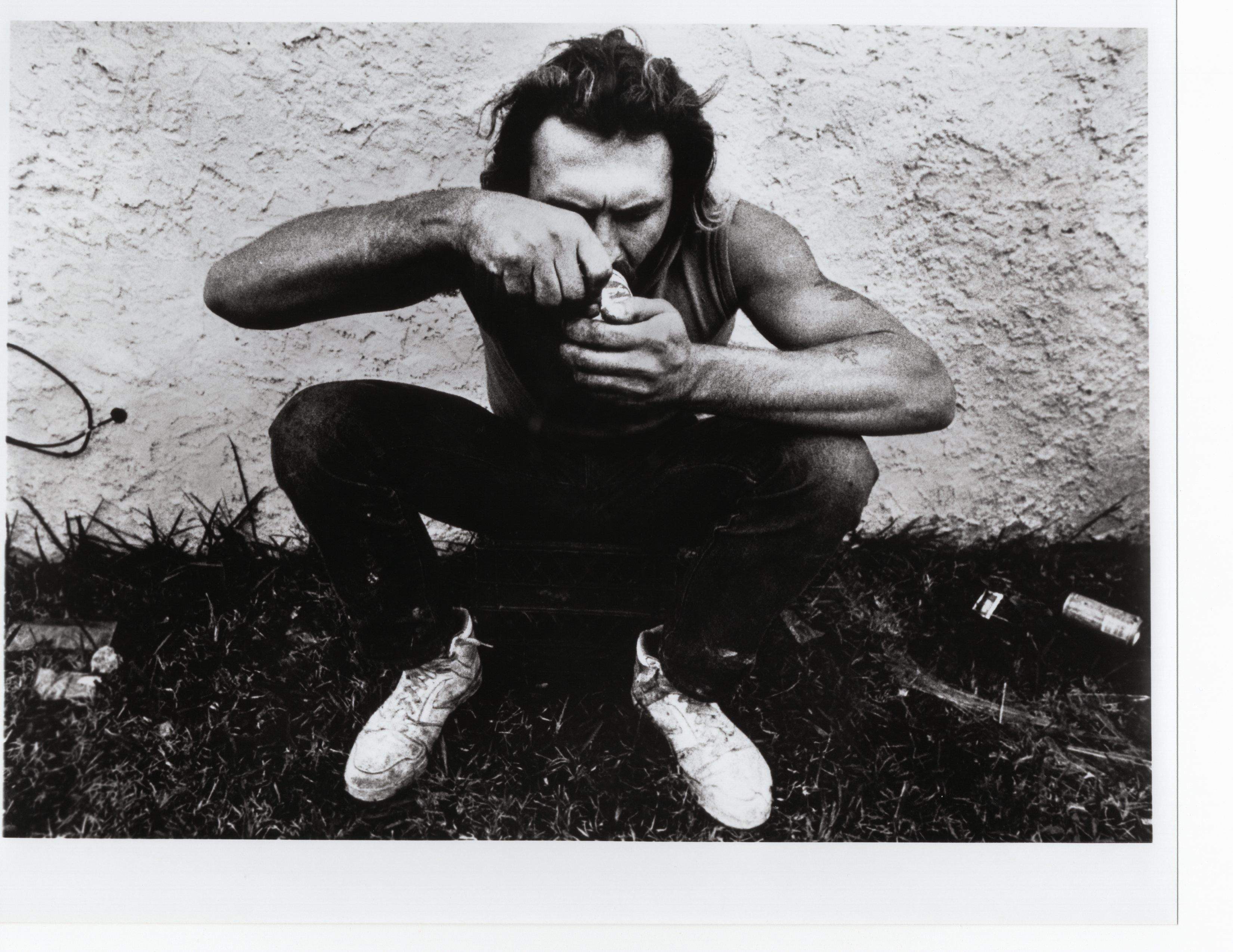
A man smokes crack near the apartment complex. (File) This photo was included in the 1988 Pulitzer Prize press packet.
At a time when crack users were frequently castigated for their perceived moral failings in the Just Say No-era popular consciousness and subject to racially inequitable mandatory minimum prison sentences (under the federal Controlled Substances Act, the penalty for first-time trafficking of 5 grams of crack was equivalent to that for 500 grams of powder cocaine), duCille’s visceral study offered a foundation for a wide range of further social inquiry by many younger academics and journalists, including Columbia University psychologist Carl Hart, legal scholar Michelle Alexander and 2016 General Nonfiction finalist Ta-Nehisi Coates. Like Walker Evans and Gordon Parks before him, his eye offered a way forward for America.
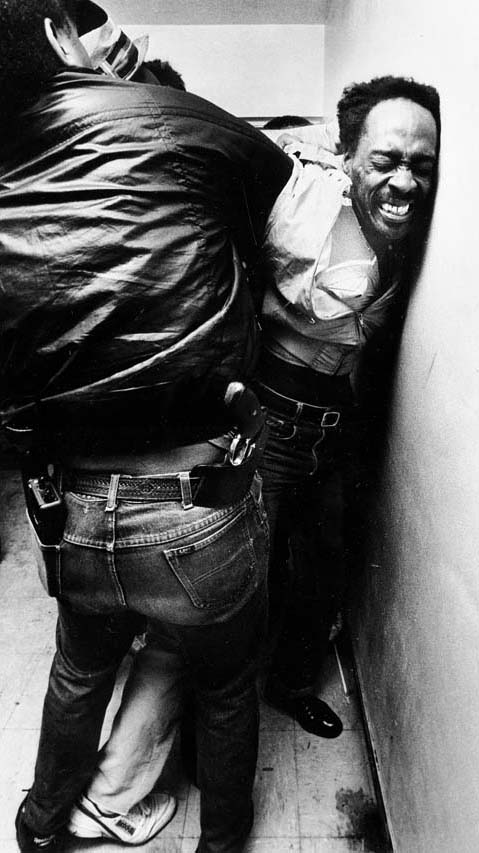
A suspect is frisked by a police officer. (Courtesy of the Miami Herald)
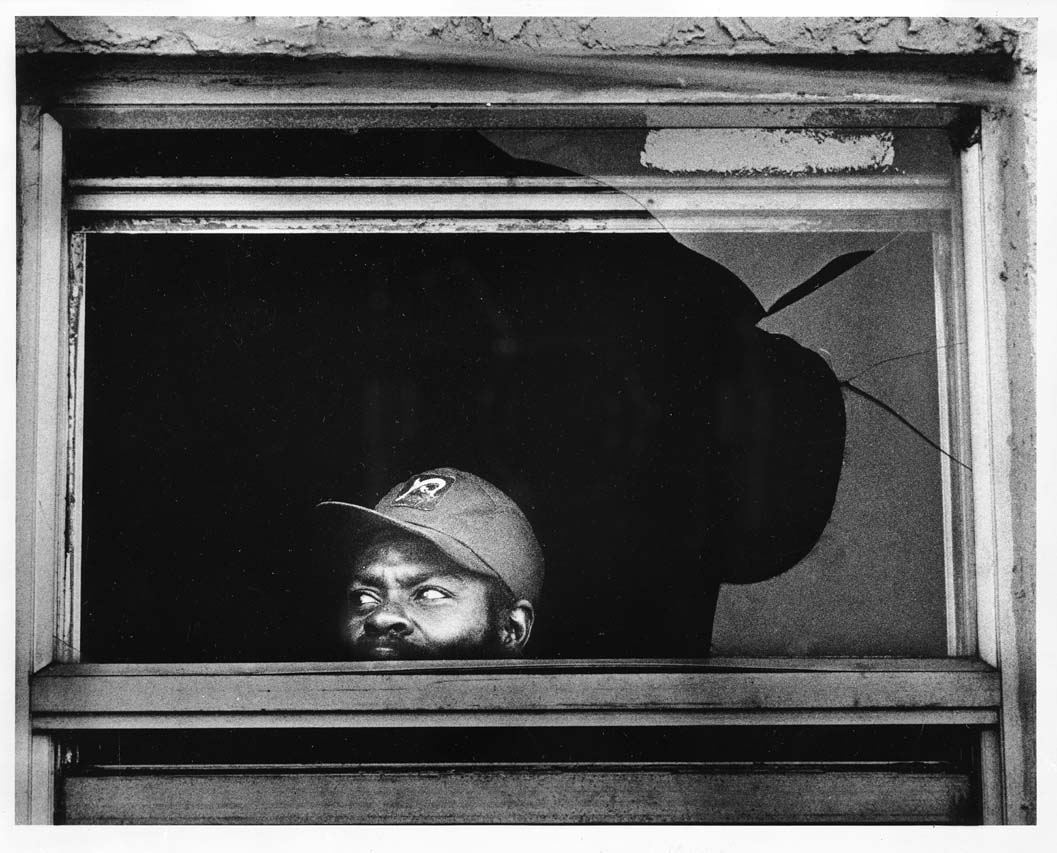
A man stares out of a broken window. (Courtesy of the Miami Herald)