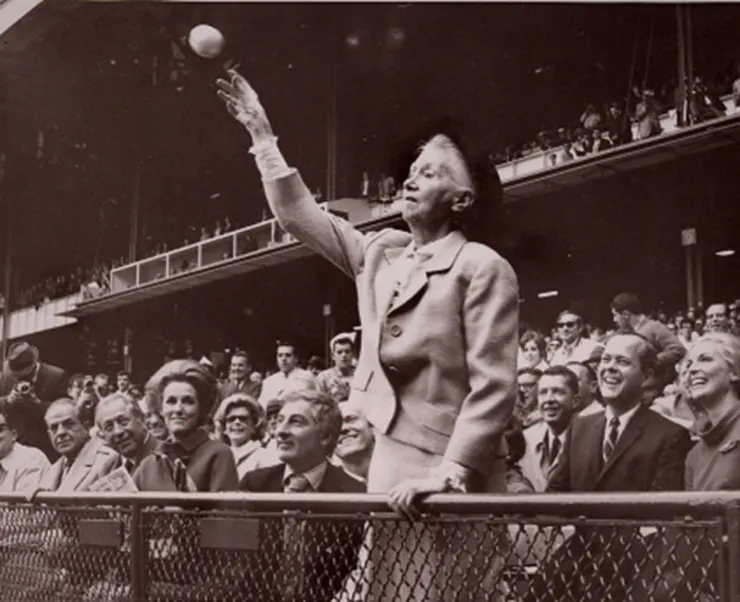
In the late winter of 1972, friends, family and admirers gathered at a Presbyterian church in central Brooklyn to remember one of the leading figures of 20th century American cultural life: 1952 Poetry winner Marianne Moore.
As her contemporaries embraced expatriation, academic posts or outside work to support their creative endeavors, Moore toiled semi-anonymously for decades as a caregiver for her mother in the borough's Fort Greene neighborhood, a Whartonesque redoubt of old Brooklyn that evolved into a more variegated milieu due to its proximity to the bohemian-nautical Sands Street district. But unlike 1948 Poetry winner W. H. Auden and Hart Crane, Moore abjured the waterfront for the solemnity of other pursuits: the aforementioned Lafayette Presbyterian Church (where she worshipped twice weekly), baseball (transferring her allegiance to the New York Yankees after the Brooklyn Dodgers departed for Los Angeles) and even boxing (once being photographed alongside Muhammad Ali).
Yet Moore's eccentric-about-town image — rivaled only perhaps by the peregrinations of Andy Warhol in the popular consciousness — belied her role in conceiving some of the most complex poetics of literary modernism. In assessing her winning "Collected Poems" (which initiated a series of major revisions to her oeuvre that would not be disentangled fully until the release of a new collection decades later), jurors Louis Untermeyer and Alfred Kreymborg initially gravitated to the "quasi-epic" fervor of 1963 Poetry winner William Carlos Williams' "Paterson," noting only that Moore "does not attempt panoramas, for she is a miniaturist, a worker in verbal tapestries."
Their initial recommendation of a joint award was dampened by further readings in which Moore emerged as "not only the finer artisan, but the truer artist." While her penchant for revision endured as a high culture contretemps, particularly in contrast to the comparative diffidence accorded to John Crowe Ransom's similar tendencies, Moore's Pulitzer ensured belated parity with the male contemporaries (including Auden and 1955 Poetry winner Wallace Stevens), who had long championed her work.
Although her more insurgent works (such as "Poetry" and "Marriage") reflect an immersion in the Imagist movement and her correspondences with such figures as H.D. and Ezra Pound, Moore's abiding concerns for naturalism also would evince a debt to the traditionalist school of California-based romanticism embodied by the likes of George Sterling and Clark Ashton Smith.
Dating from her early oeuvre, "A Jelly-Fish" presages the existential terror of H. P. Lovecraft's sui generis "At the Mountains of Madness," offering a vignette of primeval terror in short, spare lines ("It opens, and it/Closes and you/Reach for it—/The blue/Surrounding it/Grows cloudy, and/It floats away/From you") that echoes the invidious (if ever so slightly more pedantic) maw of Smith's "The Abyss Triumphant" ("The force of suns had waned beyond recall/Chaos was re-established over all/Where lifeless atoms through forgetful deeps/Fled unrelated, cold, immusical").
Beginning in medias res ("wade/through black jade/Of the crow-blue mussel shells..."), "The Fish" finds Moore again playing the recombinant modernist by invoking the catalogue, a key (if retrospectively maligned) expository device in 19th century scientific romances — namely "Moby-Dick"'s cetological documentation and Jules Verne's detailed descriptions of marine life in "Twenty Thousand Leagues Under the Sea" — that would largely fall into desuetude in the modernist era before enjoying a resurgence in the Menippean satires of high postmodernism.
Decades before ecological and environmental concerns permeated the popular consciousness, Moore presents a disquieting image pattern ("ink-bespattered jellyfish, crabs like green lilies, and submarine toadstools, slide each on the other), culminating in the powerful conjuring of a waterside cliff damaged by anthropogenic activity:
All
external
marks of abuse are present on this
defiant edifice—
all the physical features ofac-
cident—lack
of cornice, dynamite grooves, burns, and
hatchet strokes, these things stand
out on it; the chasm-side isdead.
In contrast to her progenitors (or even near-contemporary Lovecraft, who presents the extraterrestrial terror of "At the Mountains..." as a recondite matter of little interest to those outside of the academic community), Moore yields to an unerring fatalism in her assessment of the rock. "Repeated evidence has proved that it can live on what can not revive its youth." In the oceanic depths, there is no recrudescence — only faint endurance.
Ultimately, Moore's brand of modernism was a proxy for a kind of pragmatism, a way to reconcile her vast artistic ambitions with the traditionalist impulses that underpinned so much of her daily life. By remaining ambivalent toward the disciplinary impulses of her contemporaries , she retained an idiosyncratic voice that instantiated the best aspects of the tradition while applying a prescience to the problems of today.