Ed. note, August 14,2017
This prize-winning work, published in the Washington Post 71 years ago, demonstrates the role of news organizations in documenting periods of racial unrest similar to those that have unfolded in Charlottesville, Va., in recent days. In 1946, reporter Edward T. Folliard spent a week talking and listening to members of the Columbians in Atlanta.
In 2015, the mass killing of members of a North Charleston, S.C., church caused an uproar over the display of the Confederate flag. Nearly six decades earlier, the same flag with an added symbol made the first paragraph of a story in the 1947 Pulitzer Prize-winning entry in Telegraphic Reporting - National.
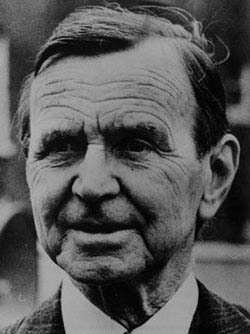
Edward T. Folliard.
The reporter was Edward T. Folliard, who, with some interruptions, served as the White House correspondent for The Washington Post from 1923 to 1967. Folliard was a World War I naval veteran who had covered World War II in Europe in 1944-45.
His beat in 1946 was the Truman administration, but for the stories that won the prize, he traveled to Atlanta, Ga. His assignment was to look into a hate group called the Columbians whose underpinnings appeared to be not only racist but fascist.
Folliard’s Dec. 1, 1946, story told Post readers what he had found.
Columbians cloud Atlanta with an aura of Nazism
By EDWARD T. FOLLIARD
A Confederate flag hangs outside the headquarters of the Columbians, Inc., located at 82 Bartow St., but it doesn't look right. Something alien-like has been woven in between the stars and bars. It is a jagged red streak and somehow it looks familiar.
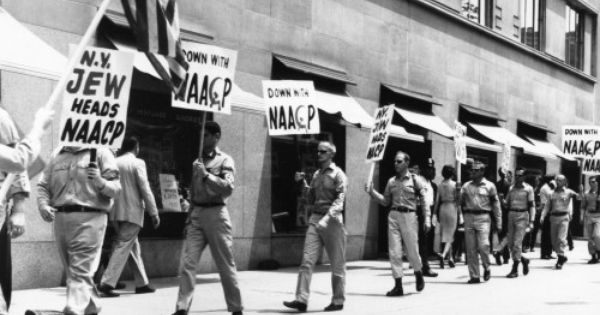
The Columbians march in Atlanta.
That crazy red streak is the Columbians' insigne, a symbolic thunderbolt that proclaims the arrival of a new and spectacular hate organization in the Southland.
The motto of the Columbians is Race, Nation, Faith, but its wild-eyed orators put it more crudely.
“This is a white man’s country,” they shout, and then go on to tell what they are going to do about it.
The Washington Post reporter has spent a week in Atlanta looking over the Columbians. He has talked to their leaders (one of whom has a gorgeous shiner) and has listened to their tirades against Negroes, Jews, the Communists, the rich and newspaper editors who don't share their views on “Anglo-Saxon culture." He has attended their mass meetings and has checked up on their vigilante tactics that have caused Atlanta police to arrest four of them on charges ranging from assault and battery to incitement to riot.
These impressions stand out:
1. The Columbians are not, as has been said, “juvenile delinquents of the Ku Klux Klan.” The Klan doesn‘t like the Columbians. Perhaps it’s because the kleagles are jealous and don't want these upstarts moving in on their side of Hate Street. Also it might be that the hood and sheet men are frightened. The word has gone out (although it’s probably just talk) that the Columbians are determined to be “40 times as bad as the Ku Klux Klan.”
2. The whole aura of the Columbians is Nazi. This is not surprising because two of the leaders are known to have been admirers of Hitler and his racial phobias. The Columbians, all fanatic racists, dress and swagger in the manner of storm troopers. They wear khaki shirts without coats, and on their arms are the red thunderbolt patches suggestive of the Runic insignia of the late Heinrich Himmler’s SS bullies. It is a startling experience, the first time, to see them swinging down Bartow Street or Peachtree Street; something like seeing an old newsreel of Munich in the days of the Beer Hall Putsch. After seeing them a third or fourth time, of course, they cease to be exciting.
3 The oddest thing of all about the Columbians is that the movement has brought a new kind of Yankee carpetbagger to the South. From above the Mason-Dixon Line has come Homer L. Loomis Jr., not to allay race prejudice but to whip it up. A strange fellow of 32, given to nervous laughter and nonstop harangues, Loomis is a New Yorker with a Park Avenue background. He attended fashionable St. Paul's Prep School and studied at Princeton until, according to his own story, he flunked out in an alcoholic haze after two years.
“I suppose it sounds funny to hear one crackpot talking against other crackpots,” Loomis told me once, and gave his nervous laugh.
4. Atlanta is terribly embarrassed by the Munich atmosphere brought to it by the Columbians. Both of the city’s newspapers — the Constitution and the Journal — are crusading against them, after first maintaining a hush-hush policy for fear of giving them free advertising. Virtually all civic and patriotic organizations are fighting them. Protestant clergyman have denounced them as prototypes of Hitler and his Nazis. The official organ of the Catholic Laymen’s Association of Georgia, the Bulletin, has joined in the fight with a bitter editorial headed “Heil Columbians!”
In view of this, and in view of the fact that Atlanta’s police have gone all out to harass them, one would think that the Columbians are doomed. Certainly it seemed so to The Post reporter after watching a Columbians‘ rally, attended by only 290. What bothers newspaper editors and others here is a fear that they might underestimate the Ku Klux Klan, or, going farther afield, an Austrian with a funny little mustache.
***
The No. 1 man of the Columbians — nominally, at least — is Emory Burke, a scrawny, undersized Alabaman who holds the title of president. Burke has figured in the news more than Homer Loomis, one reason being that Dan Duke, assistant attorney general of Georgia and a much bigger man physically, took a sock at him in court last week and opened a gash over his eye.
However, the Atlanta police regard Loomis as the “kingpin” of the outfit, although as secretary he rates as No. 2. They believe that he is smarter than Burke, more intense in his fanaticism and less inhibited.
It was Loomis who thought up the name “Columbians.”
It was Loomis, too, who conceived the idea of the red thunderbolt insignia. He says he got the idea from a shoulder patch worn by men in the Second Armored Division, with which he served in Europe.
(Loomis’ service with that great outfit ought to be a proud and an honorable chapter in his life. However, his second wife, in a divorce proceeding, has clouded it somewhat by alleging that he joined the Army in 1944 to postpone a lawsuit brought against him by her. They were then living at Alberta, Va., near Richmond.)
Loomis was reminded by the reporter that the Columbians’ insignia had a Nazi suggestiveness about it. Of course it had, he said, and he proceeded to show why. He took a pencil and paper and drew a Runic S. There it was – the SS of Himmler’s men. It did not differ much from the Columbians’ jagged red streak.
Loomis chuckled and said this was a good thing.
***
I talked to Loomis and Burke in their Bartow St. headquarters in downtown Atlanta. Their three rooms, located on the second floor of a rundown office building, had a barracks atmosphere about them. All the rooms had cots. Over a washbowl in one room was a lithograph of Lee and his generals. On the wall opposite were the Stars and Stripes and the Stars and Bars, with the Columbians’ banner in between.
A girl with pretty blond hair, but not so pretty features, sat in one of the rooms the wall of which was adorned by a diatribe against Jews. I later saw her at a Columbians’ rally, keeping the minutes.
Young men, all wearing the storm-trooper regalia, pounded in and out of the headquarters. One of them, 17-year-old Ralph Childers, wore a medal suspended from a ribbon. It was a “medal of honor” conferred on him by President Burke after he had been arrested and charged with assault and battery against a Negro youth — a charge he denied.
The contrast between Loomis and Burke, as they sat in the room, was striking.
“Handsome Homer,” as Loomis has been dubbed by one of the newspapers, had a khaki shirt, dark gray trousers and heavy GI boots. His hair was cut severely in crew fashion. Even so, it was not hard to visualize him as he must have been 10 years ago, decked out in white tie and tails and cutting up in the Stork Club.
Burke, who is the same age as Loomis, 32, looked like a man who did not get the right food when he was a boy in Alabama. He had the po’ white or cracker look about him.
"My family wasn't rich like Homer's," he said. "I had to struggle up from the bottom.”
Later, at a Columbians’ rally, I discovered that Loomis was trying to simulate a southern accent. He would say “Jaw-jaw” for Georgia, and talk about how “ah feel” and about “may contacts.” However, it didn't seem to go over. It was like Jeeter Lester of Tobacco Road (or Burke himself) trying to imitate an English professor at Princeton.
For all their differences, Loomis and Burke showed that they had two things in common. One was a profound and searing hatred for Negroes and Jews. The other was an irresistible impulse to talk — to talk and talk until their words piled up into an ocean of hate and bigotry and insane economics. A listener could only wonder how they ever get along, or what would happen if they were marooned together on, say, the Dry Tortugas.
Sources: Fischer, Heinz-Dietrich, Complete Biographical Encyclopedia of Pulitzer Prize Winners, 1917-2000, K.H. Saur, Munich, 2002, p. 72; Folliard oral history, Harry S. Truman Library and Museum, Independence, Mo.