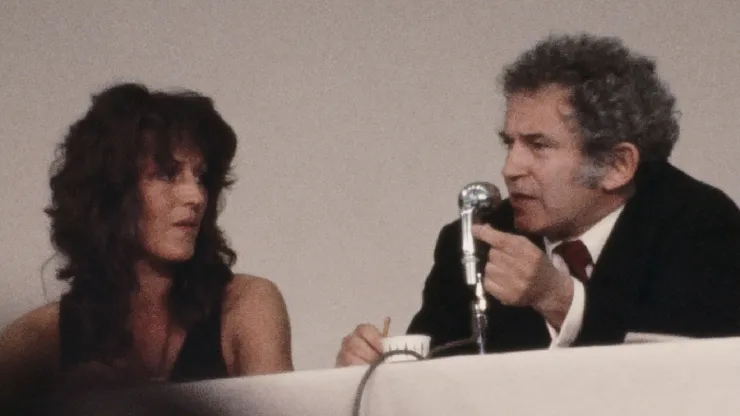
By early 1971, 1969 General Nonfiction winner Norman Mailer was nearing his high point in the popular imagination.
After falling into the thrall of 1953 Fiction winner Ernest Hemingway as a mechanical engineering student at Harvard University, Mailer became a household name at the age of 25 on the basis of his debut novel, "The Naked and the Dead" (1948), a ribald tale of enlisted life during World War II.
While some of his subsequent fiction (notably the bestselling "An American Dream" [1965], soon adapted to film by actor/director Robert Gist) resonated with audiences, critical reception of his works tended to be equivocal—especially after the author nearly fatally stabbed his second wife, Adele Morales, with a pen knife at a November 1960 cocktail party. (Following 17 days of psychiatric observation at Bellevue Hospital, Mailer was indicted on charges of felony assault, ultimately reduced to probation and a suspended sentence.)
Even though public acknowledgement of the tumult of his personal life largely was belied by his professed repentance in the wake of the stabbing, in practice it remained as baroque as ever. Following a brief marriage to journalist and British socialite Lady Jeanne Campbell, a more enduring union with actress Beverly Bentley was punctuated by the vicissitudes of alimony, child support and extramarital relationships.
A need for financial solvency led to the tapering of his traditional, Great American Novel-fueled literary aspirations throughout much of the '60s and '70s — while opening new vistas in the more marketable field of literary nonfiction, as exemplified by the popularity of exponents of New Journalism including Tom Wolfe, Truman Capote and Joan Didion.
Under the editorship of Harper's eminence Willie Morris (later known for his bestselling childhood memoir "My Dog Skip"), Mailer earned his first Pulitzer for "The Armies of the Night," an account of the 1967 March on the Pentagon that featured the author alongside a characterization of two-time Pulitzer-winning poet Robert Lowell. 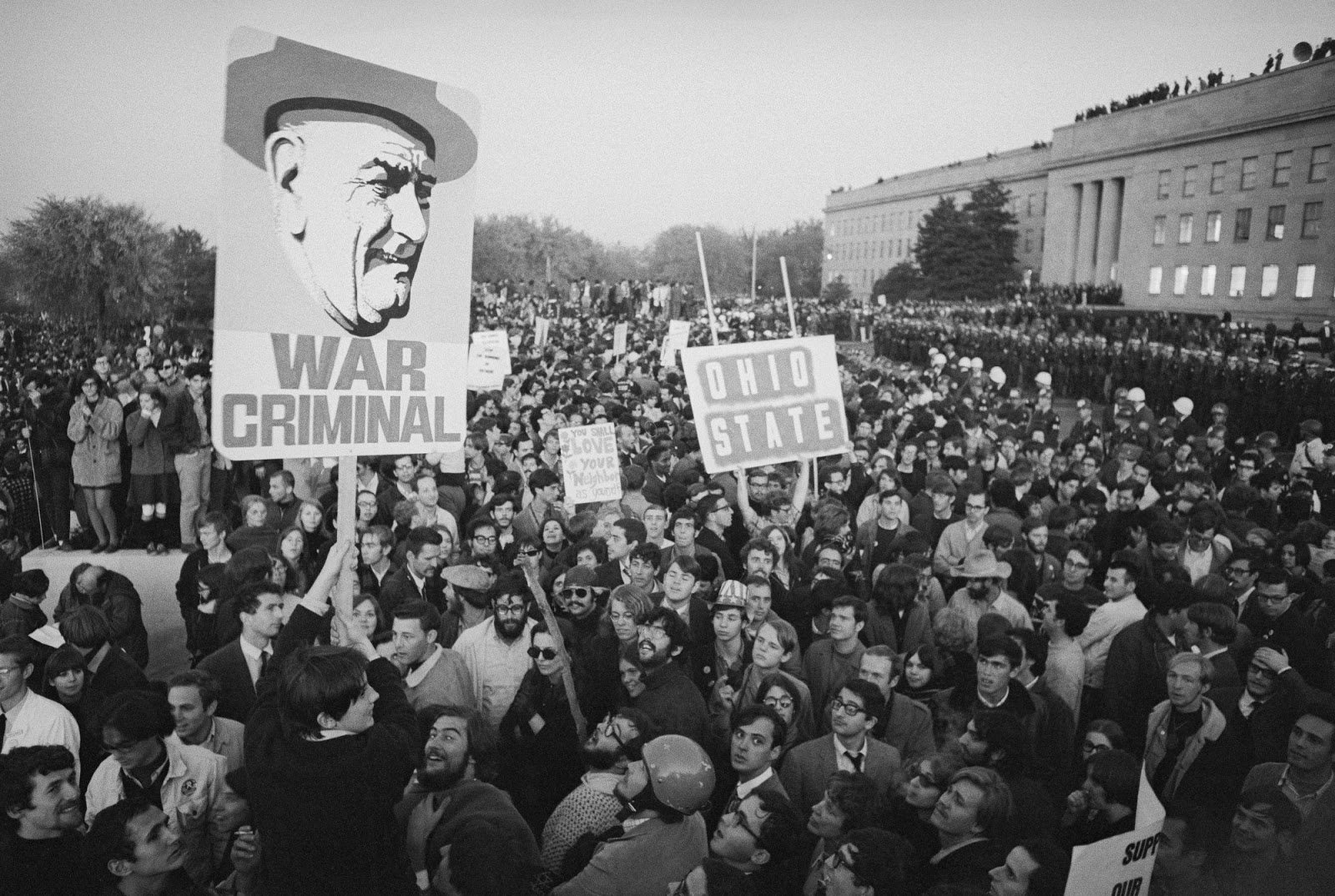
Attended by fellow two-time Pulitzer winner Robert Lowell, the 1967 March on the Pentagon inspired Mailer's first Pulitzer-winning work, "The Armies of the Night." (File)
Continuing to work with magazines like Harper's and Life, Mailer replicated the commercial success of "Armies" with "Of a Fire on the Moon" (1970), a depiction of the Apollo 11 astronauts that drew upon his academic background in engineering while baffling some readers with tangential divagations about his personal life, including the breakdown of his marriage to Bentley. But the third book in this informal trilogy would set the stage for Mailer's most explosive conflagration yet — one that would cast a shadow throughout the rest of his career.
At its core, "The Prisoner of Sex" (1971) was literary pugilism, with Mailer railing against a new generation of feminist literary critics. The most notable target was newly minted Columbia Ph.D. Kate Millett, whose "Sexual Politics" contrasted the queer modalities of Jean Genet with the patriarchal "heterosexism" of Mailer, Henry Miller and D. H. Lawrence.
Indeed, much of the book is cast as an invective against Millett, with Mailer ultimately concluding that women "must have their rights" amid vague pronouncements that second-wave feminism was "artfully designed to advance the fortunes of the oncoming technology of the state." Such sentiments informed much of his output in the '70s and '80s, from his atavistic invocation of ancient Egypt ("Ancient Evenings") to his "true-life novel"-cum-biography of murderer Gary Gilmore in "The Executioner's Song," for which he was awarded the 1981 Fiction Prize.
Published amid the Supreme Court's deliberations on United States v. Vuitch (which momentarily upheld the District of Columbia's abortion ban) and a pioneering report by the National Organization for Women (NOW) on gender bias in public schools, "The Prisoner of Sex" was nominally framed as a reactionary manifesto but amounted to a performative analog to "Portnoy's Complaint," 1998 Fiction winner Philip Roth's 1969 novel about a Silent Generation-era "lust-ridden, mother-addicted bachelor."
When the stakes were high, Mailer — who congratulated himself on his progressive bona fides, speaking at a Henry Wallace rally in 1948 in the midst of the former vice president's Popular Front presidential campaign — perceived the grievances of a new intellectual generation through the potential erosion of his own literary reputation.
Mailer's carnivalesque framing of this work continued when the Theater of Ideas, a semi-closed seminar that overlapped with many figures primarily associated with the New York Review of Books, agreed to host an open panel on the book with several feminist luminaries at Midtown's Town Hall on April 30, 1971. In addition to Mailer, the event included NOW President Jacqui Ceballos, Village Voice dance critic Jill Johnston (then one of New York's few openly queer journalists and, along with contemporary Eve Babitz, a key influence on 21st century American literary nonfiction), public intellectual Germaine Greer and 1982 General Nonfiction finalist Diana Trilling. (Millett and Gloria Steinem, the bêtes noires of "The Prisoner of Sex," refused invitations to participate.)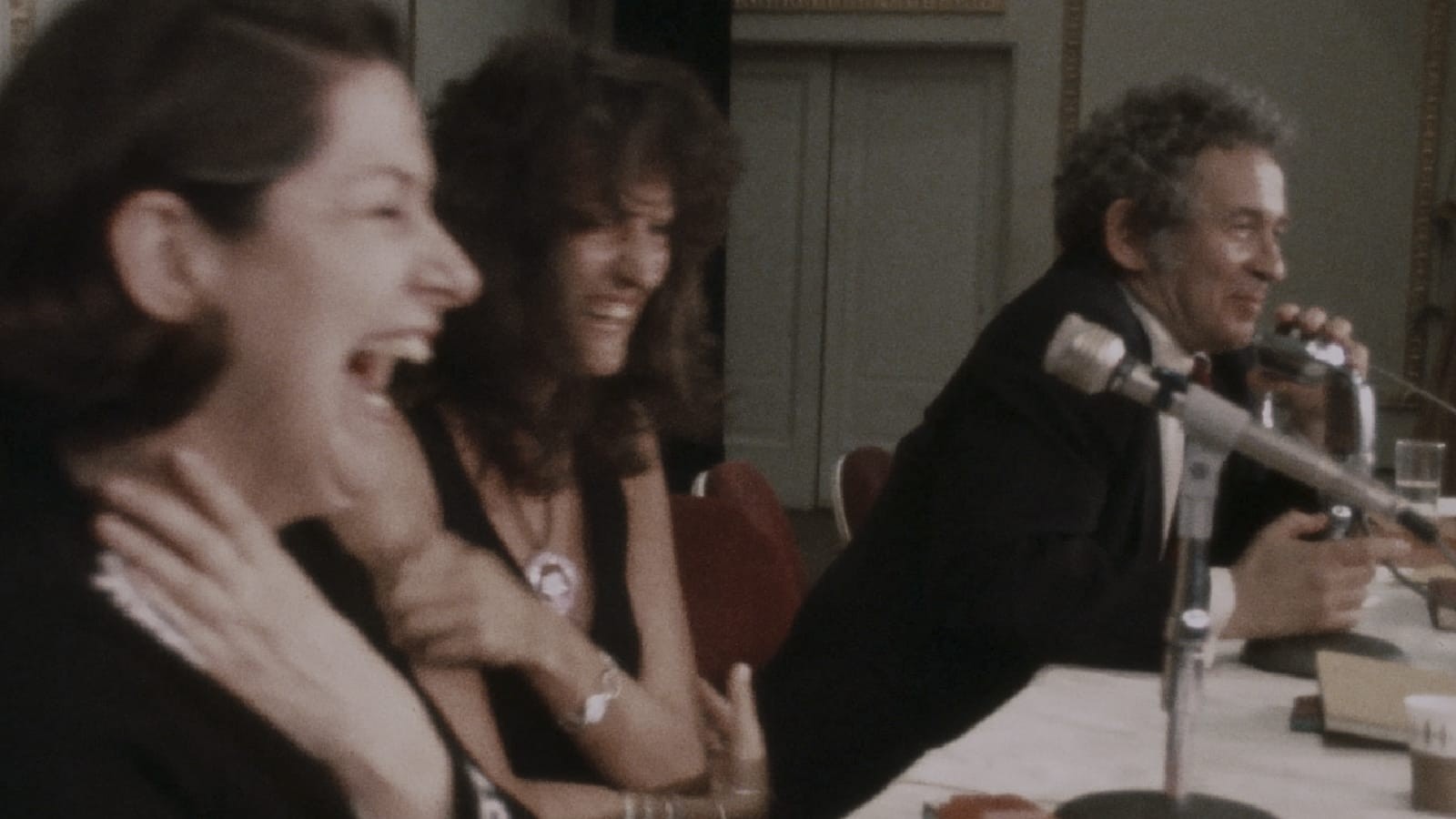
Ceballos (left) and Greer laugh at Mailer in "Town Bloody Hall." (Janus Films)
Attendees included Susan Sontag (the subject of the 2020 Biography Prize-winning biography by Benjamin Moser) and documentarian D. A. Pennebaker, who managed to surreptitiously film the proceedings despite the prohibition of the venue at the behest of Mailer, an occasional collaborator. Nearly a decade later, the footage was rediscovered by Pennebaker's wife, Chris Hegedus, who oversaw its release as "Town Bloody Hall" in 1979.
An oft-bootlegged art-house curiosity, "Town Bloody Hall" was rereleased to the masses this week by the Criterion Collection in a deluxe edition that includes a 2K restoration of the film and a 2004 commentary from Hegedus and Greer.
Although much retrospective attention has been devoted to the subversive insouciance of Johnson (a longstanding acquaintance of Mailer and a co-founder of the Voice), some of the most enduring arguments come from Ceballos, who offers an early take on privilege and her organization's unabashedly "square" activism.
Meanwhile, Trilling compares the subjugation faced by women to queer communities, asserting that Mailer "fails to imagine [...] the full humanity of women as it would never fail in its imagination of the full humanity of men." It is, in contemporary parlance, a fitting "mic drop" (particularly considering the routine diminution of Trilling's substantial accomplishments vis-à-vis those of her husband, Columbia literary scholar Lionel Trilling) that reverberates with contemporary activism.
Future Pulitzer finalist Diana Trilling listens to Jill Johnston (left) in "Town Bloody Hall." (Janus Films)
Reflecting the wisdom of age and a less turbulent domestic life with his widow, Norris Church, Mailer abandoned the rhetoric of "The Prisoner of Sex" and "Town Bloody Hall" as the decades progressed, even crafting a truly multifarious woman in Kitteridge, the interlock spanning decades of fictionalized CIA history in the epic "Harlot's Ghost" (1991).
With its newfound availability, audiences can now take in the full force of mid-career Mailer's demiurgic power in "Town Bloody Hall" — and draw their own complex conclusions.