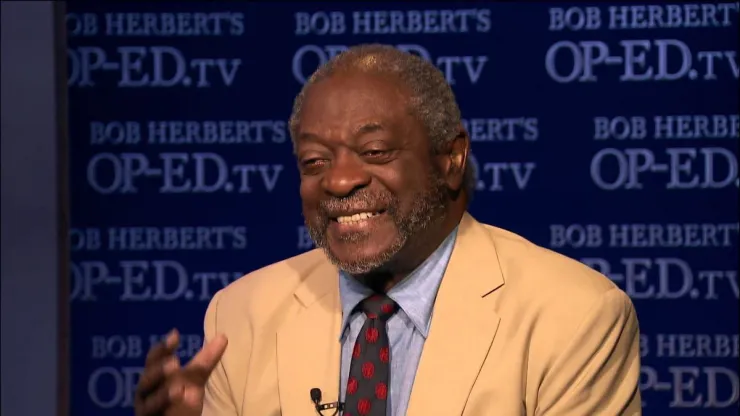
1974 Public Service contributor and former journalism juror Les Payne succumbed to a sudden heart attack at his Harlem home on March 19. He was 76. At the time of his death, Payne was working on a book about Malcolm X at his desk.
A co-founder and past president (1981-1983) of the National Association of Black Journalists, Payne spent his entire civilian career at Newsday, the Long Island newspaper that emerged as a rigorously reported alternative to New York City's tabloids in the 1970s and 1980s. According to Anthony Marro, who served as Newsday's editor from 1987 to 2003, "I don’t think any other single person did more than Les did to move Newsday from being a very good suburban newspaper into a fully rounded paper that covered the state, the nation, the world."
Current NABJ president Sarah Glover echoed Marro's sentiments: "NABJ Founder and President Les Payne was a legendary journalist whose eloquent writing brought passion and truth-telling to an industry too often tone deaf to the issues impacting communities of color. Payne fought to change that with NABJ's other illustrious founders. Founder Payne's bold words and writings showed us why it's important to be a present black journalist in the newsroom every day. He was a quiet, courageous and loving leader. His legacy lives on in us."
Born in Tuscaloosa, Ala., and raised in Hartford, Conn., Payne graduated from the University of Connecticut with a degree in English in 1964. Afterward, he served as an Army officer for five years. Attaining the rank of captain, he was a Ranger and held a series of varied billets, including Air Defense Artillery officer (specializing in Nike Hercules batteries), newspaper editor and spokesman for commanding General William Westmoreland in Vietnam.
A recommendation from William Nack led Payne to apply (in uniform) for a job at Newsday in 1969. Over the next 39 years, he covered and edited an encyclopedic array of topics — from Suffolk County town politics to Patty Hearst to human rights abuses — culminating in his appointment as deputy managing editor for national, science, and international news from 2001 to 2003.
As assistant managing editor in the 1990s, he played an integral role in shaping the newspaper's foreign bureaus, the short-lived New York Newsday (an edition of the paper oriented toward the five boroughs) and the Pulitzer-winning work of Patrick J. Sloyan, Roy Gutman and Laurie Garrett. From 1980 to 2008, Payne also wrote an incendiary syndicated column, leading Marro to remark that "we got to know the names of all the Suffolk police force bomb-sniffing dogs."
However, the dogs were far from Payne's first brush with danger as a journalist. Along with senior editor Bob Greene and Knut Royce, Payne was a lead reporter on "The Heroin Trail," a 32-part project that received the 1974 Public Service Prize and was subsequently collected as a book by Holt, Rinehart and Winston. As Greene later recalled to Roy Harris, the project was devised by Newsday publisher William Attwood to explore the French Connection and to test the Nixon administration's dubious assertion that an anti-poppy payment program to the government of Turkey had atrophied the production of heroin.
The comprehensive series traced the full sphere of the phenomenon, from the collection of raw opium in Turkey to the involvement of New York organized crime figures and the deaths of three young addicts. While in Corsica, Payne was "apprehended and caught by the henchmen of the top heroin smuggler in the world, Marcel Francisci," forcing him to depend on his military training to escape. Although Marro (who also worked on the project) would remark to Harris that "it was ... not a complete story" due to the increasing prevalence of the Golden Triangle, it remains a definitive account of the operation that dominated the heroin trade for more than thirty years.
As friends and colleagues mourn Payne's loss, Newsday has republished some of his best work, including the first part of "The Heroin Trail" and the 1976 Soweto uprising dispatches that were recommended by the jury for the 1977 International Reporting Prize before no award was given.
Read his work here.