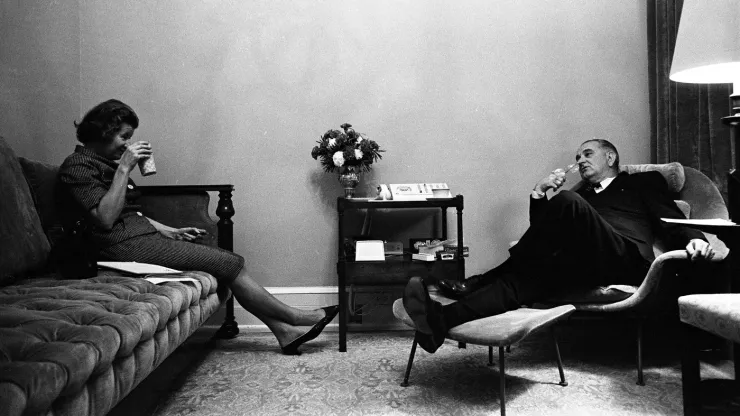
At a tumultuous moment in U.S. political history, 1975 Commentary winner Mary McGrory and 1978 Editorial Writing winner Meg Greenfield broke through the glass ceiling in Washington-based opinion journalism, writing with analytical rigor and expressing against-the-grain convictions.
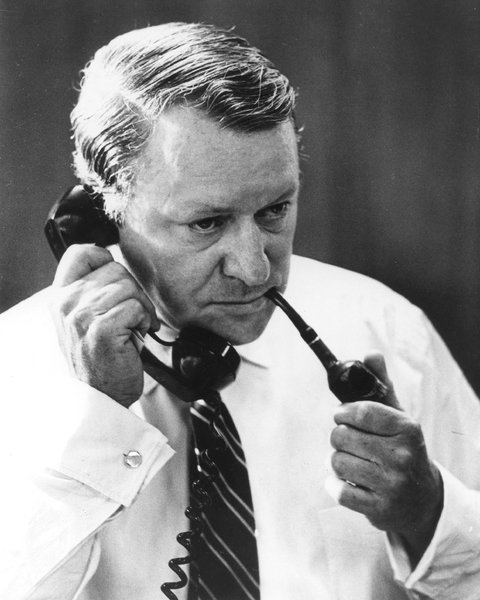
Two-time Pulitzer winner and future Pulitzer Board member James "Scotty" Reston at "the height of his power and influence" as The New York Times's Washington columnist in 1964. (George Tames/The New York Times)
Although D.C.'s evolution from a sleepy Southern city to the center of the nation's sixth-largest metropolitan area accelerated after World War II, its pundit class was slow to adapt. Well into the 1970s, columnists like Arthur Krock, Scotty Reston and Joseph Alsop brokered information with old-boy gentility, lionizing their favored sources (Krock and Reston helped cultivate the national profiles of the Kennedy dynasty and Henry Kissinger) while turning a blind eye to personal and professional indiscretions in a pre-Watergate, pre-Gary Hart era.
Given that years later, in 1990, Anna Quindlen observed that major news organizations still maintained a "quota of one" for female columnists, McGrory and Greenfield's paths to the top were remarkable.
A hardboiled Irish Catholic Bostonian, McGrory moved from book reviewing to the opinion pages of The Washington Star at the behest of editor Newbold Noyes to cover the Joseph McCarthy hearings in 1954. Her characterization of the senator would prove to be career-making. "I had seen his likes all my life, at wakes, at weddings, at the junior prom," McGrory wrote. "He was an Irish bully boy."
For the next 50 years at The Star and The Washington Post, her scrupulously reported columns broke away from the conventional wisdom, eliciting inappropriate advances from Lyndon Johnson and a place on Richard Nixon's "enemies' list." She remained a mordant voice into her final columns in 2003, casting a circumspect eye on the opening salvo of the Iraq War, unlike most of her peers.
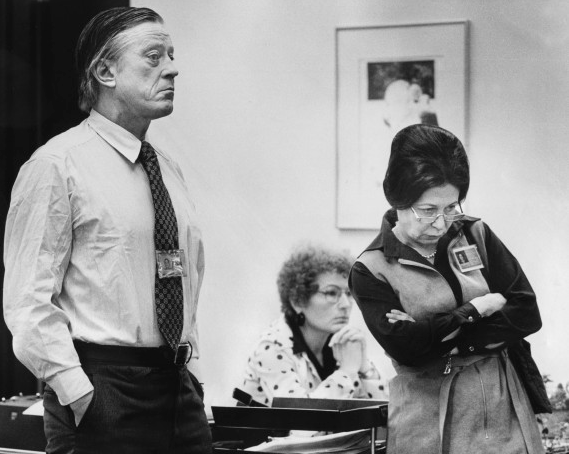
Washington Post Executive Editor and then-Pulitzer Board member Ben Bradlee (left) with Greenfield c. 1972-1975 (Courtesy of The Washington Post)
Unlike McGrory, Washington Post Deputy Editorial Page Editor Meg Greenfield reveled in contradiction. A summa cum laude English graduate of Smith College, Greenfield segued into journalism after serving as the research director for Adlai Stevenson's unsuccessful 1956 presidential campaign. Never one to miss a party, she seldom appeared on Sunday morning talk shows or the lecture circuit. She decried speech codes and political correctness (insisting on being called "Miss Greenfield" long after it was passé) but solicited an influential 1970 op-ed from 1973 Public Service contributor (and future Pulitzer Board member) Roger Wilkins on the Gridiron Dinner's legacy of racist humor.
At The Post, Greenfield notably groomed several future Pulitzer winners from non-journalistic backgrounds, including Wilkins, George Will and Charles Krauthammer. Following her promotion to Editorial Page Editor in 1979, she was elected to the Pulitzer Prize Board in 1986, ending her tenure as co-chair in 1995.
Writing their Pulitzer-winning portfolios in the aftermath of Watergate and the populist groundswell that elected Jimmy Carter to the presidency in 1976, McGrory and Greenfield offered piquant and distinct takes on the legacy of "accidental president" Gerald Ford. Following his controversial pardon of the disgraced Nixon in September 1974, an apoplectic McGrory noted that "the country had been giving strong indications of contrary sentiments, and had been asking for justice rather than mercy in its hope of complete recovery from Watergate." In January 1977, Greenfield took a more conciliatory view, lauding Ford for giving "point and purpose and respectability to those innumerable straight-arrow Republicans who had come to work in Washington and who had been let down, in fact betrayed, by their own White House."
As we celebrate Women's History Month, we invite you to read McGrory (here) and Greenfield's (here) Prize-winning work in their entirety for the first time on pulitzer.org.