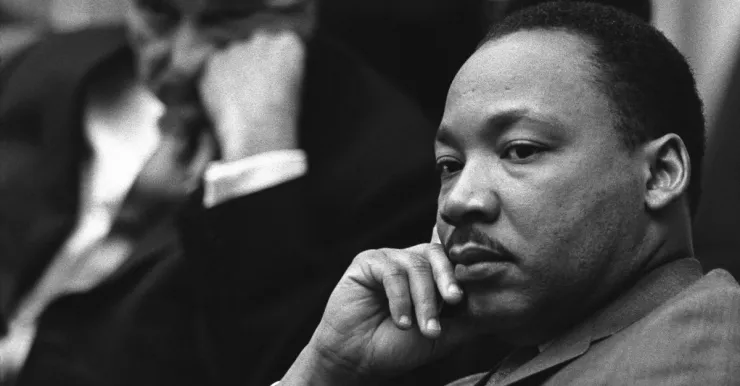
Clarence Page came of age during the civil rights struggle of the late 1960s, a time seen then and now as one in which activists had to make a choice between Martin Luther King’s nonviolent movement and black power. Page couldn’t do it.
As he told an interviewer for Contemporary Black Biography, “I was a great adherent of both.” The Autobiography of Malcolm X “had a more profound effect on me than any book I read as a young person,” he said, but he also admired King.
Page went to work for the Chicago Tribune right out of college in 1969. He has been on the Tribune editorial board for the last 32 years and still writes his column.
In 1988, near the close of Ronald Reagan’s presidency, he wrote a column on the 20th anniversary of King’s assassination. While attempting to put the Reagan years in perspective, the column’s main aim was to show a younger generation that King’s thinking remained relevant.
The column was part of a package that won Page the 1989 Pulitzer Prize in Commentary. It ran on April 6, 1988.
The cruel jest of telling a bootless man to lift himself by his bootstraps
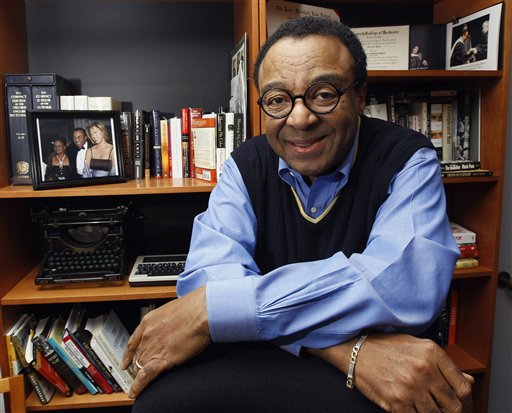
Clarence Page
By CLARENCE PAGE
It is always dangerous to play the game of “What if ... ?” But I cannot help but think Rev. Martin Luther King, Jr., who was assassinated 20 years ago this month, would be amused to see what some people have done to his memory.
I think he would be amused to see his status exalted in some quarters to that of a saint. Ol’ “Doc,” as his associates called him, didn’t even want long eulogies at his funeral. He said he just wanted somebody to say that “Dr. King tried to love somebody.” He wanted to be remembered only as “a drum major for justice.”
But if Dr. King would be amused by what others have done to his memory, he would be thoroughly bemused to see what has happened to his movement.
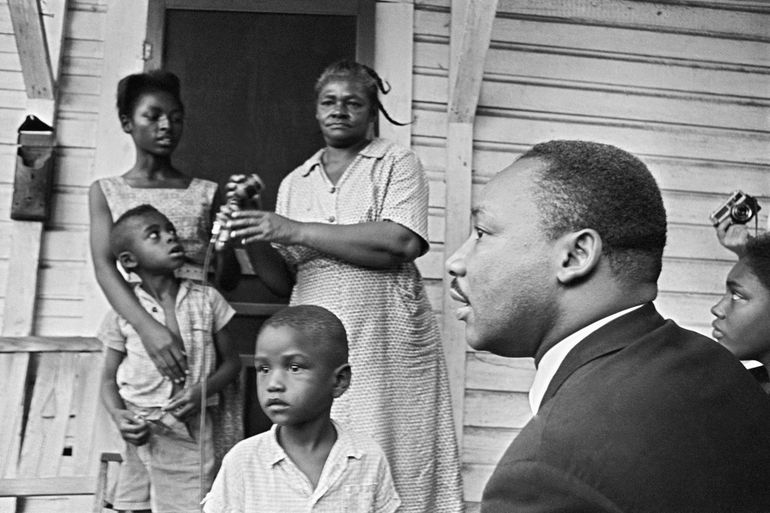
King in Mississippi
The broad coalition of students, laborers, sharecroppers, politicians, clergy and ethnic leaders he pulled together has split many separate ways. The moral clarity of his campaign against America’s legal apartheid has become so muddled that even conservatives like Ronald Reagan, who opposed both the Civil Rights Act of 1964 and the Voting Rights Act of 1965, speak as if they know more about the civil rights movement than those who led it.
In fact, that’s the justification Mr. Reagan has used to battle affirmative action and other modest efforts designed to open opportunities for women and minorities; he labels them “preferential treatment.”
Maybe. No fair-minded person is comfortable with the idea of quotas.
But conservatives do not do Dr. King justice if they think “affirmative action” is an idea that popped up after his death. As he pointed out during the last Sunday sermon of his life, the first people to benefit from preferential treatment were not black. They were the people who settled the West and the Midwest in the years after the Civil War under an act of Congress that gave away millions of acres of land to encourage expansion and settlement of the Western frontier and, as he said, “to undergird its white peasants from Europe with an economic floor.”“But not only did [the government] give the land, it built land-grant colleges to teach them how to farm. Not only that, it provided county agents to further their expertise in farming. Not only that, as the years unfolded it provided low interest rates so that they could mechanize their farms. And to this day thousands of these very persons are receiving millions of dollars in federal subsidies every year not to farm. And these are so often the people who tell Negroes that they must lift themselves by their own bootstraps.”
At the same time, Dr. King noted, the Emancipation Proclamation freed the slaves without so much as a pot to put their porridge in.
“It’s all right to tell a man to lift himself by his own bootstraps, but it is cruel jest to say to a bootless man that he ought to lift himself by his own bootstraps,” he said.
Twenty years after Dr. King’s death, most black Americans are enjoying the benefits of his work, in one way or another. Legal segregation is a thing of the past, blacks are in positions of visibility and authority that would have been hard to imagine 20 years ago, and, depending on whose statistics you believe, a half to two-thirds of black Americans can be called “middle class.”
But that leaves about 30 percent of black America still living in poverty, with life worse in many ways. When opportunities opened up, the most upwardly mobile blacks were the first to leave urban ghettos, leaving the hardcore unemployed more socially isolated than ever. With street gangs, drug dealers, teen pregnancy and inferior schools, many are locked into a seemingly permanent “underclass.”
The biggest problems facing black Americans today are economic. They are not likely to be solved with civil rights remedies, but they could be relieved with public and private action to encourage economic redevelopment and rebirth in our inner city ghettos, just as government incentives played a key role in helping pioneers develop the Old West.
American ingenuity is expected to create millions of new private sector jobs by the end of the century. Yet millions of young people will not be able to fill those jobs unless we reform our schools, break the welfare cycle and encourage new businesses to open in the communities of the people who need them most, especially when they can be owned and managed by some of those same people.
The government has no more land to give away, but it can invest in a new generation of urban pioneers. As Dr. King once said, “We now have the techniques and resources to get rid of poverty. The real question is whether we have the will.”