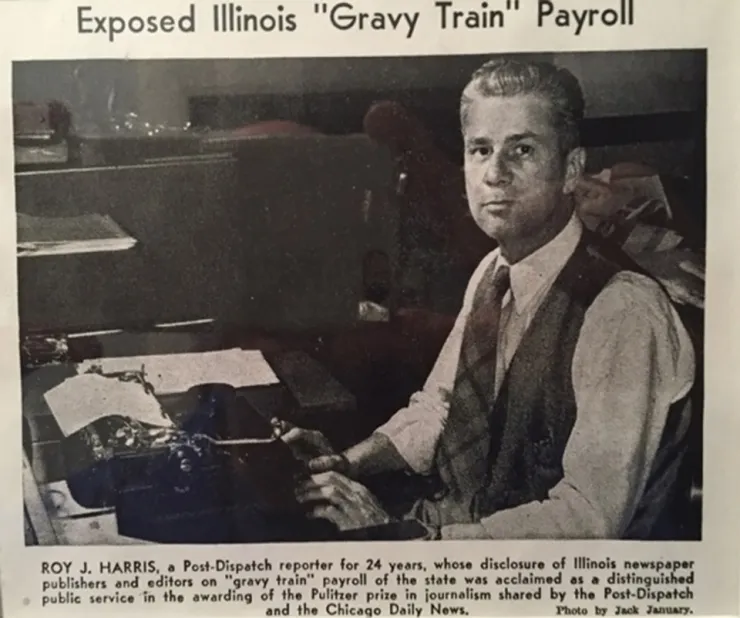
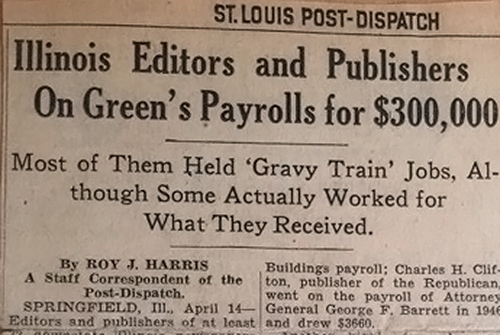
On April 14, 1949, two reporters broke a story that would go on to win the 1950 Public Service Pulitzer Prize for both my hometown St. Louis Post-Dispatch and the Chicago Daily News.
The Pulitzer Prizes were awarded for the 100th time on April 18. While centennials usually focus attention on longevity, to me this one reveals how quickly the decades – and key events in journalism history – can fly by. I see the Pulitzers through a compressed timeline, perhaps because I’ve devoted much of the last 14 years to assembling Pulitzer-winning tales in a book, Pulitzer’s Gold, now out in a new edition. But it could reflect, too, a lifetime spent with Pulitzers as part of my family.
When I began my own reporting career, in 1966, the prizes were celebrating their 50th anniversary. I was a summer replacement reporter for the Post-Dispatch awaiting my junior year of college. It was also the year before my father retired, and I rode in to work with him, occasionally questioning him about the job along the way.
Dad, who had joined what he called the P-D in 1925 – only the eighth year the prizes existed – usually didn’t tell many newspaper “war stories.” In that sense he was like the World War II vets of Tom Brokaw’s “Greatest Generation,” keeping silent about what they’d witnessed on the front. (My father was one of that generation, too, having served as an Army Engineer officer in the Pacific, and through Okinawa’s kamikaze attacks, something his children rarely heard about.) But on our morning commutes that year, he opened up a bit about some of his P-D highlights, including the Pulitzer winner.
In 1949 he was the paper’s lone Springfield, Ill., state house correspondent. He and George Thiem of the Daily News followed tips from state employees about the gravy-train editors on the Illinois rolls, realizing that splitting the investigative workload was the logical way to track them down. This allowed each reporter to perform his normal coverage duties while pursuing their scoop of a lifetime on the side.
Eventually, the two wrote their stories in dad’s hotel room, filing individually to their editors in St. Louis and Chicago – a nerve-wracking process, my father explained, because of the possibility of “a million-dollar lawsuit for each person we named.” Looking back, it was also a rare collaboration on a major story, for the times, between reporters for separate papers representing non-competing markets.
Those 1966 commutes with my dad produced more stories of Pulitzer-winning, too. In fact, three other projects involving my dad had resulted in Public Service prizes, in 1937, 1941 and 1948. The excitement of hearing him talk about them stayed with me.
After college I worked at The Wall Street Journal for 23 years before moving to a job reporting and editing in Boston with the Economist organization. Then in 2002, a few years from retirement myself, I had the idea of using my research skills to honor my dad, who had died in 1980, and our old newspaper. In an arrangement with the Post-Dispatch and the local James C. Millstone lecture series, named for a P-D editor my dad and I had revered, I prepared a program discussing the backstories of Pulitzer Public Service gold medals the newspaper had won. The Post-Dispatch, it turned out, had five medals in all, at the time the most of any paper. (The Los Angeles Times now has won six, with the New York Times and Washington Post also having won five.)
The first Post-Dispatch gold medal, in 1937, had been for exposing widespread voter fraud in St. Louis. In 1941, the paper won for a stunning campaign it led to cleanse the city’s filthy air by enrolling corporate support for low sulfur coal, and in 1948 it won for coverage of a horrific mine disaster in Centralia, Ill., that killed 111 miners. The paper wrote of abuses by state regulators and inspectors, and its stories led to mine safety reforms.My talk was on Sept. 9, 2002. It would have been my dad’s hundredth birthday. The connection was fitting; only Post-Dispatch medal number five, awarded in 1952, hadn’t involved him. That final P-D Pulitzer was largely the work of investigative reporter Ted Link, who had disclosed corruption in the federal tax-collection system. The stories resulted in the nation’s patronage- based system being replaced by the Internal Revenue Service.
Remarkably, I was able to locate several ex-Post-Dispatch journalists I’d worked with long ago. One was Selwyn Pepper, my city editor in 1966. In interviews, Selwyn delighted in recalling his own Pulitzer Prize involvement – including an editor’s ordering him to the mine disaster. It was first “a matter of finding out where Centralia was … and finding the mine.” Selwyn also worked rewrite for Ted Link’s tax stories. “He was a great crime reporter, but not much of a writer,” Selwyn said.
The staff’s response to my talk was gratifying, with most journalists in attendance admitting to little prior knowledge of the history behind the five gold medals displayed in their newsroom. And they loved Selwyn’s stories.
My research had made me a student both of Post-Dispatch and Pulitzer Prize history, which to a surprising degree were intertwined. Indeed, the St. Louis paper and the New York World were owned and edited by Joseph Pulitzer when he dreamed up the idea for the prizes in 1902 (also my dad’s birth year). Pulitzer provided for the awards in his will, and Columbia University used his bequest to create the Pulitzer Prizes five years after he died in 1911. The Post-Dispatch then was edited by Joseph Pulitzer II until his death in 1955, and by his son Joseph III until he retired in 1986. Throughout that time the governing Pulitzer Prize Board was chaired by a St. Louis Pulitzer.
The idea for a book on all the Public Service prizes, dating to the first awards in 1917, grew from the St. Louis presentation. Expanding the research to cover what is now a century of Public Service Pulitzers seemed a stretch at first but turned out to be a natural. For the earliest winners – honoring coverage from the World War I era, the Jazz Age and the Great Depression – I resorted largely to archival records. But from the 1960s on I found plenty of journalists eager to talk, just as Selwyn and other former Post-Dispatch colleagues had. (Selwyn’s daughter Miriam Pepper, recently retired as editorial page editor of the Kansas City Star, was able to present her dad with a copy of the finished Pulitzer’s Gold for his 93rd birthday in 2008 (He died later that year).
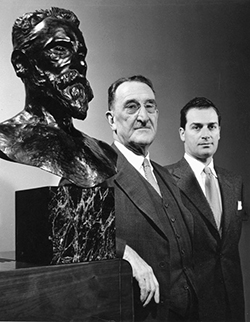
Joseph Pulitzer II and J.P. III pose with bust of Joseph Pulitzer
In my current home city, Boston Globe Spotlight Team reporters and editors helped me pull together one of my most dramatic chapters, about their winning work (2003) unearthing the Catholic Church cover-up of the sexual abuse of young parishioners by priests. Equally cooperative were journalists involved with other 21st-Century winners, from coverage of Hurricane Katrina by New Orleans’s Times-Picayune and southern Mississippi’s Sun Herald (2006) to Los Angeles Times reports on municipal corruption in the California city of Bell (2011) and the Charleston Post and Courier’s study of the high rate of murders of South Carolina women (2015).
But for a 15-year span of extraordinary Pulitzer-winning reporting by a single news organization it’s still hard to top the 1937-52 stretch of winning Post-Dispatch work that launched my research adventure.
To me that period reflects the first Joseph Pulitzer’s Post-Dispatch Platform, a retirement statement that still graces the lobby of the paper where my father worked. The language may be a bit stilted, befitting its April 1907 origin, yet the meaning remains clear, committing the paper to “never tolerate injustice or corruption” and “never be afraid to attack wrong, whether by predatory plutocracy or predatory poverty.”
On my wall at home hang other, more personal Pulitzer words – typed by Joseph Pulitzer II, and left on my dad’s desk on May 3, 1950: “Memo to Mr. Roy Harris: Thanks to you the Post-Dispatch has won the 1950 Pulitzer Public Service Prize. Please accept my thanks and cordial congratulations. J.P.”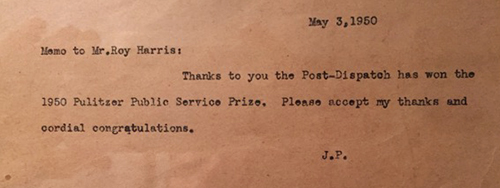
Congratulatory note written by Joseph Pulitzer II to Roy J. Harris.
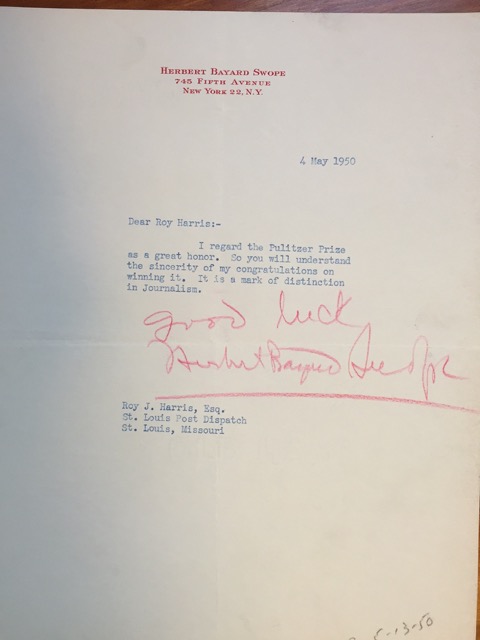
After the Post-Dispatch prize was announced, Harris received a letter of congratulation from Herbert Bayard Swope, who had won the first Pulitzer Prize in Reporting in 1917.