
Jonathan Yardley reviewed books for the Daily News in Greensboro, N.C., during the 1960s, served as book editor of the Miami Herald during the ’70s, and reviewed books first for The Washington Star and then for The Washington Post from 1978 through his retirement in 2014.
In 1981, his last year at The Star, he won the Pulitzer Prize for Criticism. The prize-winning reviews included two with Pulitzer connections. One was a review of John Kennedy Toole’s novel, A Confederacy of Dunces, the Fiction winner that year even though it was published after Toole’s death. The other was a biography of the journalist Walter Lippmann.
The biography was nominated for the 1981 Biography prize but did not win it. Lippmann, the subject of the book, won Pulitzers in 1958 and 1962 while working for The New York Herald Tribune.
Yardley deftly wove into a piece the two vital strands of a biography review: a generous assessment of the book and an informed portrait of its subject. Most readers pick up a review hoping to find out whether they’ll like the book. Yardley approached writing a review with that question front and center.
The review of Ronald Steel’s Lippmann ran in The Star on Aug. 31, 1980.
Walter Lippmann’s mission: educate, interpret, analyze, influence
By JONATHAN YARDLEY
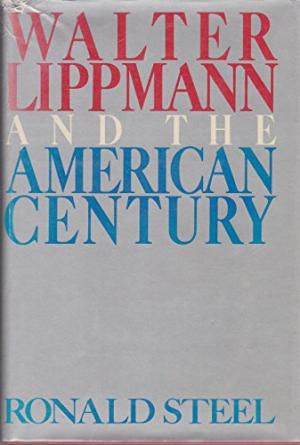
Ronald Steel's biography of Walter Lippmann.
What Ronald Steel has accomplished is rare and admirable: He has written a biography that is exactly, unerringly appropriate to its subject. Walter Lippmann and the American Century is a magisterial book: scrupulous, reflective, balanced, comprehensive, admiring yet never fawning. Lippmann, who approved Steel’s project and cooperated with it until his death in 1974, knew what he was doing.
This is, let it be said at the outset, a state biography, though Lippmann never held a high state position. Readers doubtless will wish, as I did, for more glimpses of the private Lippmann than Steel provides, but his underlying assumption is that an account of Lippmann’s private life is of less moment (with two important exceptions, of which more later) than an analysis of his long and fruitful career.
Though Lippmann operated within the framework of journalism, he was an essentially statesmanlike figure who exerted enormous influence both as a columnist and as a behind-the-scenes manipulator. In addressing himself to this dual career, Steel raises questions of considerable consequence for journalism and government alike.
That Lippmann was a great journalist is indisputable, but in assessing him as a journalist, a good many of the rules must be thrown out the window. He was never a reporter in the traditional sense of the term. Though he served for several years as editorial page editor of The New York World, he detested the ordinary housekeeping of editing and performed it perfunctorily. His sense for breaking news was so attenuated that he once actually departed just as an anti-de Gaulle coup was about to reach its climax.
Lippmann was, rather, a writer and thinker (“philosopher” strikes me as excessive) who managed to find a place within the confines of journalism from which to express his opinions. In fact, he manufactured one: He was the first editorial columnist to deal in opinion rather than high-level gossip. He was a remarkably graceful stylist who possessed what Steel calls a “rare knack for synthesizing complicated material and putting it into language the average reader could understand.” He considered it his mission to educate, to interpret, to analyze — and to influence.It is in his discussion of Lippmann’s role as molder not merely of opinion but also of politics and policy that Steel brings his biography into sharpest focus. Meticulously, he strips away Lippmann’s “reputation for being a man of Olympian detachment — a Jove prone to hurling thunderbolts, but too scrupulous to descend into the political fray.” Instead he shows us a man who was the archetypal “insider,” who “operated entirely within the system” and often — this his readers did not know — in stealthy collaboration with the high and mighty.
There was nothing dishonorable about this; to the contrary, at all times Lippmann had in mind the best interests of his country — as, of course, he perceived them. Steel passes no direct judgment on Lippmann for these excursions into influence without accountability; he simply records how Lippmann was drawn, by his deep concern for the national interest and by his own penetrating intelligence, into situations that compromised him as a journalist — working behind the scenes to help nominate or defeat political candidates, privately advising presidents and high ministers, even serving overseas as an administration mouthpiece on a delicate matter of foreign policy.
Steel also shows how Lippmann’s underlying trust of those in power — and his desire for their approval and confidence — led him to be seduced by Lyndon Johnson on Vietnam; and then how, late in the eighth decade of his life, Lippmann at last comprehended his seduction and repudiated it, abandoning his mask of detachment and becoming the war’s most persistent, articulate and effective critic.
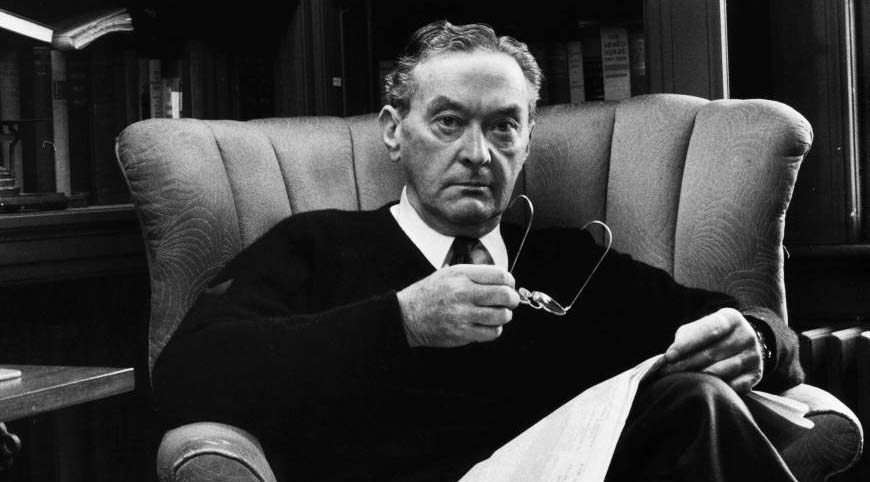
Walter Lippmann
Not until he found himself on the outside, Steel convincingly argues, was Lippmann free to express his outrage over the war and the men who relentlessly, clandestinely widened it. Steel (who, as the author previously of Pax Americana, has his own biases) believes that for Lippmann Vietnam “was perhaps his finest hour.” Perhaps Steel is right.
To come out as forcibly as he did against his own government, and at such a late hour in his life, was a painful and costly wrench for Lippmann. It took him against the grain of his entire life. Born an outsider, the son of wealthy New York Jews, Lippmann spent nearly eight decades establishing a firm position on the inside: at Harvard, at The New Republic, at the World, as a syndicated columnist, as a self-appointed minister without portfolio.
Lippmann’s identity as a Jew is one of the two private matters Steel explores at length — as does Louis Auchincloss in his fine novel about Lippmann, The House of the Prophet. Though Steel does not go so far as to say so, it is transparently clear that Lippmann was an anti-Semitic Jew. He held the bizarre notion that Jews are somehow responsible for the prejudice against them: “Instead of demonstrating the irrational basis of anti-Semitism — how the Jews, like other minority groups, were used as scapegoats — Lippmann accepted its premise by blaming the Jews for fulfilling the role imposed upon them by Gentile society.”
His indifference toward the Nazi extermination of the Jews was callous in the extreme; until the civil rights movement of the 1960s belatedly awakened his more generous instincts, he rarely challenged discrimination in any form, indeed at times practiced it himself. He had no objections to the Nisei internment, and Bill of Rights questions as a general rule did not unduly vex him.
This extreme sensitivity to his Jewishness was only one of the signs of insecurity that Lippmann harbored within his aloof manner. He was uncomfortable in the company of those he perceived as his social and/or intellectual inferiors. He was utterly maladroit mechanically and thought it nothing short of phenomenal that he managed to learn how to brew a passable cup of coffee. He was so worried about the critical reception of Essays in the Public Philosophy that he suffered a nervous collapse from which it took him several weeks to recover; at the time, he was 65 years old.
Had he not fallen in love at the age of 47, with Helen Byrd Armstrong, he might have retreated for life into a cocoon that would have shielded him from all his uncertainties. Instead, he came to believe that their love affair and subsequent marriage were his liberation. It is a painful, poignant story, one that Steel tells with the utmost discretion and sympathy.
Helen, at the time they fell in love, was married to Walter’s best friend, Hamilton Fish Armstrong, and Walter himself was still married. The divorces were bitter and, in Lippmann’s case, expensive. But neither ever expressed any regret, only gratitude. Here is Walter writing to Helen on her 70th birthday:
“I feel I must write you a letter on this day. For in it I can say how happy I am that I married you and how deeply and everlastingly grateful I am. Looking back, I feel as if I had never really begun to live until we set out together, and that I have known from you not only unimagined happiness, but also the secret of starting life anew.
“You have been the decisive influence. But for you I would have settled down dully 30 years ago in the grooves I cut when I was young. But for you I would now be settling into a dull old age instead of feeling that we are at a new and fascinating beginning.”
That letter is a rare moment — a glimpse into the heart of a man who kept that heart resolutely closed to the world. If the private Lippmann remains largely a mystery at the close of this long book, that is through no fault of Steel’s. He seems to have told us as much as he knows, and perhaps as much as we need to know. He has written a thoroughly honorable book.