1986 General Nonfiction winner Joseph Lelyveld turned 81 on April 5. A graduate of the Bronx High School of Science and Harvard College, he earned a master's degree from the Columbia Journalism School two years later and began working on the copy desk of The New York Times following a transformative Fulbright fellowship in 1962. His ascent at The Times was swift, including notable correspondent assignments in Congo, South Africa (where he was deported by the government in 1966), India and Hong Kong.
Admired by Washington insiders for his cerebral and impartial style, Lelyveld also experimented in the Times Magazine with first-person accounts that helped to "[loosen] up the Times from the inside," echoing contemporaneous efforts by Gay Talese and Pulitzer winner J. Anthony Lukas.
After stints as foreign and managing editor, he served as the newspaper's executive editor from 1994 to 2001. Since leaving the paper, he has authored four books (including a memoir) and frequently contributes to the New York Review of Books.
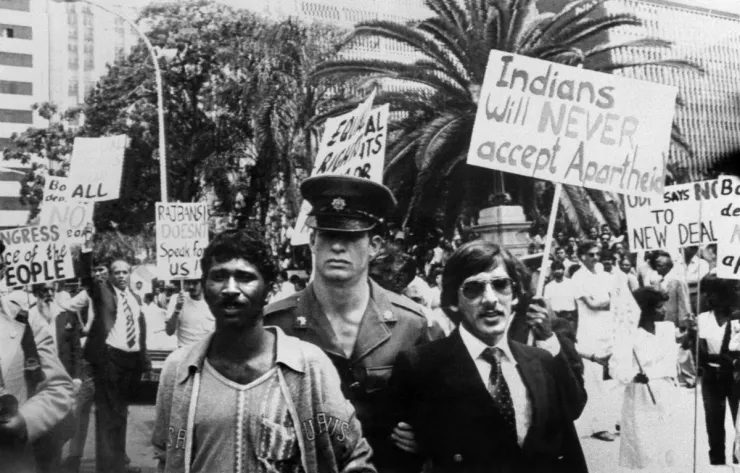
Although his work at The Times was often singled out for its excellence, Lelyveld received his Pulitzer for his first book, "Move Your Shadow: South Africa, Black and White." The book is a memoiristic take on his experiences in South Africa, where he was again posted as a correspondent from 1980 to 1983 after briefly abandoning his editorial career.
Written in the waning years of apartheid, "Move Your Shadow" (derived from a phrasebook that instructed golfers to interact with their caddies) includes a number of chilling vignettes. "The black room service waiter who brought my breakfast in the Carlton Hotel ... managed to 'sir' me four or five times," he wrote. "The servility got under my white skin; for the first time in years, I felt the urge to protest, 'I'm not from here.' Instead, I grabbed the check."
Immediately thereafter, the waiter pointed to a group of men being beaten on a nearby rooftop by white police officers. To Lelyveld, this was "a particular kind of sensation, a cheap thrill maybe, available to outsiders and voyeurs who can maintain access of a kind on all sides ... as few South Africans can — experiencing the huge evasions of the whites and the helpless knowledge of the blacks, the willful denial of reality as well as its crushing weight."
Upon his return, Lelyveld was mystified by the increasingly byzantine nature of the apartheid classification system, which encompassed thousands of pages of regulations and recognized several principal castes with varying degrees of legal and educational rights, including "African," "White" and "Coloured" (ostensibly including all individuals of multiracial descent). According to Lelyveld, "It is impossible to change caste without an official appeals board ruling that you are a different color from what you were originally certified to be. ... The spirit of this grotesque self-parody, which results from the deliberations of an official body known as the race classifications board, is obviously closer to grand guignol than the Nuremburg laws; in other words, it's sadistic farce."
But Lelyveld reserved his staunchest criticisms for American analogies to the discriminatory Jim Crow laws that pervaded the South following Reconstruction. "Americans tend to misconstrue the conflict, to talk about human rights and living standards while fuzzing the central issue of power. ... This makes it easy to suppose that whites who talk about 'reform' and 'change' are talking about an end to white dominance when often they are really searching for a way to make it more tolerable so it can endure." Much as the legacy of systemic racism continues to haunt American institutions, apartheid's power dynamics continue to pervade contemporary South African life.
Long (and regretfully) out of print, "Move Your Shadow" was excerpted by the Columbia Journalism School as part of their Centennial celebration in 2012. Read it here.