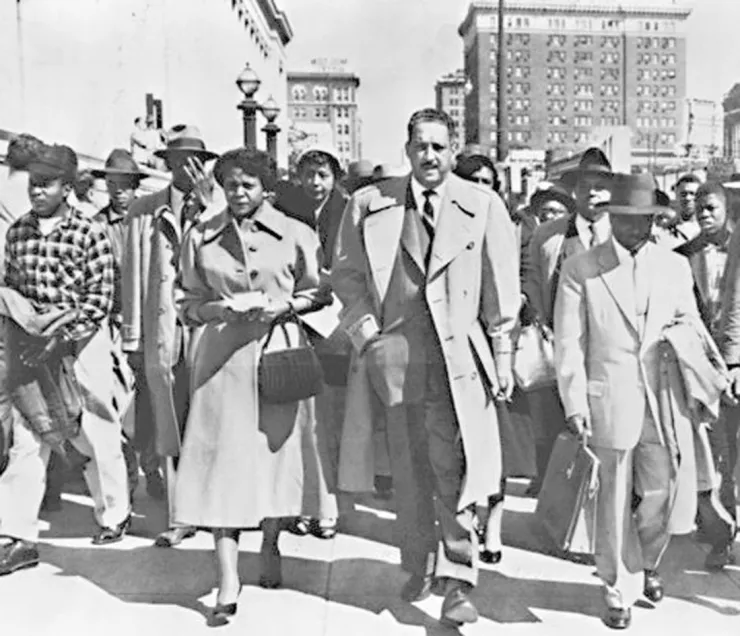
Autherine Lucy entered the University of Alabama in Tuscaloosa as its first African-American student on Feb. 3, 1956. It had taken a Supreme Court order to enroll her. Crowds of students and townspeople gathered on campus to protest her presence.
By Feb. 6, a Monday, the mob had become so large and menacing that Lucy had to hide on the floor of a highway patrol car to escape the campus. The university trustees expelled her “lest greater violence should follow.” After she protested that school officials had conspired to create the mob that drove her away, the trustees expelled her permanently for “baseless accusations.”
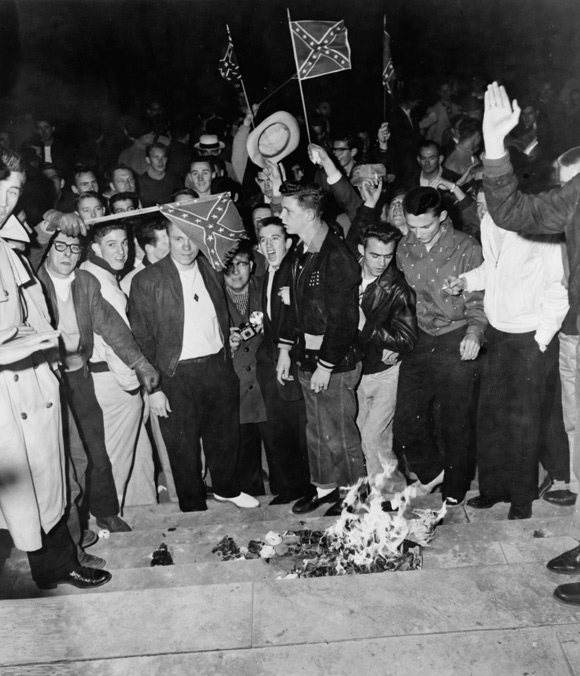
A mob of Lucy's fellow students and others protest her enrollment at University of Alabama.
Buford Boone, publisher of The Tuscaloosa News, wrote an editorial for the next day’s edition supporting Lucy’s right to attend the university. In giving him the 1957 Pulitzer Prize for “fearless and reasoned editorials in a community inflamed by a segregation issue,” the Pulitzer board specifically cited this editorial.
In it, Boone explained that Lucy had abided by the rule of law in gaining admission to the university. In contrast, he wrote, the university had “knuckled under to the pressures and desires of a mob.” The answer to a mob “lies in the use of whatever force is necessary to restrain and subdue anyone who is violating the law.” Yet there had been no arrests.
“What has happened here is far more important than whether a Negro girl is admitted to the University. We have a breakdown of law and order, an abject surrender to what is expedient rather than a courageous stand for what is right.”
That week, Everett Walker, Sunday editor of the New York Herald Tribune, telegraphed Boone with this request:
“Would appreciate your comment and views on segregation; its status your area. Can problem be solved? How much of Alabama situation a true reflection of situation? Will situation become more acute? Planning symposium page view this Sunday.”
Boone published his response to Walker in his own paper on the same Sunday, Feb. 12. Alongside it ran several letters to the editor from readers responding to the Feb. 7 editorial.
Here are Boone’s response and several of the letters.
When Autherine Lucy made the jump, all hell broke loose
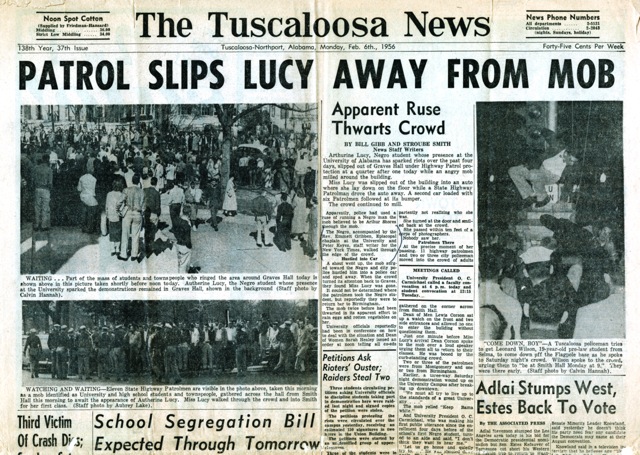
A 1956 Tuscaloosa News front page.
Mr. Walker:
A great majority of students at the University of Alabama would prefer that Negroes stay away. But mob violence and mob dictation are not condoned by most of those on the campus.
Sentiment ranges from an attitude of calm acceptance of the inevitable to a bitter determination to fight to the last against any change. Student opinion probably reflects the feeling of the people of the state accurately.
Some of those who were active in the mob believe that murder is better than submission. They are far from a majority for, actually, the mob action was by a definite minority of students. And many of those who participated were so frenzied that they wouldn’t have realized what they had done until after they had killed the Negro student last Monday — If they had succeeded in getting their hands on her.
Courageous action by university authorities and law enforcement, plus an abundance of luck, kept Alabama's conscience from bearing the load of a murder. For the mob was ‘gone’ Monday noon. Its members, white-faced and out of touch with reality, tried to do what a white-haired woman, perhaps the mother of a student, kept shouting for them to do: ‘Kill her, kill her, kill her!’
(Reference to “courageous action” applies only to protection given the Negro student — not to the namby pamby policy which permitted the mob to become so strong and so vicious.)
The thinking people of the South will pay the price of maintaining respect for law, and for bringing themselves to face the realities of the present. For white Southerners, that price is an agonizing slipping away of some customs and habits as comfortable as old garments. For Negro Southerners the price is calmness, continued patience and a measure of satisfaction in the ever so slow implementation of rights that are theirs as American citizens.
But white Southerners will not submit to force and intimidation, nor to all-the-way-at-once changes in a way of life. It is silly, in some people's minds, to revere a cow. But the Hindus do. It may not be sensible, intelligent, nor American in the opinions of many for Southerners to think as we do about segregation.
However, in understanding the problem, it is necessary to recognize a condition that exists, whether right or wrong. For sentiment has coalesced and congealed, over the generations and decades, into a condition.
Changes from such a status, which is a concrete fact and not something nebulous and unperceivable, are not going to come suddenly, whether the effort is to stamp out, legislate out or order out by a decision from the bench. For our problem is one of dealing with men’s minds. And those men are fiercely free, proud and independent.
The area of danger lies in friction between extremists. The area of hope lies with Southerners, white and black, who believe in law and order. It lies with people who are willing to think — to think about the truth that when one American is denied unjustly something that is justly his, we all are poorer.
Gradual change has been taking place. But sometimes change cannot be continued in slow steps. There has to be a jump. When Autherine Lucy made the jump, all hell broke loose.
Most of the “jumps” will come, for a period of years, only as a result of court order. Agitation for more will breed strong groups of Citizens Councils and Ku Klux Klaverns. The South, it appears, is going to lose this one, too. But it’s going to take longer than it took before.
Personally, I know that change is here. I am neither ashamed of the past, afraid of the present, nor despondent about the future. I believe law and order will emerge triumphant. And if it doesn't, all is lost.
My newspaper, whose policy is made solely and exclusively by myself and a few fine editors who work with me here where the problem is, will continue to stand for what is right in all issues, to champion justice for all men, to encourage spreading, instead of limiting, the blessings and privileges of true democracy.
In so far as the rest of the world is concerned, I’d ask that you let us continue to have your intelligent interest in this problem. Give us your patient understanding and your prayers. Otherwise, leave us alone.
What readers had to say
In the same Sunday edition of The Tuscaloosa News, Buford published his letters policy and many letters responding to his Feb. 7 editorial. Here is a sampling:
Editor’s Note: The News welcomes expressions of opinions from its readers on matters of current interest and controversy. It urges that these communications be held to approximately 300 words and that they be signed with the name and address of the author. Unsigned letters cannot be used. The News uses all letters, regardless of viewpoint on issues of interest and importance, unless they violate sensible rules of good taste or are so libelous that editing can’t clean them up.
Let the schools alone
Your editorial of Feb. 7 is nothing to be proud of. Who caused all the commotion at the University of Alabama? Nine old men who had no authority whatsoever to tell any school in any state what to do.
Do you want your sweet little girl to sit beside a big black Negro in school, go to church with him, eat with him on trains, sit beside her on trains?
“Come ye out from among them and be separate saith the Lord.”
Any state has the constitutional right to run its affairs with no interference from the federal government.
If the white in the University should move out, Negroes would not want it.
Let the schools alone. Let the states tend their business of schools, churches, parks, golf games and swimming pools.
Think it over.
Dr. A.F. Charlton
Ita Bena, Miss.
What can be done?
I have just read with interest that part of your Feb. 7 editorial carried in today’s (Memphis) Commercial Appeal and am writing because of my deep and sincere concern about the matter and that of the whole question of integration and would not have you think for one moment that I condone any such violence.
But the question that is presented to us is what can we do when our protests are ignored by our federal and state officials and courts and by the Negroes to whom the Southern people have been so considerate and generous?
This Negro woman’s crime was in no wise her being born black (or mulatto) but rather in forcing herself where she was not wanted and in her purpose in doing so. In this she was of course directed by the NAACP and the crime is more theirs.
It is true she had the ruling of the Supreme Court on her side and such illegal rulings are equally as responsible for disrespect for the laws as are the actions of those who are provoked into taking the law into their hands.
People before have rebelled against tyrants and will again do so.
In the humble opinion of this correspondent and many others of his thinking a double-barreled gun should be used: one to blast the rioters and the other to blast those who make this situation possible: courts, federal and state; executives, federal and state; and school authorities of all levels.
When those who seem to think of themselves as all powerful come to realize the states yet have sovereign powers, the union of these states will be on a more sound basis.
Naturally I hope you are using your influence to that end.
Willis P. Newman
Memphis
Laws can’t change tradition
Certainly no staid, solid observer, watching with cool and detached interest, can state that the woman [Autherine Lucy] would not have been killed had she been cornered Monday morning. She would have died!
And even more frightening is the thought that the highest court in our land was directly responsible for this happening because of a hasty, pressured decision that even now the court indicates it wishes it could withdraw.
But the court cannot bear the entire load.
Much of the responsibility rests on the shoulders of University officials who, with political consequences in mind, lacked the courage of their convictions and bumbled around without rapid, firm, decisive action. Had the Board of Trustees acted in barring this woman immediately following the first small demonstration, or, had the University officials so acted in the knowledge that the Board would back them, then the following series of increasingly dangerous demonstrations would not have occurred.
Surely the possibility that these demonstrations were a part of an overall plan on the part of Negro sponsors cannot be ignored by any studious observer. Happenings subsequent to the initial small demonstrations greatly strengthen this possibility; the woman’s late appearance for classes, the police escorts, the drama attached to every move, and lastly, her continued appearance on TV and radio with smug impudence in every word and curtailed meaning in her phrases. (Wednesday a.m. TV ... “I think the police should have arrested every one of those students. ...”
Integration may work, with the passage of time and the death of many of us who absolutely cannot, and will not, accept it either by passage of legislation and regulation, and never by custom.
Traditions cannot be banished overnight by Law, just as repeated experiment has proven that morals cannot be legislated. Time, and time alone, provides an erasure of tradition.
And for some of us, though we live another hundred years, our traditions will remain a part of our lives, unbroken and solid.
Jim Buford
Tuscaloosa
Didn’t think it’d happen
I notice in my Tuscaloosa News where the supposed-to-be white people of our state and city have at last stooped so low as to accept Autherine Lucy into the grand widely publicized University of Alabama. Also, the University patrolmen are escorting “Miss Lucy” to and from classes.
Now I wonder if they think some of the young men students are going to kidnap her, and it could be possible as the river isn’t too far from there. I also wonder if those same officers will continue to go with her to her “sleeping quarters” and watch over her as she goes into dreamland and has sweet dreams of her past, present and future air castles?
I should think they would get very incapacitated escorting their dark-skinned tootsie wootsie in her every walk while there. I’m thinking that her stay there among those sweet girls and boys will be very short: in fact, like one boy told one of his pals once that he’d gone through the University and his friend asked him for how long, and he said he went through the front and was kicked out of the back.
I’d never have thought I’d remain on this earth long enough to see the “blacks” enroll in our used-to-be Southern aristocratic Druid City [Tuscaloosa’s nickname] University of Alabama. Shame on some one. The much talked about communists are busy on their job at present. We evidently have them close by or this visit at the University of Alabama wouldn’t have occurred. No wonder the news has gone all over the entire world like a flash. ...
Now, please will some one be so kind and considerate to tell me when the United States or act of Congress etc. has changed so as to permit the blacks to enter our schools and colleges. I thought a man born under the stars and stripes of our country and on this side of the Mason-Dixon line could prevent this is he wanted to do so. And if it is the law now for the colored to go to our schools, why wasn’t it lawful 125 years ago? Has evolution from the monkey made its debut among the whites at last?
Mrs. Maggie H. Carpenter
Fosters, Ala.
Applauds stand
I hasten to congratulate you on your front-page editorial on the matter of the University’s ‘surrender’ to the demands of the mob rather than standing for what was and is right. . . .
Keep shouting from the housetop.
Dr. Otis E. Kirby
District Superintendent,
North Alabama Conference,
Methodist Church
Decatur, Ala.
Condemns violence
The University’s action in excluding Miss Autherine Lucy from the campus is a shocking example of capitulation to mob action. It is especially to be deplored in view of the fact that not one arrest was made, and not one student disciplined of those who sought to impose their will against the orderly procedures of constitutional government. To pour ink on the American flag, to throw gasoline on burning crosses, to hurl rocks and eggs at students and University officials — are these to become the traditions at the finest center of learning in our state?
The victim of violence is punished, and the perpetrators are now assured that their course of action will be sanctioned by the powers that be! Is violence to become the pattern at Auburn, Montevallo, Howard, Birmingham-Southern and any other Alabama college to which the courts may grant admission to a Negro student?
As a white student I can only feel shame, and I am sure that this feeling is shared by a majority of conscientious students at the University. But we who are opposed to anarchy have too long been silent, hoping that better judgment and reason would in the long run prevail. Instead our silence has been mistaken for weakness, and the mobsters, following in the footsteps of Hitler’s hoodlums, have increased each day their lawlessness. ...
The public both here and abroad now assumes that the entire student body condones the recent mob action. It is up to those students who believe in the American constitutional form of government to disassociate themselves publicly from the advocates of violence. Let us hope that the democratic process is important enough to our well-being to be fought for, even though the issue be unpopular, and that the dignity of the University, the State of Alabama and our entire nation will be reinstated.
Henry R. Howard
Tuscaloosa
Commends board’s stand
You may, if you wish, use the following copy of a letter I have mailed to the Board of Trustees of the University of Alabama:
“I wish to add my voice to those who commend you for your stand during the unpleasant situation on the University campus. For some 60 years as a newspaperman I have held a liberal view on the subject of equal rights under the law for all men, but I also agree with Abraham Lincoln, when he said at the historic State Fair Week debate with Douglas, ‘Make them politically and socially our equals? My own feelings will not admit of this, and if mine would we know that those of the great mass of whites will not. Whether this feeling accords with justice and sound judgment is not the sole question, if indeed it is any part of it. A universal feeling, whether well or ill-founded, cannot be sagely disregarded.’
“This, I believe, applies to the University’s situation.
“I am personally concerned deeply with the welfare of the University of Alabama. My grandfather was the first student to enroll when the University opened its doors in 1831, and later became its fourth president, during the trying time of reconstruction. My father, my uncles, my sons, my daughters have all attended. Two of my grandsons are there now. Two more of my sons will attend in a few years.
“Your stand, and that of President Carmichael, has been one of courage, and duty and obedience to the law.
“The star on Alabama’s flag has never yet dimmed.”
William Russell Smith III
Editor, The Cochran Journal
Cochran, Ga.
Opposes News’ View
Have read with regret your article about “surrender to mob spirit” when it was necessary for peace to return that half-breed Negro Autherine Lucy to Birmingham.
In my opinion you are wrong. She should never have been admitted to the University of Alabama. There are plenty of Negro colleges.
The NAACP, if Christian, would promote high type of government in Haiti and Liberia, eliminate the crimes of rape, not encourage it by condemning punishment. Jesus condemned evil, lustful thoughts and strife. Our creator segregated the Negroes in Africa. Since they were kidnapped and brought here by the Yankees, dissatisfied Negroes should return there and make it a fine, God-fearing country with our blessing.
I was in Chicago a number of years. There, some newspapers, many times, printed rape by a Negro in fine print on page 26. That happened often in Chicago, but a rare lynching in the South was hugely headlined on page one. Why?
No wonder there was a race riot in 1919. I was there.
If newspaper editors would fight the narcotics, liquor and tobacco that made slaves of all races, and try to let races live in peace, it would be pleasing to our Savior.
G.W. Gerst
Huntsville, Ala.
Grist for the Commies
For three nights my wife and I were spectators of a demonstration that we would have believed impossible to take place in our democratic country.
It hardly seems possible that a demonstration based on such prejudice could take place among supposedly liberally educated college students.
If the students feel that we are entirely incompatible with the Negro in our schools, why not write our congressman or governor expressing our sentiment?
I was born and raised in Alabama and up til now was proud to call myself a Southerner and an Alabamian. But since these violent demonstrations against the Negro, I am ashamed to call myself either. When students who are to become leaders in our country, against Communism, participate in mass violence, what is to become of our great democratic country? ...
Now that our central government has laid down what must be carried out by all the states eventually, let’s be the first to submit and let’s be good Americans about it — doing the best possible under the circumstances.
Charles Pulman
University, Ala.
Praises stand
Congratulations on the finest editorial I have read in an Alabama newspaper in over a year.
You must have known that it would bring down upon you the wrath of the howling, cursing rioters who by their very actions make suspect their claims of superiority; this is all the more reason you are due an accolade.
Your courageous stand for law and order in the midst of lawlessness and disorder emerges as the only bright light from a very dark and stormy situation. The rest of the nation will know, by it, that there are those of us in Alabama that still respect, in the words of Senator Kilgore (D-W. Va.), “the basic concepts of our nation.”
As an ex-editor from South Alabama (Geneva County News, Samson, Ala.) I had to make an editorial decision as to my newspaper’s policy immediately following the Supreme Court decision outlawing segregation in public schools. I made that decision, and would make it again.
Eddie George
Huntsville
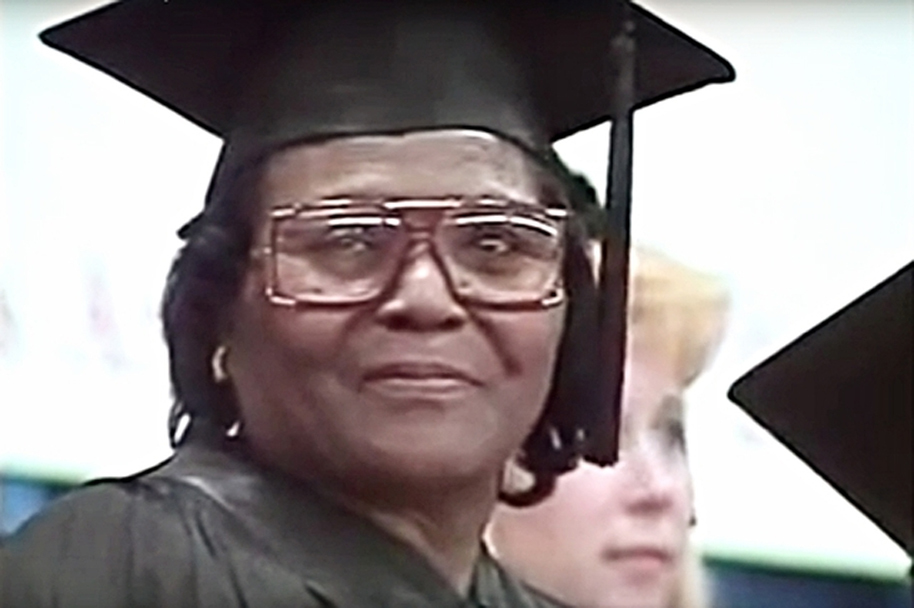
Lucy on her graduation day at University of Alabama in 1992. She had just completed her master's degree in education.
Postscript: Thirty-two years after the riots, Autherine Lucy’s expulsion was annulled. She returned to the University of Alabama and earned a master’s degree in education in 1992. The university named an endowed scholarship after her and hung her portrait in a prominent location.
Sources: Pulitzer Prize Editorials: America’s Best Writing, 1917-2003 (Third Edition), William David Sloan, Laird B. Anderson (eds.), Iowa State Press, 2003, pp. 139-40; The Tuscaloosa News, p. 3, Feb. 12, 1956; encyclopediaofalabama.org