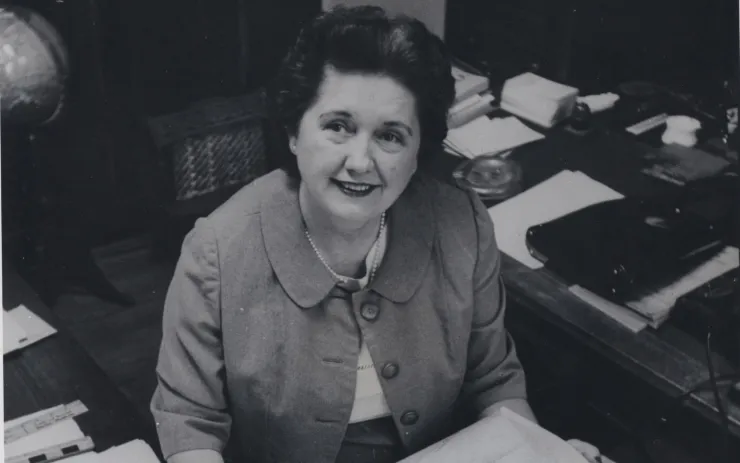
“She was a product of her times.”
You’ve heard that one, of course. It’s usually trotted out as an excuse for the shameful actions or attitudes of those who came before us, a way of saying we should not hold against them their racism, sexism, homophobia or anti-Semitism. The implication is that those things were more common back then, more broadly accepted, so a given woman was helpless to know better. She lacked agency over her own beliefs, so we should give her a pass when those beliefs appall us.
What then, should we say of Hazel Brannon Smith, a 1964 Pulitzer Prize winner for editorial writing? Smith, who would grow up to own and edit four Mississippi newspapers, was born in 1914 near Gadsden, Alabama. As a white woman of that era and place, she grew up believing in Jim Crow, the government-mandated separation of the races in virtually every aspect of life. She was, indeed, “a product of her times.”
Except …
She was also a woman of moral audacity, a woman possessed of that singular component of greatness: the courage to strike out from the pack, to follow conscience to vindication, regardless of the odds. So that, when the Supreme Court struck down school segregation in 1954, when a local sheriff shot an African-American man in the back, it was not in her to ignore it, to pretend she did not feel conscience stirring itself awake and the very earth shifting beneath her feet.
She understood that if her times had shaped her, she had the power, as a journalist, as an American, to return the favor.Thus it was that this daughter of segregation became a proponent of the Civil Rights Movement, an ally of the African-American struggle for freedom. She penned editorial after editorial — several of them reproduced here — decrying white supremacy and all the violence wrought in its ungodly name. Smith spoke out boldly at a time when the price of doing so was often a bullet or a bomb.
But she didn’t stop. Not when friends abandoned her. Not when a cross was burned at her home. Not when two of her newspapers were dynamited. Not when local white conservatives boycotted her paper and arranged to have her husband fired from his job.
In awarding her journalism’s highest honor, the Pulitzer committee praised her “steadfast adherence to her editorial duties in the face of great pressure and opposition." Which was putting it mildly.
Fifty-four years later, that Pulitzer and the woman who won it remind us of the need for journalistic courage. And the reminder could not be more timely.
Fifty-four years later, we live in a time and place when language and behavior demeaning African-Americans, Muslims and others flows like sewage from the highest office in the land. Fifty-four years later, we live in a time and place where journalism — and, indeed, the very concept of truth — are under siege as never before.
And yes, we are products of our time. But the life and legacy of Hazel Brannon Smith prove this is no excuse for failure to be brave. Because our times are also products of us.