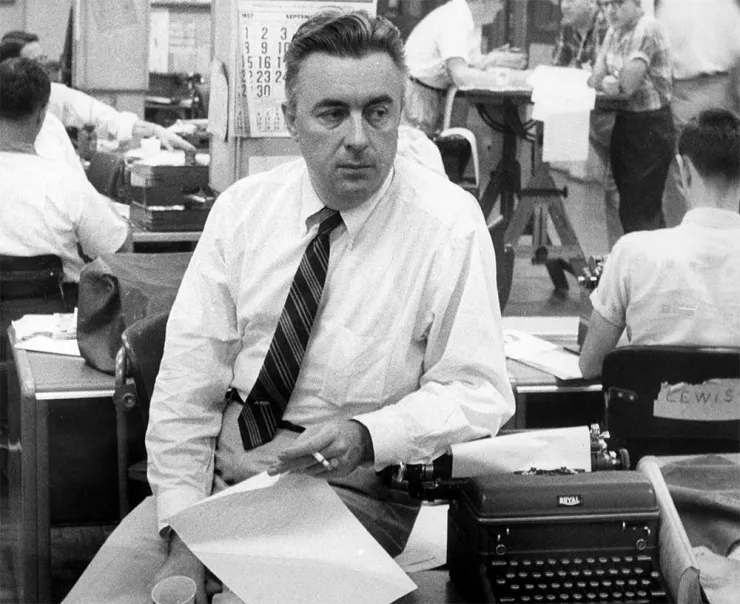
When the NAACP successfully registered nine African-American students at Little Rock's all-white Central High School in the aftermath of Brown v. Board of Education of Topeka (the "Brown II" case), Arkansas Gazette executive editor Harry S. Ashmore was in a unique position.
He had written a critical Ford Foundation report (The Negro and the Schools) on segregated education that had served as a source for the Supreme Court in Brown II and was in the midst of writing a book (Epitaph for Dixie, published by Norton in 1958) that delineated his vision for a progressive South. Ashmore had also effectively salvaged the political career of incumbent Governor Orval Faubus in 1954, ghostwriting a critical speech for the politician when his opponent revealed that he had served as the student president of Commonwealth College, a defunct democratic socialist institution.
What happened next was a matter of history: Faubus deployed the Arkansas National Guard to prevent the students from enrolling on September 4, drawing condemnation from the Little Rock School District and a warning from President Dwight D. Eisenhower. On September 24, Eisenhower federalized the National Guard and deployed the 101st Airborne Division without its African-American members, ensuring that the students were admitted under armed escort. For its coverage, the Gazette received the Public Service Prize in 1958, while Ashmore (who ended his friendship with Faubus) was awarded the Editorial Writing Prize for the "forcefulness, dispassionate analysis and clarity of his editorials" on the integration conflict.
Ashmore would go on to become editor-in-chief of the Encyclopedia Brittanica and president of the Center for the Study of Democratic Institutions, but his work with the Gazette during the Little Rock crisis defined his career. As close friend Bill Emerson recalled at his memorial service, "If you search for Ashmore in the bosky dell—that is, in the grove of academe—he might appear in the distance to be half scholar, half Dionysus, but on an editorial mission that would take no prisoners."
On this final day of Black History Month, we are proud to present Ashmore's editorials for the first time on pulitzer.org. Stay tuned for ongoing updates (including the Gazette's Public Service entry) in the months to come.
Click here to read Ashmore's entry.