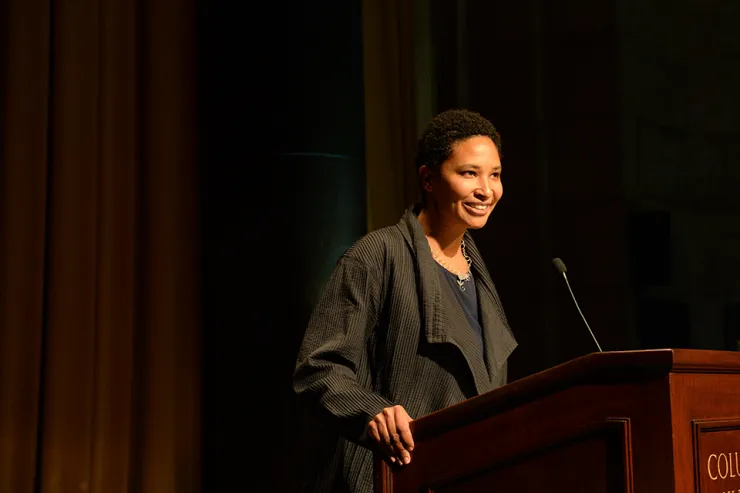
Good evening, President Bollinger, Members of the Pulitzer Prize Board past and present, Winners of the 2016 Prize, and all the agents, editors, publishers, friends, family, and demon-lovers who have lifted up this year’s winners.
What has brought us together under the grand dome of Low Library on this mild October evening? In 1911 Joseph Pulitzer died on his yacht, leaving a will that bequeathed to posterity a school of Journalism and the illustrious Pulitzer Prizes in journalism, arts, and letters, both housed here at Columbia University. The first prizes were awarded in 1917. You, the winners here assembled, are the 100th cohort of honorees. We are here to celebrate all of you, yes, but also to conjure up an oasis of reflection.

Columbia University's Low Library on the night of the 2016 Pulitzer Prize ceremony.
Life expectancies may be lengthening but a hundredth birthday party isn’t yet an everyday occurrence. Is there some accumulated wisdom in a century’s worth of award-winning work? Two years ago, in the fall of 2014, the Pulitzer Board dug through its archive scouting out enduring lessons. We recognized that our Centennial celebration would coincide with a presidential election year. And we settled on four broad themes for public convenings to be held over the course of 2016. These were: Social Justice and Equality; The Presidency, The People, and the Press; Power: Accountability and Abuse; and, finally, War, Migration, and the Quest for a More Peaceful World.
Those have been permanent themes in the Pulitzer archive; they turned out also to be prescient themes for 2016. Two years ago, the Black Lives Matter movement was just getting off the ground and hadn’t yet hit prime time. We were six months away from the Obergefell ruling. The Snowden revelations were recently out. The Syrian refugee crisis was well on the way to its present massive proportions but still going largely unacknowledged by the American public. This year, the U.S. Presidential campaign has plowed all these fields, and the over-heated arguments have been punctuated by a staccato of terror attacks and deaths at the hands of police.
Running alongside all of this, around the country prize winners and loyal readers of newspapers and novels gathered to discuss the Centennial themes. Again and again the same pattern emerged.
Pulitzer-winners exhibit powerful intelligence trained to find meaning even in chaos; they display physical and moral courage and compassion; they refuse short-cuts. Los Angeles Times photographer Carolyn Cole told the story of running into Bethlehem’s Church of the Nativity to cover a siege against Palestinian militants; everyone else was headed out as she went in. We traveled back to the Vietnam War for perspectives that deepen the war’s moral complexity thanks to historian Frederick Logevall and novelist Viet Than Nguyen. Sara Ganim, a 2012 winner for the Patriot-News in Harrisburg, Pennsylvania, shared tales of her after-hours and weekends pursuit of the truth about Jerry Sandusky. New York Times editor Dean Baquet vowed that he would risk jail, in order to print leaked tax returns from Donald Trump.It would, though, be too easy to congratulate ourselves for having laid a timely table for much needed conversation. In fact, our prescience was limited. In one early Centennial planning meeting, we batted around anticipated scenarios for the election year. One colleague predicted that Jeb Bush would easily secure the Republican nomination. I disagreed. I thought something was afoot, that the race might get shaken up. I suggested that the man to watch was Rand Paul. So much for that. None of us, really, saw this year coming.
Why not? Here is my hypothesis. We didn’t see what was coming because we, the community of readers, are now members of a cultural minority. According to data from Pew, as recently as 2005, the majority of adult Americans with less than a high school degrees and above were daily readers of newspapers. This is no longer true. Currently, at best, 40% of adult Americans frequently get news from the family of Pulitzer organizations, whether in print or digital form. In contrast, 57% of adult Americans frequently get news from television, in all its formats. While the absolute number of readers, both print and digital, has increased since print only days for our remaining papers, the share of the population that regularly partakes of text is shrinking. On average people now give twenty minutes of weekend leisure time to reading and 3 and ¼ hours to television.
In the eighteen months leading up to the official start of the campaign, we readers failed to register the country’s pulse. I think this is because we weren’t tracking the whole public conversation. We weren’t even tracking its greater part.
Our attention was elsewhere, and this is plain even from the Pulitzer plan for award. To quote from the Prizes FAQ document: “Broadcast media and their websites are ineligible in all categories.” With these words the Board a few years ago made explicit what had been an implicit, longstanding practice. We were trying to navigate the shifting landscape of “media convergence,” still trying to use problematic categories like “broadcast,” and for all kinds of good reasons, we essentially chose to look away from media that self-identify as “television.” Our averted gaze would perhaps have minimal impact if the majority of Americans still read newspapers and newssites daily, but surely it’s a different story when we, the devotees of text, are in the minority.
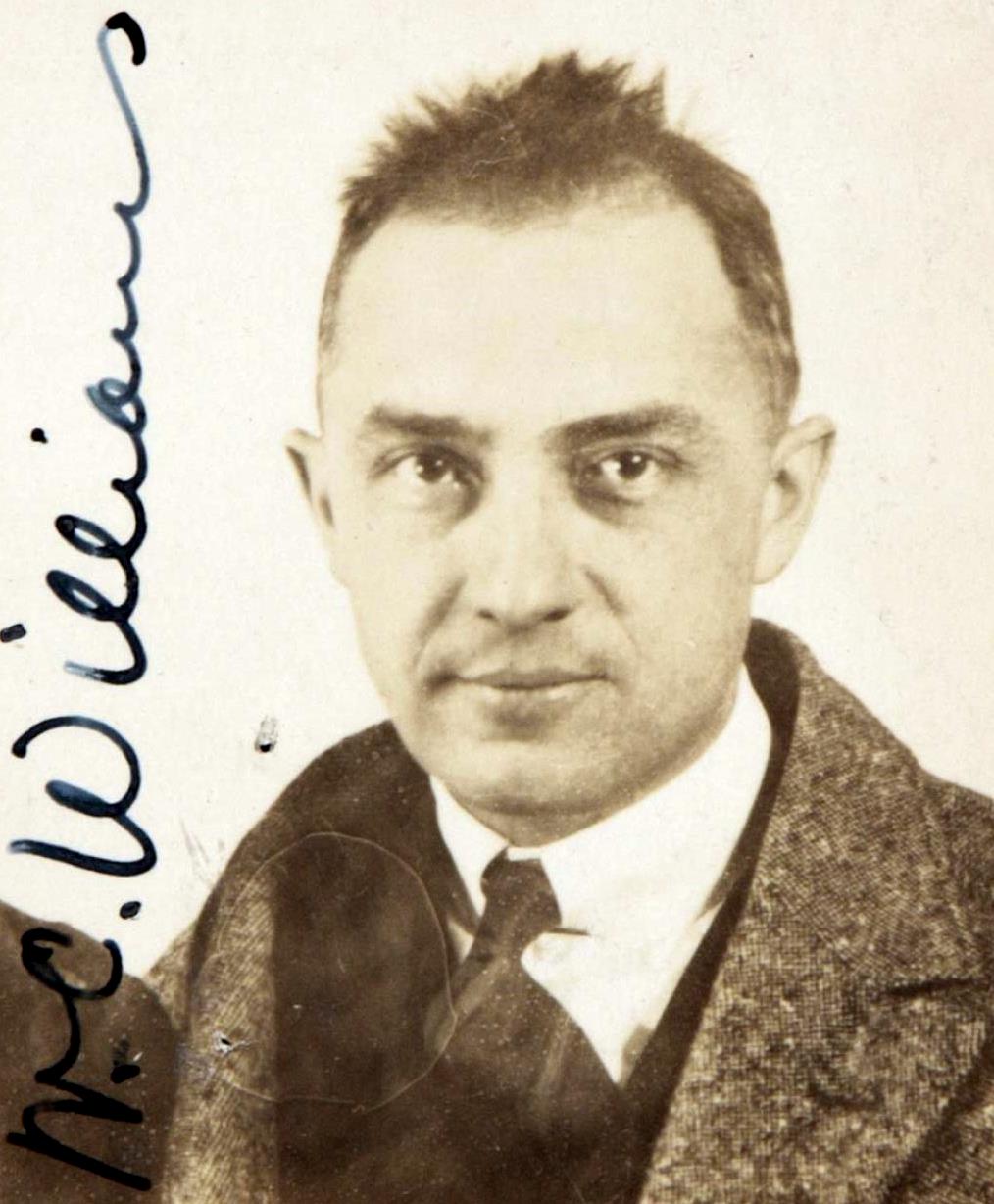
Pulitzer Prize-winning poet William Carlos Williams
By now, I may seem to have strayed, in these remarks, too far into political terrain. The politics of the Prizes. The politics of the country. But I do this out of a sense of urgency. Let me quote the poet William Carlos Williams from a poem called “Asphodel”:
My heart rouses
thinking to bring you news
of something
that concerns you
and concerns many men. Look at
what passes for the new.
You will not find it there but in
despised poems.
It is difficult
to get the news from poems
yet men die miserably every day
for lack
of what is found there.
Our new status as a cultural minority requires our direct attention.
To color in its significance it helps, I think, to return to Joseph Pulitzer’s vision. He wrote: “Our Republic and its press will rise or fall together. An able, disinterested, public-spirited press, with trained intelligence to know the right and courage to do it, can preserve that public virtue without which popular government is a sham and a mockery. A cynical, mercenary, demagogic press will produce in time a people as base as itself.”
The brilliance of Joseph Pulitzer’s plan for the prizes was the decision to wed what in the early 20th century would have been seen as high with low, literature and scholarship with — sorry, folks — the middling register of journalism. The taproot and rootlets of Pulitzer’s papers lay among ordinary readers, working people, and not only professionals. In the words of Seymour Topping, “Pulitzer appealed to the public to accept that his paper was their champion …. This populist appeal was effective, circulation mounted, and the paper prospered.” With the Prizes, Pulitzer ensured that poets and composers and dramatists would win audiences beyond what they could otherwise dream of. He also guaranteed that audiences reading papers like his would extend their education. The gift Pulitzer gave us was the chance to dissolve boundaries between the supposedly “elite” culture of writing salons and universities and the broad culture of all Americans. The solvent was the newsroom. Pulitzer offered an inclusive vision that invited all to partake of the richness of word, image, and sound.
With this deepening of everyone’s education, readers would grow ever hungrier for high standards in their journalism. Newspapers would be the people’s champions but the people would learn how to ask their champions for noble advocacy. At their best, the Pulitzer Prizes establish a virtuous circle of mutual improvement among writers, musicians, scholars, journalists, and people from all backgrounds. Reading, and not just of newspapers, was the link.
Should we aspire to reverse the trend of declining readership? Yes, I think. Fine examples of television journalism abound, but Pulitzer winners especially carry a torch for the highest standards of truth-telling, analysis, and social investigation. Perhaps I merely favor my own tribe, but I would be cheered to see these standards for use of evidence, precision in argumentation, originality and concision in writing spread through the whole cultural fabric.
In our own Centennial celebration, we took up the mission of broadening audiences for our winners’ remarkable work. This feature of our Centennial year is what makes us proudest.
In partnership with the country’s fifty-six State and Territorial Humanities Councils, we sponsored 220 “Pulitzer Campfire” events of amazing diversity and power across 107 different cities or towns throughout the nation. The Iowa Center for Public Affairs Journalism broadcast an interview with 1997 Pulitzer winner Michael Gartner on nineteen different radio stations. In Washington D.C., the Soul of the City Youth Leadership program enabled fifty public high school students to learn and practice journalism under the guidance of Pulitzer-winning journalists. A New Hampshire conference brought together 1,000 high school students to discuss censorship and freedom of expression.
Every one of you is a shining example of Pulitzer’s ideals: a trained intelligence, courage, craft, and dedication. I hope you will therefore pardon me for also saying this: an even greater inspiration lies in what we found with our Campfires Initiative. Throughout the country, despite the trends in reading, there is actually a powerful hunger for your work—for hard-hitting journalism, moving fiction, unsettling drama and spirit-lifting song. It’s time to think big, again. It’s time for all the writers here assembled and for this family of news organizations to reach even harder for the audiences who have fallen away. As they do so, may the journalists of the future, like our predecessors, forge bonds among themselves, the people, and the poets. Along this path lies hope.
Data cited about newspapers is from Pew research. Data about reading generally is from the National Humanities Indicators. The “at best 40%” figure is my best assessment of the evidence on the Pew site rather than a number that can be found there.
The other numbers cited can be found at the following links:
- http://www.journalism.org/media-indicators/newspapers-daily-readership-by-education-level/
- http://www.journalism.org/2016/06/15/newspapers-fact-sheet/
- http://www.journalism.org/2016/06/15/digital-news-audience-fact-sheet/
- http://www.humanitiesindicators.org/content/indicatorDoc.aspx?i=11097
- http://www.humanitiesindicators.org/content/indicatorDoc.aspx?i=13