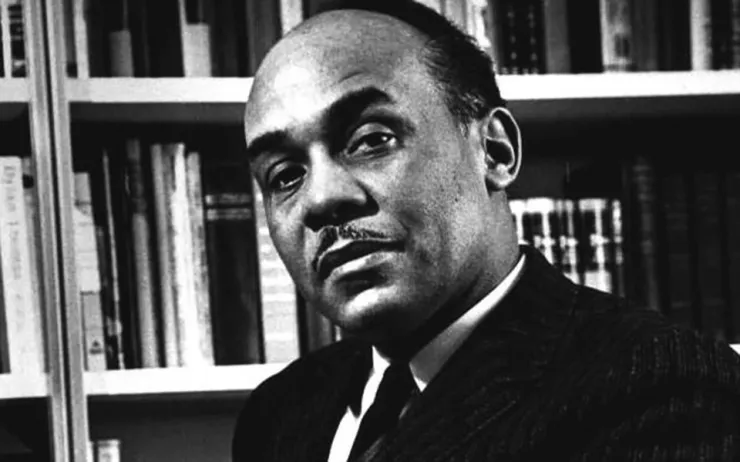
The words seem gratuitous, the Dartmouth professor going out of his way to criticize Invisible Man by Ralph W. Ellison as unworthy of the Pulitzer Prize. The professor, Eric P. Kelly, had already identified The Old Man and the Sea by Ernest Hemingway as his favorite for the 1953 Fiction prize. When he called out Ellison, he was down to the sixth book on his list – the novel Have You Been to the River? by Chancellor Williams.
Williams was an African-American professor at Howard University. His novel was a recasting of the field research for his doctoral dissertation. Here is what Kelly wrote about it in his Pulitzer jury report:
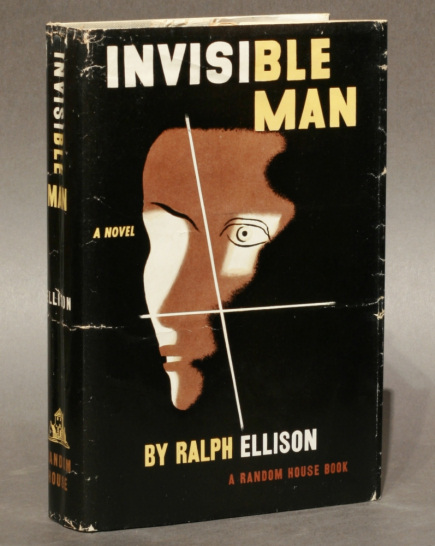
“It is the best book I have read thus far dealing with the negro problem in the United States. It is excellently developed. The scenes are quiet, the power of the author is penetrating. The people are alive and convincing and we are won to them by affection almost. The book is such a contrast to the shadowy, impressionistic sensational story Invisible Man, which despite its power overplays the situation and is guilty of misstatements. The latter book leaves a terrible taste in the mouth, not because it gives a disagreeable picture, but because it shies away from known truths.”
Kelly need not have worried about the chances of Invisible Man in the competition. His fellow Pulitzer juror, Roy W. Cowden, an English professor at the University of Michigan, complained that too many of the entries were humorless novels about whores and whorehouses. Nevertheless, he listed 18 favorites, expounding on the top six. He did not mention Invisible Man.
Thus did a classic of American literature fail to impress the 1953 Fiction jury. The jury and the board chose The Old Man and the Sea, giving Ernest Hemingway his first and only Pulitzer Prize. It was a quarter century later, in 1978, that James Alan McPherson became the first African-American to win the Fiction prize.
It is worth noting that significant reviews published in 1952 did praise Invisible Man, though not without reservation. Here are excerpts.
Commentary, June 1952, by Saul Bellow
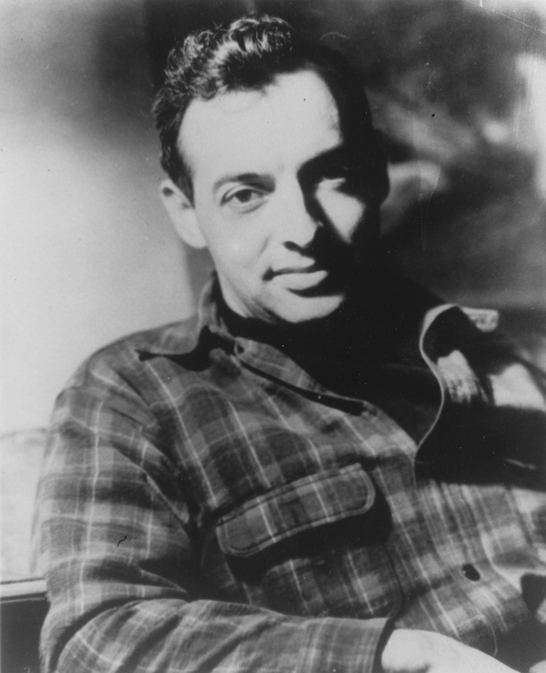
Saul Bellow
“A few years ago, in an otherwise dreary and better forgotten number of Horizon devoted to a louse-up of life in the United States, I read with great excitement an episode from Invisible Man. It described a free-for-all of blindfolded Negro boys at a stag party of the leading citizens of a small Southern town. Before being blindfolded the boys are made to stare at a naked white woman; then they are herded into the ring, and, after the battle royal, one of the fighters, his mouth full of blood, is called upon to give his high school valedictorian's address. As he stands under the lights of the noisy room, the citizens rib him and make him repeat himself; an accidental reference to equality nearly ruins him, but everything ends well and he receives a handsome briefcase containing a scholarship to a Negro college.
“This episode, I thought, might well be the high point of an excellent novel. It has turned out to be not the high point but rather one of the many peaks of a book of the very first order, a superb book.”
New Republic, April 21, 1952, by George Mayberry
“To paraphrase Graham Greene’s already classic remark, ‘I am not a Catholic writer, but a writer who happens to be a Catholic,’ it can be said of Ralph Ellison that he is not a Negro writer, but a writer who happens to be a Negro. . . .
“Invisible Man is a book shorn of the racial and political clichés that have encumbered the ‘Negro novel.’ It firmly establishes Ellison with that small group of writers – William Faulkner, Bucklin Moon, J. Saunders Redding – as an artist in handling his given material. The bane of the problem novel, in particular the ‘Negro novel,’ in America is that the cart of the subject has preceded the horse of artistic sensibility. Having given ample proof of the latter, it can be earnestly hoped that from the underground to which history and human frailty has driven him, Ellison can emerge to write of other places.”
The Nation, May 10, 1952, by Irving Howe
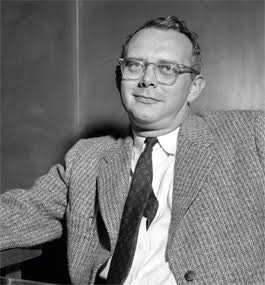
Irving Howe
“This novel is a soaring and exalted record of a Negro’s journey through contemporary America in search of success, companionship, and, finally, himself; like all our fictions devoted to the idea of experience, it moves from province to city, from naive faith to disenchantment; and despite its structural incoherence and occasional pretentiousness of manner, it is one of the few remarkable first novels we have had in some years. . . .
“Some reviewers, from the best of intentions, have assured their readers that this is a good novel and not merely a good Negro novel. But of course Invisible Man is a Negro novel -- what white man could ever have written it? It is drenched in Negro life, talk, music: it tells us how distant even the best of the whites are from the black men that pass them on the streets; and it is written from a particular compound of emotions that no white man could possibly simulate. To deny that this is a Negro novel is to deprive the Negroes of their one basic right: the right to cry out their difference.”
The New York Times Book Review, April 13, 1952, by Wright Morris
“The reader who is familiar with the traumatic phase of the black man’s rage in America will find something more in Mr. Ellison's report. He will find the long anguished step toward its mastery. The author sells no phony forgiveness. He asks none himself. It is a resolutely honest, tormented, profoundly American book."
“ ‘Being invisible and without substance, a disembodied voice, as it were, what else could I do?’ the Invisible Man asks us in closing. ‘What else but try to tell you what was really happening when your eyes were looking through! And it is this which frightens me: Who knows but that, on the lower frequencies, I speak for you?’“But this is not another journey to the end of the night. With this book the author maps a course from the underground world into the light. Invisible Man belongs on the shelf with the classical efforts man has made to chart the river Lethe from its mouth to its source.”
The New York Times, April 16, 1952, by Orville Prescott
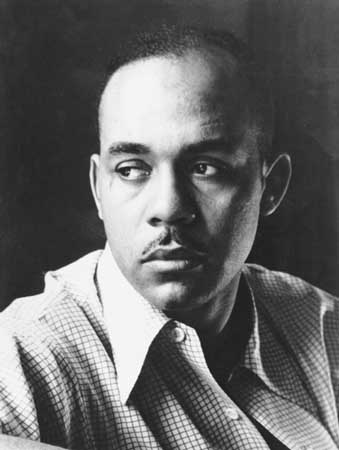
Ralph Ellison
“Ralph Ellison’s first novel, Invisible Man, is the most impressive work of fiction by an American Negro which I have ever read. Unlike Richard Wright and Willard Motley, who achieve their best effects by overpowering their readers with documentary detail, Mr. Ellison is a finished novelist who uses words with great skill, who writes with poetic intensity and immense narrative drive. Invisible Man has many flaws. It is a sensational and feverishly emotional book. It will shock and sicken some of its readers. But, whatever the final verdict on Invisible Man may be, it does mark the appearance of a richly talented writer. . . .
“Mr. Ellison has a grand flair for gaudy melodrama, for savage comedy, for emphatic characterization. He is not interested in literal, realistic truth, but in an emotional, atmospheric truth which he drives home with violence, writing about grotesquely violent situations. With gruesome power he has given Invisible Man the frenzied tension of a nightmare.
“Invisible Man . . . blazes with authentic talent. No one interested in books by or about American Negroes should miss it.”