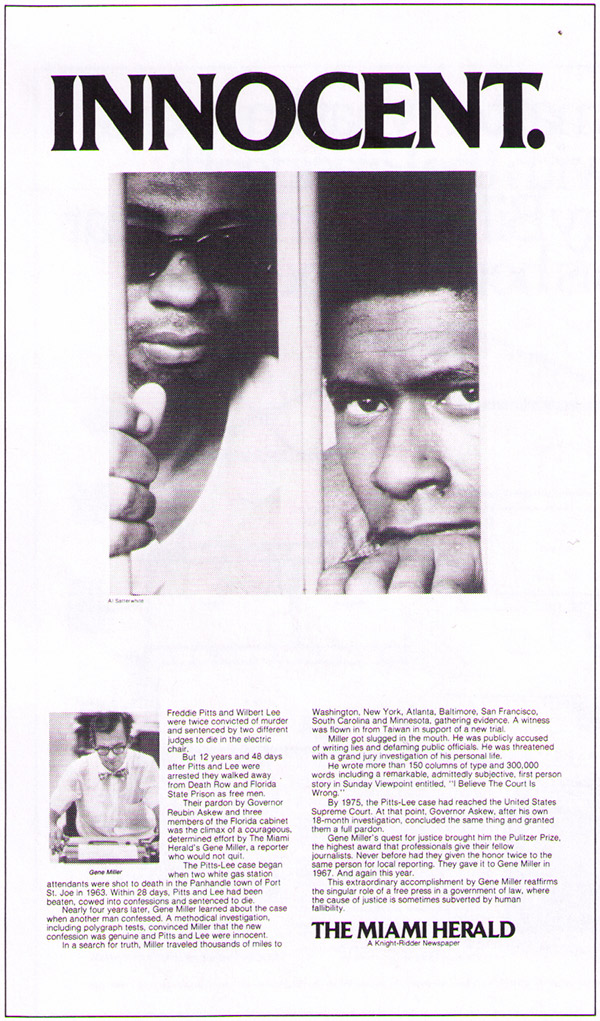
A 1976 Miami Herald ad recognized Gene Miller's work in freeing death row inmates Freddie Pitts and Wilbur Lee.
Gene Miller was a one-man Innocence Project. As a reporter at the Miami Herald, his work earned him two Pulitzer Prizes. Each involved exonerating prisoners convicted of murder because of false confessions coerced by the authorities.
One such case involved Mary Katherin Hampton, a teenager at the time. She had been set up by her boyfriend, by then a vindictive convict, and sent to a Louisiana prison after her confession to two murders. There was no physical evidence she had had anything to do with the crime.
Warren D. Holmes, a polygraph expert and former Miami detective, tipped Miller that the case against Hampton was bogus. When Miller won the 1967 Pulitzer Prize for Local Specialized Investigative Reporting, he said: “My good fortune is directly attributable to my partner, Warren D. Holmes, an honest man.’’
Mary Katherin Hampton was released from prison six months after publication of the story reprinted below, which appeared in the Herald on May 8, 1966.
When she was released, Harris, who had spent five years in prison, said: “I have no bitterness toward anyone. I’d like to be happy and find myself a life.”
Matthew Doig, a Sarasota Herald-Tribune reporter, told her story 42 years later, in 2008. He found her living in a duplex in Georgia. Her life after prison had been difficult.
Gene Miller won a second Pulitzer in Local General or Spot News Reporting in 1976 for stories that freed two Florida death row prisoners.
Miller worked at the Herald as a reporter and editor for 48 years. A column written by a colleague after Miller’s death of cancer in 2005 described his journalism philosophy in these words:
“Put everything in the newspaper, unvarnished. Just ask questions, write down the answers and put them in the newspaper.”
Frustrating fight to free an imprisoned woman
This is a personal account of a 2½-year failure. It is about a girl imprisoned for two murders in Louisiana. Her name is Mary Katherin Hampton. I believe she can be proved innocent.
I want to label this newspaper story clearly. It is opinion.
Let me try to make something clear at the beginning. Most newspapers, this one included, try hard to be fair. I sometimes think that if the 20th Century press could report the crucifixion of Christ, the second paragraph would be an explanation from Pontius Pilate.The point I am trying to make is this: In the case of Mary Hampton, I am personally far beyond a position of so-called journalistic fairness.
The State of Louisiana, I believe, is inflicting a terrible wrong upon Mary Hampton; a wrong judicial and moral. Somehow, by incompetency, by ignorance, by stupidity, by ineptitude, perhaps by sheer carelessness, or possibly by deliberate design, the State of Louisiana erred judicially.
Mary Hampton, in my opinion, no more committed the crimes for which she is incarcerated than did Grandma Moses or Mamie Eisenhower.
Yet, worse perhaps than her imprisonment, is the attitude of the State of Louisiana. It refuses to examine the possibility of error, let alone acknowledge or rectify error.
My opinions, I also realize, are meaningless in a court of law.
I first heard about the plight of Mary Hampton in November 1963, two weeks before the assassination of John Kennedy.
Warren D. Holmes, a polygraph expert, spoke of her. Holmes, basically, is all cop, accusatory and skeptical. Unlike all cops, though, he seeks absolute truth in the investigation of homicide. He tries hard not to play mental gymnastics with himself. He is a highly persuasive and extremely competent interrogator; quite probably, he is the most experienced interrogator of murderers in Florida.
It is not my purpose here to detail the case for the innocence of Mary Hampton, or how Holmes, investigating another murder, first suspected something radically amiss in Louisiana. This has been chronicled previously in this newspaper.
It is appropriate, nonetheless, to scrutinize the peculiar confessions of Emmitt Monroe Spencer, now 35, a condemned murderer awaiting execution in Raiford Prison. He killed a man in Key West in 1960.
Spencer is a liar. He is a man deranged, a man of great cunning, a man of hate and revenge.
With considerable ease five years ago, Spencer duped a sorry-lot police force from the bayous of Louisiana. In effect, he accomplished from inside a prison what he never accomplished outside: The perfect crime.
He got even with Mary Hampton. As a runaway schoolgirl of 17 from the back hills of Kentucky, she lived with him 11 months. Her testimony in Key West put him where he is: Death Row.
Before Spencer duped the Louisiana deputies, he tried the same tactics on officers from Texas, California and Idaho. They didn’t believe him; Louisiana did.
A striking parallel
Spencer tried the same act in Florida. The parallel is striking, and this is the story I want to tell now. You have never read it in newspaper type.
Late the afternoon of Dec. 19, 1959, Clifford Walker drove his jeep down a lonely shell road to his home about 1½ miles northeast of Osprey, Fla. He had only a few minutes to live.
The home is in Sarasota County. It is isolated. Although a railroad track within 100 feet of the house, Walker’s nearest neighbor lived half a mile away. On that cold and rainy day, he parked the jeep, loaded with livestock feed, near a garage. He kept a loaded rifle in the jeep. He left it there.
Unaware, presumably, he walked into his home.
Early the next morning, a friend arrived to go hunting. He sensed something wrong. He suspected asphyxiation. He cut the back screen and entered the house.
In the living room, his hat still on his head, lay Walker, shot once between the bridge of his nose and the corner of his right eye.
But this was not all. A killer or killers, without perceptible motive, also had murdered Walker’s wife, Christine, and their two children, Jimmy, 4, and Debbie, 2.
As Sarasota Sheriff Ross E. Boyer later reconstructed, Christine Walker had quite probably been shot superficially while lying on a bed. He found bloodstains there. Most probably, she struggled with an intruder before a second bullet to the skull killed her.
Oddly, someone had wiped blood from her legs with a quilt comforter, reason unknown. An autopsy indicated sexual intercourse, time unknown. Her body had been dragged three feet across the dining room floor. Investigators found a bloodstained slipper of Christine on the front porch.
The boy, Jimmy, had been shot three times, twice in the top of his head and once in the right cheek. A child’s lollipop stick lay near his body.
Bloodstains led into the bathroom, and there, in the tub, lay the little girl, shot once in the top of the head. Apparently she had not died immediately. Someone had stuffed a shock in the drain, presumably to drown her when ammunition ran out.
It was a brutal, savage and seemingly senseless crime. There couldn’t have been more than $17 or $18 stolen from the home.
The ensuing investigation led nowhere. Month after month, it remained unsolved.
A message from Raiford
Then, from Raiford Prison, came indirect word from Prisoner 00642, Emmitt Monroe Spencer, soon to become America’s most obliging murderer. “Me and Mary Katherin Hampton did it,” he said.
Such an assertion couldn’t be dismissed lightly. Spencer had indeed killed four persons during an 11-month trek from Kentucky to California to Florida in 1959-60.
Sheriff Boyer didn’t believe him. Still, there were elements that needed clarification. He asked the Florida Sheriff’s Bureau for help.
From April 1962 until June 1963, the bureau investigated the Walker murders and Spencer’s confession.
At first, Spencer seemed ambiguous. Yet in subsequent interrogation, he began to get things right. He spoke of the dragging of Christine, a sexual assault. He said she threw a bloody shoe. He mentioned a woven-wire fence around the home. This was correct.
There was a can of Maxwell House coffee in the kitchen, he said, and a picture of a cowboy on a horse on the wall.
The Walkers used Maxwell House coffee. The picture in the living room was of Walker, dressed in a white cowboy hat, astride a Palomino, holding two prize ribbons.
The more Spencer talked, the more convincing he became.
In explicit pornographic description, he related his life with Mary Hampton. He depicted her as a whore, a drunk and an incredibly sadistic murderess; by this time, she was in prison for murder in Louisiana.
He quoted her as she supposedly sashayed from the house. “ ‘I gave that kid the last bath she will ever get in this world. Those goddamned bastards were as poor as us.’ “
Yet, Spencer’s account didn’t quite make sense.
For one thing, he couldn’t produce a shred of evidence. They pressed him hard for physical proof, the murder weapon. At his direction, agents used mine detectors and dug up Oscar Scherer State Park near Osprey. They found nothing.
A terrified girl
The Florida deputies, expecting a ruthless and depraved killer, questioned Mary Hampton. They found a simple, terrified girl of low intelligence. She had a bad facial tic. She could hardly communicate.
She said she and Spencer couldn’t have killed the Walkers because they were in Poway, Calif., until Christmas Day in 1959, six days after it occurred.
Five agents of the Florida Sheriff’s Bureau, E.W. Farris, Robert Cash, Perry Ivey, Clifford Powell,and Norman Desilets, along with Sheriff Boyer, eventually interrogated in excess of 210 witnesses.
Trying to substantiate Spencer’s tales, they catalogued him in 66 cities in 13 different cars, using four aliases, eight weapons and supposedly committing “26 or 27 murders.”
If he was to be believed, he and Mary Hampton had become the most prolific mass murderers in modern history (except for the airline bombers). In theory, they had killed more than Charles Starkweather and Howard Unruh combined. (Starkweather, a Nebraska garbageman, killed 11, then went berserk in Camden, N.J., killing 13.)
For Florida, the truth emerged slowly and painfully. It never emerged in Louisiana.
At the precise time of the Walker murders, Spencer lived in Poway, Calif., as the girl said. He made 17 telephone calls there the week of the crime. He had made six purchases at a lumber hardware company, signing his name. Handwriting analysis proved the signature.
Police even went a step further: They verified the sequence of receipts to make sure he couldn’t have signed them in advance.
Spencer’s employer in Poway had fired him Dec. 21 and paid him by check. Another employer paid him $20 by a check Dec. 28. Both produced the canceled checks. A grocer loaned him money that week. A car dealer argued with him. His landlord found him laying bricks there Dec. 23. A TV store sold him a TV. A friend helped him move a washing machine.
Witness after witness emphatically placed both Spencer and Mary Hampton in California at the time of the Walker murders.
And, eventually, Spencer’s story crumbled, exposed as the glorious fraud that it was. Confronted with abundant documentation, Spencer admitted his phony account of mayhem.
He had brain-picked his interrogators, feeding back facts of the crime. He had read, retained and recited detective magazine accounts. He had enjoyed himself immensely.
Fabricated tales of murder
It is not possible in the confinement of this newspaper article to document other fraudulent Spencer confessions. After 2½ years, I am able to list 33 Spencer “murders,” which, if true, would entitle him to the notoriety of Jack the Ripper.
Suffice to say, putting it delicately, Spencer is full of garbage.
The Texas Rangers once searched the high and byways of Dallas for a corpse Spencer said he buried. His “victim,” a missing person, turned up in East Gary, Ind.
For a while, Spencer had the entire Miami homicide bureau on a magnificent merry-go-round in the Ethel Ione Little case, this city’s most sadistic torture murder. It, too, like the Walker case is still unsolved.
In the course of the Little investigation, Miami detectives traced the true movements of Spencer and Mary Hampton into Florida. They established dates, times, precise locations.
Inadvertently, as a byproduct almost, the detectives here soon had evidence in severe conflict with the Louisiana conviction.
Holmes, as a somewhat stunned police officer, made this clear to Louisiana police in Louisiana in 1962. They did nothing.
Resigning from the force in 1963, Holmes made his opinion public.
I can summarize this oft-reported evidence in two paragraphs:
Someone killed Benjamin Yount, an oil executive, in a bar near Boutte, La., early Dec. 31, 1959. Someone apparently kidnapped the barmaid, Hermine Fiedler, and killed her 75 miles away three days later, Jan. 2, 1960.
During this timespan, Spencer and Mary Hampton were in Florida, not Louisiana. There are five witnesses to this fact, including a Florida state trooper who issued Spencer a traffic citation (No. 49374G) at 10:30 p.m. Dec. 31 near Crestview, Fla. Earlier that same day they were 460 miles from the murder scene.
Finally she broke
This is when I began to share Holmes’ frustration. At the time, we had only superficial knowledge of the Louisiana murders.
We both felt Spencer had merely duped a few unwary policemen, a forgivable error.
Then came this shocker: The Louisiana deputies knew full well of some of the gross inconsistencies. They themselves had interviewed three key alibi witnesses – and suppressed the statements. (We now have photostatic copies.)
This is what had happened: They had listened to Spencer’s unsworn rambling at Raiford Prison, hurried to Mary Hampton’s home at Sandy Hook, Ky., persuaded her to waive extradition to help them “identify a few things,” put her in shackles and handcuffs, and charged her with first-degree murder. This was in February 1961.
Day after day they interrogated her, demanding a confession. For nearly six weeks, often crying and screaming, the girl denied guilt.
Mary Hampton was 19 then, terrified, frightened, emotionally unstable, and overwhelmed with guilt for having lived with Spencer. Out of wedlock, she had given birth to his son.
Then, suddenly, she broke.
In desperate fear of the electric chair, she pleaded guilty “without capital punishment.”
There was never a formal confession. There was never a scrap of corroborating physical evidence in a courtroom.
Her court-appointed lawyer never asked her if she, in fact, committed the crimes. In another parish, she didn’t meet her lawyers until a few minutes before sentencing.
I’ll never forget
There is a childhood verse, sung to “London Bridge,” which goes, “Off to prison you will go, you will go.” As if in cruel parody, Mary Hampton, the child-woman, went off to prison. This was five years ago last month.
I’ll never forget the first day I saw that prison. You walk through the gate and you walk into the last century. St. Gabriel, it is called; named after the archangel of the Bible, trumpeter of the Last Judgment, Angel of Truth. A big dog with a rat clenched in its teeth walked in the gate as I walked out.
Holmes and I paid our respects that day, Jan. 13, 1964, to Capt. John Thomas, now major, a detective chief for the Louisiana State Police. He had worked on the initial phases of the double murder.
“See these gray hairs?” he asked, running his palm over his head. “That girl gave them to me.”
His wife, he said, had mailed packages to her at the prison. To me this didn’t appear to be the act of anyone convinced of the imprisonment of a vicious killer.
The captain spoke of a deputy who took the Spencer “confession.” For purposes here, he can be known as Old Joe. Years ago, the captain explained, Louisiana used a portable electric chair which went from parish to parish for executions.
Old Joe had an execution in his parish one day, and “he strapped in the nigger” and pulled the switch. But nothing happened. The power had failed. Old Joe was so angry he grabbed a pipe to personally execute the order of a court. Wiser heads prevailed.
We left the captain’s office with a borrowed 300-page transcript of the deputies’ interrogation of Spencer at Raiford.
With the aid of a prison priest, we Xeroxed the entire transcript in a Catholic seminary office in New Orleans that night, and an incredible document it was indeed.
Here, from the deputies’ own interviews, we learned that Spencer had not known the location of the crimes, the dates or the times of the crimes, the cars used or the weapons used. He claimed “me and Mary Katherin” walked into the Boutte bar carrying eight different guns. (He wanted to make sure he would guess the caliber of the murder weapon.) He had up to seven persons committing the crimes. The deputies had found only Miss Hampton.
A quiet approach
By dawn the next morning, Holmes and I had much of the information organized for a hearing before the Pardon Board scheduled weeks before.
Naively, we thought a hat-in-hand approach, quiet, polite, diplomatic, civilized and, most important, without accusations, would be the most intelligent way to help the girl.
It took us two years to fully realize how wrong we were.
Holmes began politely, stating he felt an innocent girl, through error, had been imprisoned wrongfully.
“Are you implying dishonesty, sir?” a board member asked. He spoke of upright, experienced and honorable investigators of two parishes, the results accepted by two honorable district attorneys, the indictments by two honorable grand juries. “And furthermore,” he said, “the woman pleaded guilty, didn’t she?”
To his dying day, Holmes will regret he failed to give them a straight answer. “I should have said, ‘The state framed her.’ ”
The board didn’t have time to listen. Submit a brief, it suggested.
“Of course, we don’t want an innocent person to die in prison,” said the attorney general, Jack Gremillion. For the benefit of newsmen, he announced “an investigation and reopening of the case.”
To this very moment, I am unaware of anything his office ever did to either substantiate or disprove Spencer’s movements in Florida during the crucial hours of the crimes in Louisiana.
Yet, at this juncture two years ago, we had far more trouble than we realized.
We had inherited a lawyer, retained by a prison priest who believed Mary Hampton innocent. The plight of Mary Hampton, to put it mildly, was not a popular cause among Louisiana politicians. Both the attorney general and the lieutenant governor are on the pardon board. Peculiarly, so are the sentencing judges for each case under review. In the Hampton case, this meant two judges because crimes were committed in two parishes.
This lawyer No. 1, a politician to the marrow, couldn’t have been less interested in disputing the board. Much later I discovered lawyer No. 1 had a $10,000-a-year state job.
Even then, it soon became apparent that if a brief was to be submitted, Holmes and I must write it. We did. We are not lawyers. The brief ran a tight 50 pages and argued only the fact of the case without legal citation. With it, when submitted, went a 7¼-pound appendage of exhibits.
A big-name lawyer
But we had labored under bad legal advice: Give the State of Louisiana the opportunity to correct a miscarriage of justice, we were told. Don’t force. Don’t push. You will only keep the girl in prison longer.
Twice we went this route, asking the Pardon Board for a commutation of sentence from life imprisonment to ten years and six months. “Ten and six,” it is called, and this would have made Mary Hampton eligible for immediate parole.
Frankly, Holmes and I weren’t too concerned with legal exoneration. Our goal was simpler: Get her out.
It didn’t work. Upon the last occasion, a few months ago, the two sentencing judges voted for commutation. The lieutenant governor disqualified himself. But the attorney general said, “I don’t think she has served enough time.” Guilt or innocence wasn’t an issue.
Over long months of unanswered letters, unreturned telephone calls, unfiled motions, unexplained inactivity and futile journeys to New Orleans, it became apparent that lawyer No. 1 couldn’t carry the freight. Neither could another lawyer brought in to share the burden. Both were fired.
There is no satisfaction in firing a do-nothing lawyer who is working for nothing anyway: only frustration.
Holmes and I, meanwhile, had gone to what we consider one of the finest criminal lawyers in the country, F. Lee Bailey, a young, brilliant, polished and, when necessary, courtroom-mean attorney from Boston. He is the appellate attorney for Dr. Sam Sheppard.
Bailey, a man with a pressuring national practice, accepted the Mary Hampton case without fee. I told him the only thing I could do for him was spell his name right in a Miami newspaper.
Bailey was considerably more philosophical about lawyers No. 1 and 2. “I’ve been sandbagged by experts,” he said.
Bailey obviously needed competent co-counsel in Louisiana, and I turned to an ex-Herald staffer, Leo Adde, now a New Orleans TV reporter, for a stand-up lawyer unafraid of severe abrasion. Adde produced him, Salvator Anzelmo. And Anzelmo came without fee.
Bailey had disapproved of the Pardon Board approach. He wanted a direct attack in the courts, and soon the judge in St. Charles Parish ruled. As a matter of law, he said, he had no power to allow Mary Hampton to withdraw her plea of guilty.
Anzelmo wrote the appeal to the Louisiana Supreme Court. Not expectedly, the reply came back in two words: “Writ denied.”
This is called “exhausting state remedies.” It is a step usually required before the federal courts will listen.
I would be less than candid to suggest all this occurred smoothly. All of us became embroiled in our own personal problems of making a livelihood, fighting other battles in other wars, and the Hampton case often lay idle, untouched, hanging fire in legal limbo.
We’ll prove she didn’t do it
On March 31, 1966, we walked into a federal district court in Baton Rouge for the first time on a show cause hearing on a habeas corpus petition.
This is necessary before anyone is allowed to testify. The question before the federal court is not guilt or innocence, but did Mary Hampton receive a fair trial? Was her plea coerced? Were her constitutional rights violated? Should the State of Louisiana be forced to grant her a new trial?
With affidavits from her court-appointed parish lawyers, the state took the position that her guilty plea had been free and voluntary, and furthermore, she had not exhausted her remedy in the state courts.
Federal Judge G. Gordon West, unfamiliar with the case at first, said, “I don’t see anything complicated about this matter.”
Then Lawyer Bailey began to speak. “Your Honor,” he said, “we can prove that the petitioner is innocent of the crimes for which she is incarcerated.
“Is it my understanding,” the judge interrupted, “that there never was a factual admission of guilt? Only judicial?”
“Yes, sir,” said Bailey.
The prosecutor for St. Charles parish argued against a full evidentiary hearing. “Are we going to permit people from Florida to come here and tell us about this old case?” he asked.
“I may permit evidence from England or Russia,” said the judge. The judge asked that both sides file memoranda on the law on whether the case still properly belongs in the state courts.
Bailey filed last April 27. He wrote of a frank and cooperative effort he made a year before to ensure only one trip through the state courts would be necessary. His letter went unanswered.
“While the Attorney-General of Louisiana has no duty to lead advices to counsel seeking to attack a state judgment, he has no legitimate interest in protracted and unnecessary state litigation… We respectfully request and urge this court to take jurisdiction of the petition, and to dispose of it upon its merits,” he said.
Her only crime
This is where the case stands now. The federal judge could rule to hear the witnesses; he could rule not to at this time.
In my own mind I have tried to understand what truly happened in Louisiana five years ago. I suspect that Mary Hampton’s abrupt plea of guilty more or less shocked the deputies.
(For the same crimes, they had previously held an innocent man in jail for 58 days for interrogation – and he didn’t plead guilty.)
I suspect they began to rationalize. Like Spencer said, they began to believe that Mary Hampton was all bad, a lesbian, a whore, a shrew, a fiend, or to use his words, “a no-good bitch.”
Had she lived with him when he killed four people? Why hadn’t she left him? She belonged in prison, any prison.
In Miami, I sometimes hear a more sophisticated view. “She is not a sympathetic person.”
The truth, I believe, is that Spencer, 12 years her senior, a man cunning enough to befuddle some reasonably astute Florida policemen, totally dominated a pathetic human being. This he accomplished by wit and brute force.
Mary Hampton, in fear of her life much of the time, and if you will, a stupid girl, lived with a killer who had her pregnant. This alone is her crime. She survived in the next thing to captivity.
I get her letters from St. Gabriel, stamped with the red C of the censor. “Mr. Miller, I can’t stay here much longer and remain a sane person. I can’t face another disappointment. There isn’t much justice for me.”
In the book Gideon’s Trumpet, there is a statement from a sensitive Miami lawyer:
“It has become almost axiomatic that the great rights which are secured for all of us by the Bill of Rights are constantly tested and retested in the courts by the people who live in the bottom of society’s barrel.
“Upon the shoulders of such persons are our great rights carried.”