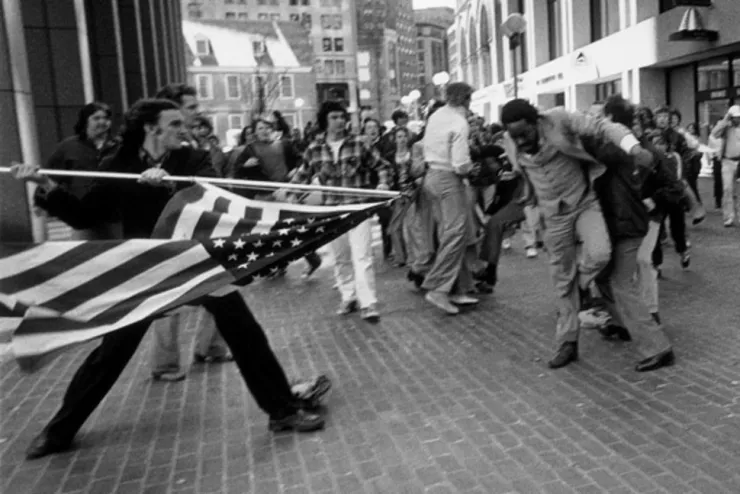
Stanley Forman’s dad liked to chase police cars and fires. Sometimes Stanley went along. Even as a kid he considered himself “a spark.” The spark became a news photographer for the Boston Herald American, where his pictures won Pulitzer Prizes for Spot News Photography in 1976 and 1977.
He described how he took these pictures in an interview with Karen Rothmyer for her 1991 book, Winning Pulitzers. His story began on July 22, 1975, as Forman walked past the assignment desk at the Herald American and heard the fire department put out an alarm — a “box” in the vernacular. Here, in Forman’s words, is what happened next.
‘Two more seconds and I would have had them’
“The first call I heard was Engine 33 and Ladder 17. Within thirty seconds a box came in and instead of an engine and a ladder they were sending three engines and two ladders and a chief. They were talking about people trapped in a building.
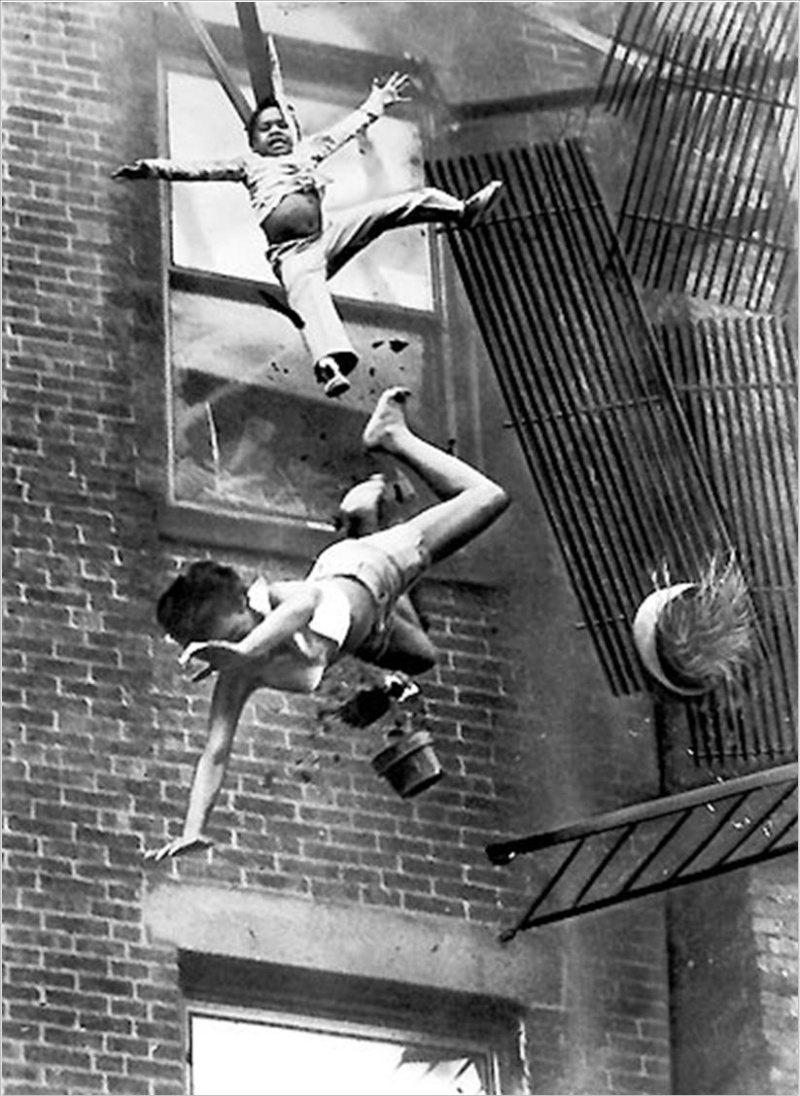
Stanley Forman's prize-winning photo of a mother and child falling from a fire escape.
“Well, I ran out of the newsroom. I didn’t even know exactly where it was, but I knew it was the Back Bay because the box was a 1500 area box. I went up Harrison Avenue toward the South End and there’s a fire station there, Engine 3, and Engine 3 was just going out on the box and I got behind them. We got to Boylston Street and of course Engine 3 went through the red light and there was a damn mail truck that wouldn’t let me go through, but I finally got around him.
“The fire was on Marlborough Street, Dartmouth and Marlborough. I parked the car and they were still screaming, ‘Get a ladder truck to the rear of the building’ ‘Ladder truck to the rear of the building,’ so I ran down to Marlborough and I saw there was heavy, heavy smoke pouring out the windows.
“I ran to the back of the building and when I got there a firefighter was climbing off the roof onto the back fire escape and below him a woman and a child were huddled next to the window, just ducking down. They moved the engine company that was there out of the way and a ladder truck came down the alley and parked and I got some pictures of the firefighter up there. I climbed up onto the bed of the truck where the ladder rests so I’d have a little more height and a little better angle. I had my motor drive on, set for three frames a second.
“As far as I was concerned it was just going to be another good ladder rescue picture. The ladder was going up and the firefighter who’d come down to the roof was guiding it toward the fire escape. He was going to climb onto the ladder, the woman would hand him the baby, he would hand the baby to a firefighter coming up the ladder from the bottom, then he would help her onto the ladder and they’d be out of there. Routine ladder rescue.
“And then the fire escape let go. I was just shooting as they came down. At the end I said to myself, ‘I don’t want to see them hit,’ and I turned around. As it worked out the woman and the baby fell behind a fenced area. I couldn’t have seen them hit anyway. When I finally turned around again, people were screaming and yelling and there was the fireman who’d been on the fire escape, hanging onto the ladder by one arm, like a monkey. He had all his gear on but managed to hoist himself back up onto the ladder.
“I came back off the ladder truck and of course I was shaking. The little baby had already gone in the ambulance and the woman, who was the baby’s grandmother, was still on the ground and they were trying to revive her. I was going to switch lenses, but I couldn’t find my 20 mm lens and all of a sudden I started thinking, ‘Oh my God, I lost my lens, I’m going to be in the shit now’ — these are the things going through your head.
“Then I decided I better get out of there. I always have this fear that a well-meaning relative is going to rip the camera off my neck so I always run as soon as I’ve got my pictures. So I was running out the alley and there was the firefighter who’d been on the fire escape. I went up to him and I said, ‘Nice job’ — I didn’t know what to say — and he was looking at me, dazed, and he kept saying, ‘Two more seconds and I would have had them, two more seconds.’
“I raced back to the office and I walked into the office of my boss, Myer Ostroff, and I told him what I had and I said, ‘If these pictures don’t come out, I won’t be in to work tomorrow and I might never come back.’ I developed the film and he looked at the negatives and he saw that I was a nervous wreck and he said, ‘Stanley, do me a favor, just go over there and sit back.’ Myer wrote a note to the publisher who was in the middle of a meeting and he came in and he looked at the pictures and he said, ‘Did anybody else get this?’ And my response was, ‘I don’t know but they didn’t get anything better than I did.’
“Later I went home and about eight o’clock that night Dennis Brearley, a photographer, called to tell me the baby was all right but that the woman died. And I said, ‘Do you think they’re still going to run the pictures?’ I really said that. ... And he said, ‘Oh, sure.’ That night there was a fire in the North End and my neighbor called me and we went out about two o’clock but it was nothing. Afterward we stopped in a store to see the paper and I said, ‘Oh, wow!’ I couldn’t believe it. I had the whole front page plus all of page three. ...
‘If it’s your day, it’s your day’
“Before I knew I won the first Pulitzer, I’d already taken the picture that won the following year. ... I was in the office one day (April 5, 1976) and I went up to the assistant city editor, Al Salie, and I said, ‘What’s doing?’ and he said, ‘There’s an anti-busing thing down at city hall,’ and he said one of the other photographers was there. And I said, ‘Can I go down there and help out?’ — not thinking there would be any trouble, just wanting to get out of the office.
"There was a protest practically every day at that time. There was periodic violence and protests, and you know, it was spring and these kids were skipping school to come down to city hall.
"So I went down there and I parked and I sauntered in and as I was walking up the steps to the council chambers where the group was, they were coming down. So I was in front of them and all the other photographers were behind them or in the middle. It’s like hitting the Megabucks; if it’s your day, it’s your day.
“As they came out onto the plaza, there was a group of blacks about to go on a tour of city hall. There was a little scuffle right on the steps so I switched to a wide angle lens to get it all in. Then they started walking down toward the old statehouse and I happened to look up and I saw this black man taking the corner and I thought, ‘My God, they’re going to beat him up.’
"It was like the gauntlet, everybody started taking a punch. I could hear that the camera wasn’t transporting the film right so I started shooting single frame, and of course I had this super-wide lens on so I had to be within a few feet of what was going on to get a big enough image of the action. There was another black guy who happened to stroll by and he just got himself out of the way. But the first guy was caught. One of the high school kids happened to have a flag in his hand, I guess, because the group had had the flag with them, so he used it as a weapon. There was no significance to that fact, but there was no thought of ‘Let’s not do it with the flag’ either. Then the cops moved in and it was all over.
“So that was the second Pulitzer. It didn’t get as much play as it should have because that same day Howard Hughes died. The top of the paper was ‘Howard Hughes Dead,’ and my picture was below the fold.”
Source: Winning Pulitzers: The Story behind Some of the Best News Coverage of Our Time, by Karen Rothmyer, Columbia University Press, 1991, pp. 154-58.