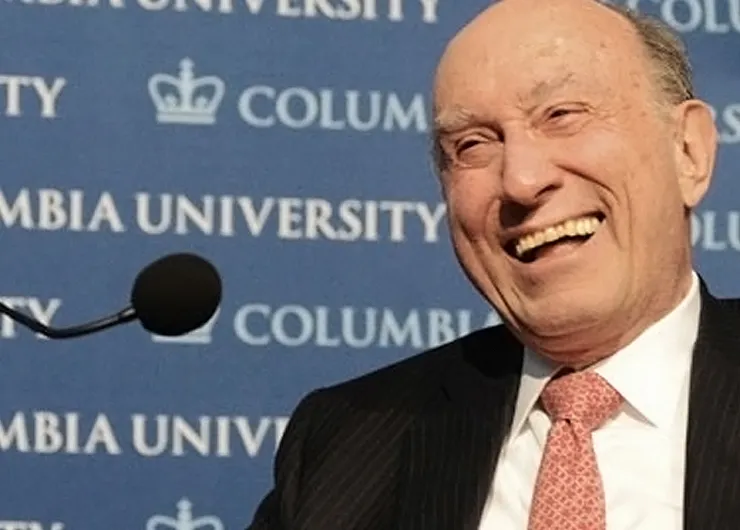
When Columbia President Michael I. Sovern addressed the 75th anniversary banquet of the Pulitzer Prizes, he was the senior member of the board that presents the prizes. The president has a voting seat, and Sovern was in the 11th year of a 13-year run.
In his audience that day – Sept. 22, 1991 – were the winners of the prizes that year and many of their predecessors. To name a few, they included Peter Arnett, Dean Baquet, Herbert Block, Daniel J. Boorstin, Taylor Branch, Art Buchwald, David Herbert Donald, Roger Ebert, Horst Faas,, Susan Faludi, Jules Feiffer, Alex Haley, Marvin Hamlisch, Oscar Handlin, Oscar Hijuelos, Justin Kaplan, William Kennedy, Carolyn Kizer, Anthony Lewis, J. Anthony Lukas, Ann Marie Lipinski, David Mamet, Robert K. Massie, Mary Oliver, Carl Sagan, Harrison Salisbury, Sydney Schanberg, Karl Shapiro, Neil Sheehan, Neil Simon, John Updike, Wendy Wasserstein, John Noble Wilford and Edward O. Wilson.
Sovern’s message to them was not rosy. He called upon them to right a country that had lost its sense of direction. Here is an excerpt.
‘The enduring recognition of high responsibility’
By MICHAEL I. SOVERN
I suspect this year’s recipients have already wondered: how do I top this? The answer is everywhere in this assembly. Pulitzer Prize winners do not rest on their laurels. They believe with George Eliot that “The reward of duty is the power to fulfill another.”
That expectation would have pleased the first Joseph Pulitzer, who looked upon the Prize not as a fleeting celebration of one-time achievement but as the enduring recognition of high responsibility.
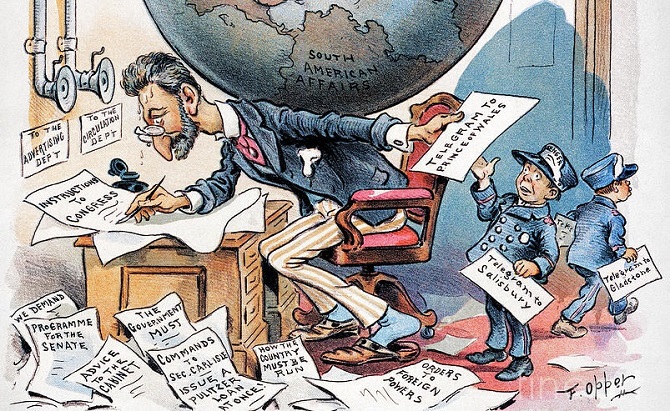
Cartoon by Frederick Burr Opper (1857-1937)
It was one year after the awarding of the first Nobel Prize in 1901 that Joseph Pulitzer originally conceived of the Pulitzer Prize. The idea, bred of his belief that journalism is a high calling, was of a piece with his founding of the Columbia Graduate School of Journalism. It took almost 15 years to bring the Prizes into being and by then America was at war and the world was on the brink of transformation.
Since then, a hundred new nations have been born; old and new empires have died, from the Ottoman to the Soviet. Mass migrations to the cities and mass migrations out of the cities; a racial revolution and a sexual revolution; communications, computers, space travel, medicine – the whole unbelievable burst of science and technology: all these and much more have characterized the astonishing years of the Pulitzer Prize.
Woody Allen believes that we have arrived at a “fork in which one road leads to despair and the other to extinction.” He asks “God to grant us the wisdom to make the right choice.”
While I persist in the native notion that our choices are somewhat broader, we do pause to take stock today, just as we did a quarter-century ago when Archibald MacLeish, borrowing from Yeats, urged his Prize winning colleagues to “Draw rein, draw breath,/Cast a cold eye/On life, on death…”
In linking a group of prizes to Columbia, Joseph Pulitzer expressed the hope that this would encourage “public service, public morals, American literature and the advancement of education.” The spirit in which he began is the spirit in which we continue.
Columbia is very proud that one of the most influential journalists in American history, the man who brought America the Statue of Liberty, chose this University as the foundation on which to build the Pulitzer Prize.
As we present this year’s Prizes, and honor past and continuing attainments spanning the world of art and ideas, we are especially mindful of the central commitments shared by scholars, journalists and artists in an open society.
They are, first, to truth. Let us remember this well in the months ahead as reams of newsprint are devoted to a national campaign in which, we may safely predict, hardly a single candidate of any party will utter a hard truth spelled t-a-x-e-s.
Yet for all its faults, we will watch the campaign closely, for we here are bound by another common commitment – to freedom. We know that wherever tyranny takes hold, whether of the left or of the right, the first targets of oppression and censorship are the forums of education, journalism and the arts.
Today, the principles we stand for are triumphant in places we had not dreamed would be free. But will they remain so? In the long course of human history, triumphs are followed by defeats, freedom is often broken under the wheel of tyranny, and the complacent pay a terrible price.
Constant vigilance, the quest for truth, the exercise of freedom, the performance of public service, the expression of talent or genius – these qualities and attainments are implicit in the awarding of the Pulitzer Prize.
And all of them serve the Pulitzer Prize winner’s most powerful attribute – a moral vision.
That vision need not be profoundly philosophical or religious or zealous. It need not be expressed explicitly or with gravity or with a hammer on the head.
I refer to an underlying sense of what our world should be; a vision of more justice and kindness than we will ever achieve, but toward which we must strive if we are to be something more than brutes.
It is the quality that Joseph Pulitzer sought to honor when he made his bequest, and it is still the quality that animates the distinguished work produced by winners of the Pulitzer Prize.
It is a quality that we in America need badly.
You know, I am sure, that ours would be a far better country if more people obeyed just two of the Ten Commandments. Any two.Unfortunately, the moral confusion of our nation is no laughing matter. We are a people almost accustomed to hearing from leading citizens the statement: “I have done nothing wrong; I have broken no law” – as if the two were synonymous.
In important respects Americans today live by higher moral standards than their grandparents did. States may not decree that one race is inferior to another. Coal miners may not be sent into death traps. Corporate “insiders” may not capitalize on secret information to unload stock on an unsuspecting public without risking arrest, humiliation and prison. And there is much more that has been created in the law through changes powerfully influenced by you, your colleagues and your predecessors.
But aren’t we still missing something fundamental? My good friend and Columbia colleague, Dr. Willard Gaylin, has spent much of his life exploring the moral issues posed by modern medicine. He worries about such things as triage, genetic choice, the boundaries of life and death. Yet he has come to believe that the most pressing ethical issue of our time is the rediscovery of community; that in the joy of our boundless freedom in America, we have lost the sense of sacrifice, of limits on our authority, of service to others.
Einstein saw it coming when he observed the perfection of our means and the confusion of our goals.
Yet from the life and work of Einstein we have learned exactly the wrong lesson. In 1991 we Americans have developed the smartest bombs in the world, and we have developed children with no sense of history.
We debate whether to splurge on stealth bombers – $865 million each – while we scrimp on one of the most cost-effective contributors to our national strength – scholarships and fellowships for students.
This year the federal deficit will exceed a third of a trillion dollars – two and a half times the deficit of four years ago – and what have we to show for it?
We have a society where the quick buck of the moment looms larger than national productivity, visionary research, social justice and investment in our future.
We witness a national theater of the absurd where lip service is displayed unabashedly for what it is, as the photo op for a bill is accompanied by an announcement that the program will not be funded.
I am reminded of the story that has John Maynard Keynes, that true genius of the dismal science, if at times somewhat absentminded, seated on a train, frantically searching for his ticket as the conductor approached. The conductor recognized him immediately and told him not to worry, the ticket could be sent in whenever he found it. But Keynes remained distressed. “I have to find it now!” he said. “The problem is not where is my ticket; the problem is, where am I going?”
Today, in this great land of achievement and opportunity, we as a nation don’t know where we are going. We have little sense of our future, no concept of national priorities. Differences accumulate as the ties that bind us fray. Vacuous slogans dominate the national response to the crisis in our schools. We are dragged kicking and screaming to agreements protecting the global environment. Attacking the roots of crime arouses less interest than erecting prison walls with revolving doors. Compassion for the helpless, a source of Joseph Pulitzer’s personal strength and of the popular success of his crusading journalism, is now widely considered sentimental, not the business of government.
This is not a partisan matter. Neither the administration nor the opposition is pointing the way. We have hard choices to make. If we do not make them explicitly, they will be made by default, and our children and grandchildren will have to live with the consequences.
Who, then, can show the way? Not simply in negotiating stopgap measures, but in setting forth the principles, the goals, the national agenda on which we as a country and as individuals should be working at this very moment.
Who can make it clear to the American people that we must see beneath and beyond the skirmishes for political advantage and make fundamental, guiding choices?
Who can help us leave old antagonisms behind and follow our own best instincts; help us to a confidence born of understanding in place of fears bred in ignorance; help us put the petty and the trivial in their place so that we can seek what William Saroyan called “that which shines and is beyond corruption”?
I believe that the greatest force for the public good in America today is to be found in that powerful triad of scholars, journalists and artists represented by the people and the work we honor today.It is with that recognition foremost that I am very proud to welcome each one of you to the 75th anniversary of the Pulitzer Prize. Thank you.