For the Record


A devastating COVID surge takes a fresh toll on Indian journalism

Journalists in India Face Pandemic Surge, Press Restrictions:


Journalists in India are confronting a surge in COVID-19 cases (exemplified by overflowing crematoria and a disputed death count) alongside "a period of deteriorating freedoms for the press," Jon Allsop of the Columbia Journalism Review reported Tuesday. In recent years, women and minority journalists "have faced a rash of online abuse, as well as physical violence at the hands of officials and civilians tied to the Hindu-nationalist government of Prime Minister Narendra Modi," which has manipulated newspaper and television coverage "via a system of financial and regulatory carrots and sticks." Observers have cited the case of Siddique Kappan, a journalist who was initially detained last October while covering a gang-rape case and has been reportedly chained to a hospital cot after being diagnosed with the virus. "Western media should avoid treating India’s surge as a sad event in a distant land [...] and treat it instead as part of an interconnected, global story that we are all still living," said Allsop. "The same goes for India’s deteriorating media climate: An attack on press freedom somewhere is an attack on press freedom everywhere — and that’s especially true when the story concerns all of us."


YouTube Ad Revenue Tops $6B in First Quarter

YouTube Revenue Tops $6 Billion in Q1:


YouTube "brought in more than $6 billion in advertising revenue in the first quarter of 2021," marking a year-over-year increase of 50% following initial tumult stemming from the "pandemic advertising drawdown," according to Alex Weprin of The Hollywood Reporter. The Google-owned video platform also is "increasingly playing hardball in distribution negotiations involving its flagship app and its YouTube TV live TV service," with digital media player service Roku recently alleging that Google demanded prioritization of YouTube content in search results and the use of chips "that would force the company to raise the prices of its hardware." Parent company Alphabet "overall brought in $55.3 billion in revenue, with net income of $17.9 billion."

Spotify launches paid podcasts through new Anchor feature

Spotify Launches Paid Podcast Subscriptions Following Apple Announcement:


Beginning Tuesday, podcasters who employ Spotify-owned podcast tool Anchor "will be able to mark select episodes as subscriber-only content" before releasing the content to Spotify and other platforms, according to Sarah Perez of TechCrunch. Initially, subscriber-only episodes will be limited to U.S.-based creators, although the company plans to expand the option internationally in the coming months. Whereas Apple plans to take a 15-30% cut of subscription revenue through its newly announced Apple Podcasts platfotm, Spotify has said that its program will not charge creators until 2023, when a 5% fee will be introduced. Apple iOS users who wish to subscribe in one of three tiers beginning at $2.99/month will be routed to an external website, thus avoiding Apple's in-app purchasing requirement. "It's basically up to every creator to educate their their listeners about how and where to subscribe to the podcast, and the actual subscription happens on an Anchor webpage — on the creator’s profile page on Anchor. But once you do that and you authenticate it and you come back to Spotify, it’ll be unlocked," said Anchor co-founder Michael Mignano.

Why The New York Times Is Retiring the Term ‘Op-Ed’

New York Times Retires 'Op-Ed' Term:


New York Times Opinion Editor Kathleen Kingsbury announced Monday that the publication no longer will characterize opinion articles by outside authors as "Op-Eds," instead employing the moniker of "guest essays." Editorials written by the newspaper's staff will continue to be identified as such. "In the digital world, in which millions of Times readers absorb the paper's journalism online, there is no geographical 'Op-Ed,' just as there is no geographical 'Ed' for Op-Ed to be opposite to," said Kingsbury, who received a Pulitzer for editorial writing in 2015. "It is a relic of an older age and an older print newspaper design." She added: "In an era of distrust in the media and confusion over what journalism is, I believe institutions — even ones with a lot of esteemed traditions — better serve their audiences with direct, clear language. We don’t like jargon in our articles; we don’t want it above them, either." The descriptor was introduced in 1970 in an effort to "[put] out a welcome mat for ideas and arguments from many points on the political, social and cultural spectrums from outside the walls of The Times."

The New York Times says it won’t use identity tech like Unified ID 2.0

New York Times Rejects Identity Tech:


In a conversation with Kate Kaye of Digiday, New York Times Senior Vice President of Products Allison Murphy has confirmed that the publication "does not plan to use identity technologies" designed to replace third-party cookies, including the industry-wide, open-source Unified ID 2.0. "We're going to see things like Unified ID 2.0 try to gain traction, but I’m not sure how successful they'll be and they are not a priority for us right now,” said Murphy, who reiterated the newspaper's commitment to subscriptions. "We don’t look favorably on solutions that in the end are still about a lot of data transfer about individuals' online behavior in ways they don’t understand." The alternate identifiers, which are often purveyed by data consultancies and brokers, "use email addresses or other personal information to create encrypted identity signals that can be used to track people across the web and target and measure advertising in programmatic ad systems."

German groups file Apple antitrust complaint as it makes privacy changes

Facebook, Axel Springer Representatives File German Complaint Against Apple:


Nine German industry associations (including representatives of Facebook and Insider owner Axel Springer) "have accused Apple of antitrust abuse as it introduces changes to the privacy settings of iPhones that they say will harm the ads market" in a complaint with Germany's competition regulator, Javier Espinoza of Financial Times reported Monday. The filing presages Apple's anticipated Monday rollout of iOS 14.5, "which will force all apps to ask users if they wish to be tracked for advertising purposes" and is expected to initiate a 60% decline in advertising revenue among the petitioners. Although Apple "did not immediately comment on the new complaint in Germany," a spokesperson pointed to a statement made in conjunction with a similar French complaint last October that characterized privacy as a "fundamental human right."

Academy President David W. Oxtoby and Chair of the Board of Directors Nancy C. Andrews have announced that more than 250 outstanding individuals have been elected to the Academy in 2021

Pulitzer Winners, Board Member Named to American Academy of Arts and Sciences:


American Academy of Arts and Sciences President David W. Oxtoby and Chair of the Board of Directors Nancy C. Andrews announced the election of more than 250 outstanding individuals to the learned society and independent research center Thursday. The electees include 2017 Criticism winner Hilton Als, 2020 Poetry winner Jericho Brown, 2020 Commentary winner Nikole Hannah-Jones, 2002 Drama winner Suzan-Lori Parks, 2001 National Reporting contributor Ginger Thompson and 2007 General Nonfiction winner Lawrence Wright. Pulitzer Prize Board member Kelly Lytle Hernández and guitarist/songwriter Robbie Robertson (a frequent collaborator of 2008 Special Citation recipient Bob Dylan) also were elected to the society. Other electees in this year's class include three-time Drama finalist and past juror David Henry Hwang, past juror Andrés Reséndez and postmodern literary theorist Gayatri Chakravorty Spivak.

Bloomberg Media hits 300,000 subscribers

Bloomberg Media Reaches Subscription Milestone:


Bloomberg Media "ended Q1 with more than 300,000 active subscribers, up from 250,000 in Q4 2020," according to Sara Fischer of Axios. CEO Justin Smith told Fischer that the quarter's "really strong year-over-year revenue rise versus a pre-pandemic quarter" has been "spurred by growth in every area from advertising to subscriptions and live events." The company will soon hold its first upfront presentation for its streaming network Quicktake in an effort to reach more potential subscribers. In the autumn of 2020, the company launched Inventing Possibilities, a multi-million dollar marketing campaign centered around its subscription products.

Tribune Publishing sets May 21 shareholder vote on Alden merger

Tribune Publishing Sets Merger Vote Date:


Tribune Publishing "set a May 21 date for shareholders to vote on its deal to sell the Chicago-based newspaper chain to hedge fund Alden Global Capital for $633 million," Robert Channick of the Chicago Tribune reported Wednesday. The announcement follows the company's decision to cease "discussions with a group headed by Maryland hotel executive Stewart Bainum after it was notified that Swiss billionaire Hansjörg Wyss had pulled out of a fully financed nonbinding offer of $680 million for the company." Tribune Publishing board members and executive officers have announced their intention to vote all of their shares in favor of the merger with the exception of CEO Terry Jimenez, who has said that he will vote against the deal, Channick added. In addition to the Chicago Tribune, Tribune Publishing owns such newspapers as The Baltimore Sun, the Hartford Courant, the Orlando Sentinel, the South Florida Sun Sentinel, the New York Daily News and the Capital Gazette.

World Press Freedom Index Ranks China Near Last, Cites ‘Grave Threat’ to Hong Kong Journalism

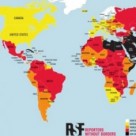
2021 World Press Freedom Index Released:


Reporters Without Borders (RSF) "ranked China fourth to last out of 180 countries on its 2021 World Press Freedom Index on Tuesday, while warning that Hong Kong journalism is also now under 'grave threat,'" according to Rebecca Davis of Variety. China "currently rates higher only than the totalitarian countries of Turkmenistan, North Korea and Eritrea, which for years have come in last." The report added that Beijing "continues to take Internet censorship, surveillance and propaganda to unprecedented levels" amid the COVID-19 pandemic, which has enabled "[enhanced] control over online information." Out of all countries, Malaysia "fell the furthest in RSF’s new rankings, dropping 18 places to hit 119th" after issuing an "anti-fake news decree" that circumscribes critical journalism.