For the Record


Barry Diller’s IAC in Talks to Buy Magazine Publisher Meredith

Diller's IAC in Negotiations to Acquire Meredith:


Barry Diller's IAC holding company "is in advanced talks to acquire magazine publisher Meredith, owner of brands including People and Better Homes & Gardens, according to people familiar with the situation, in an effort to build more scale in online publishing," Jeffrey A. Trachtenberg of The Wall Street Journal reported Thursday. The agreement, which is expected to be valued at more than $2.5 billion, "would vastly expand IAC’s collection of online publications, which include Brides, Serious Eats and TripSavvy" while "also [bulking] up IAC's portfolio of websites, which has shrunk recently after the company moved to spin off online-dating behemoth Match Group and video-hosting and sharing platform Vimeo." Diller's company, which traces its lineage to the Home Shopping Network, outbid Phoenix-based private-equity firm The Najafi Cos. in recent days. Trachtenberg added that the decision to sell the company "would mark a major turnabout for Des Moines-based Meredith, which less than four years ago placed a bet on the future of the magazine business when it agreed to buy Time Inc. for $1.85 billion." During its ownership, it sold off such high-profile titles as flagship Time magazine and Sports Illustrated while "[focusing] on leveraging the brands of other Time publications such as People, which it felt had room to bring in more money." The media company divested its TV affiliates to Gray Television earlier this year. In addition to Match and Vimeo, other businesses once owned by IAC "include Expedia, Ticketmaster and LendingTree."
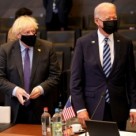
White House blames Boris Johnson after U.S. press corps denied opportunity to ask questions

White House Blames Johnson Amid Press Corps Fracas:


The editorial component of the White House press pool "filed a formal complaint after a meeting between President Biden and the British Prime Minister Boris Johnson ended with questions only from members of the British press" following a Tuesday Oval Office meeting, Adela Suliman of The Washington Post reported Thursday. However, White House Press Secretary Jen Psaki appeared to hold Johnson responsible for the oversight during her Wednesday briefing. "He called on individuals from his press corps without alerting us to that intention in advance," the assistant to the President said. "I think our relationship with the United Kingdom and with Prime Minister Johnson is so strong and abiding, we will be able to move forward beyond this." After Biden wished Johnson "good luck" prior to the media opportunity, the head of government took questions from two British journalists. According to White House Correspondents’ Association President Steven Portnoy, Biden "then signaled it was time for the press to leave, without taking any questions from his own press corps." The complaint comes after Biden "ruffled some feathers among the press corps in the early days of his presidency when he waited more than two months after his inauguration to hold his first news conference in March," with UC Santa Barbara’s American Presidency Project determining that his 15 most recent predecessors all held at least one solo media availability window within 33 days of taking office. "The President knows that he was elected not to just get the pandemic under control and put people back to work, but protect our democracy and stand up for what’s right and be transparent," Psaki added. "And, certainly, part of that is engaging with all of you." Prior to entering politics in 2001, Johnson worked as a reporter and columnist for various British newspapers, including The Times, The Daily Telegraph and The Spectator.

Google is testing using Drive as a newsletter platform called Museletter

Google's Area 120 Incubator Develops Newsletter 'One-Srop Shop':


Google's in-house Area 120 incubator is developing Museletter, an experimental product that "gives users a public profile on Google Drive through which they can share documents, spreadsheets, and slideshows with anyone who subscribes," potentially bridging the gap between its popular Docs word processing service and its flagship search engine, according to Tom Maxwell of Input. A website previewing tool "says that users could get paid by offering premium subscriptions," Maxwell added. The success of Substack's newsletter platform and streamlined payment system has inspired competition from other entities (most notably Twitter and Facebook) as top writers "have been able to make hundreds of thousands of dollars (or more)" every year. "It makes a lot of sense that Google would try and get a piece of the action since it already controls the creation and promotion side of the newsletter business," said Maxwell. "Advertising on newsletters could be a lucrative new space for Google as the price it’s able to charge per click on search ads has declined over the years and it faces more competition in the advertising space from Amazon. Advertisements inside newsletters could theoretically be worth more because they would be targeted at people interested in a very specific topic." On its website, Museletter suggests that it could direct users to ancillary Google products, such as custom domains. In a statement, a spokesperson said that Museletter is "one of many experiments" offered by the platform and that "it's still very early." Potential users may request access through Museletter's website.

The Washington Post announces the addition of 41 editing roles, including 2 masthead positions

Washington Post Adds Dozens of Editorial Roles:


In a Monday press release from Executive Editor Sally Buzbee and Managing Editors Cameron Barr, Tracy Grant, Krissah Thompson and Kat Downs Mulder, The Washington Post announced that it is adding 41 editorial roles in "a major expansion to accelerate [its] transformation into a fully 24/7 news organization and strengthen the leadership of the newsroom." As part of the effort, two new deputy managing editors will work alongside incumbents Scott Vance and Barbara Vobejda "in running the daily report, ensuring that a senior editor is in place to direct news coverage" from 7 a.m. ET (when the newspaper's new London relinquishes control to Washington) until late evening (when Seoul takes over from Washington). The expansion also "will create eight new positions for assignment editors – in Photo, National, Metro, Investigations, Design and Business – to strengthen coverage and reinforce colleagues who’ve been taxed by the unrelenting news cycle" in addition to eight assistant editor reports. In addition, more than 10 multiplatform, breaking-news and weekend editors (including a supervising producer) in the news divisions will be joined by three additional visual enterprise editors and an audience strategy editor in Business. "This expansion demonstrates anew that The Washington Post is an ascendant news organization, with boundless ambitions and a growing capacity to meet them," the editors added. "We hope you’ll join us in taking a moment to reflect on all we have accomplished – it is your success that enables the company to strengthen the newsroom in this way. We feel privileged to join you in the important work that lies ahead." (Washington Post Nonfiction Book Critic Carlos Lozada is a member of the Pulitzer Prize Board.)

Here’s why Olivia Rodrigo keeps handing out songwriting credits

'Interpolation Credits' Prevail Amid Litigation Fears, Publishing Boom:


In a conversation with Nilay Patel of The Verge, "Switch on Pop" host Charlie Harding discussed the rise of so-called "interpolation credits" in songwriting following 2015's "Blurred Lines" lawsuit (in which composers Robin Thicke and Pharrell Williams unsuccessfully contended that their ubiquitous 2013 pop hit did not borrow from Marvin Gaye's "Got to Give It Up") and the recent music publishing sales boom (as exemplified by 2008 Special Citation recipient Bob Dylan selling his catalog to Universal in a $300-400 million deal). In this environment, emergent singer-songwriter Olivia Rodrigo (whose work has elicited frequent comparisons to a range of earlier artists) has given such credits to Taylor Swift in an effort to potentially preclude legal measures. "Olivia Rodrigo made a great album full of extremely catchy songs with really great narratives," said Harding. "They're fun songs. There are a lot of different genres that appeal to people from different generations. There's a critical consensus this is a really good album and it has sold and streamed exceptionally well. As it has done better and better, as the album has rolled out more singles and those songs have succeeded at radio and streaming, people on the internet start to notice some similarities with her influences. Connections to Taylor Swift songs, connections to Paramore songs, connections to songs by Elvis Costello. They’re more sort of hints — I would call it mostly influence. The chatter on the internet then turns into actually handing over songwriting credit to a number of these artists." He added: "We covered this story weeks ago, maybe months ago at this point, when it was just people on TikTok saying 'Hey, these songs kind of match up, this is clearly theft,' which is an interesting point of conversation. Then that public campaign turns into actually, supposedly they were in touch beforehand. You never know really. We can only speculate as to if they were really in touch with each other’s publishers beforehand. But yeah, Paramore after the fact gets a credit, and it’s turned into a much larger discourse on intellectual theft and, I think, important conversations of sexism and who gets accused of theft. You have a very divided internet right now over whether or not Olivia Rodrigo is making original creative works or she’s simply taking from preexisting material."

Commentary: Burns’s ‘Muhammad Ali’ tells a story that teems with relevance

Pride, Remnick on Ali:


In a review of Ken Burns' "Muhammad Ali" (set to debut on PBS stations this Sunday) that appeared in the New Hampshire Bulletin, former Pulitzer Administrator Mike Pride lauded the eight-hour project's ambition and scope. "Five years after his death, in the Me Too and Black Lives Matter era, Ali’s story teems with relevance," said Pride, who previously interviewed Burns in conjunction with the documentarian's "The Vietnam War" in 2017 and recently conducted a separate Q&A with Burns about the Ali film. "We were interested, as we usually are, in a comprehensive look," said the documentarian, who interviewed such authorities as Pulitzer Prize Board member David Remnick (who wrote the bestselling 1998 biography "King of the World") for the project. As it progresses, the film explores Ali's emblematization of the "generation gap and youthful rage over racial injustice and the Vietnam War" and early 1970s triumphs, culminating in 1974's "Rumble in the Jungle" against George Foreman, which was covered contemporaneously by two-time Pulitzer winner Norman Mailer in "The Fight" (1975). But an "excruciating" decline would accelerate in the early 1980s, prompting the end of his 21-year professional career in December 1981 amid two consecutive losses. Although he was increasingly quiescent after announcing his diagnosis of Parkinson's disease in 1984, Ali remained a towering public figure for generations of Americans until his 2016 death, with Remnick asserting in the film that he was "revered [...], almost like the Buddha." Ultimately, the athlete proved to be a signpost to new expressions of masculinity even as his own sport was largely supplanted by other interests in the popular consciousness. "As defined by [1953 Fiction winner] Ernest Hemingway, [...] Mailer and other mid-century writers, real men sought their identities in perilous physical confrontations," Pride wrote. "The macho culture still thrives, but the roles of men often include partnering in parenting, sharing in household chores and supporting working spouses."

Some questions (and answers) about the Local Journalism Sustainability Act

Demystifying the Local Journalism Sustainability Act:


Introduced with bipartisan support in the House this summer, the Local Journalism Sustainability Act has elicited widespread support from many professionals, with even detractors preferring "to see it passed with some modifications," according to Sarah Scire of NiemanLab. The legislation (which may be included in the looming $3.5 trillion reconciliation package despite the lack of Republican co-sponsors in the Senate) would offer a "tax credit of up to $250 to incentivize subscriptions and donations to local news" (covering "80% of the cost of a local newspaper subscription or donation to a local news nonprofit in the first year, and 50% in the subsequent four years") alongside a "tax credit of up to $5,000 for small businesses that buy ads in their local publications" (paralleling the structure of the subscription tax credit) and a "payroll tax credit to make hiring [...] local reporters, editors, photographers, and other journalists easier," covering half of the salary of a reporter earning up to $50,000/year in the first year and 30% of the salary for three additional years. News organizations that primarily publish “original content derived from primary sources and relating to news and current events” for a local readership with at least one local journalist on staff and no more than 750 employees would be eligible for the tax credits. Pivot Fund founder Tracie Powell has criticized elements of the bill (citing the "luxury of a newspaper subscription or contribution" for poor and working-class readers and the longtime reliance of local news organizations on non-employee independent contractors), objections echoed by The Salt Lake Tribune's editorial board in its endorsement of the legislation: "It is also true that the bravest and boldest of community-serving publications will benefit alongside the shallow, absentee-owned newspapers being stripped for parts by vulture hedge funds. Can't have everything."

Broadway’s Biggest Hits Reopen in Festive Night of Theater

Broadway Reopens:


The longest shutdown in Broadway history is over, with many of the most notable shows in musical theater (including "The Lion King," "Wicked," "Chicago" and the Pulitzer-winning “Hamilton") reopening Tuesday night after an 18-month interregnum prompted by the COVID-19 pandemic, according to Michael Paulson of The New York Times. "People are ready," said "Lion King" director Julie Taymor, "and it's time." Despite ongoing pandemic-related complications and a paucity of tourists stemming from domestic travel hesitancy and international restrictions, "the crowds who packed into shows all over Broadway Tuesday night were grateful to be there," offering "roaring ovations and, at times, tears," Paulson added. "Broadway, and all of the arts and culture of the city, express the life, the energy, the diversity, the spirit of New York City," Mayor Bill de Blasio said at a news conference Tuesday. "It's in our heart and soul. It’s also so much of what people do to make a living in this town. And that makes us great. So, this is a big night for New York City’s comeback." As part of the reopening, "Hamilton" creator Lin-Manuel Miranda led a group of Broadway performers in a performance of John Kander and Fred Ebb's "New York, New York" in front of the Richard Rodgers Theater Tuesday evening. Every show is stipulating proof of vaccination for adult attendees (ineligible children under 12 are required to provide a negative test), while all patrons must remain masked throughout the performance. Four shows had already reopened before Tuesday, including Bruce Springsteen's one-man "Spingsteen on Broadway," two preexisting musicals ("Hadestown" and "Waitress") and Antoinette Chinonye Nwandu's new play "Pass Over." The venerable franchises are scheduled to be joined by a new production of Ruben Santiago-Hudson's "Lackawanna Blues" and more than two dozen other productions by the end of the year. 

Q&A: 9/11 journalism lessons from Pulitzer-winning teams at The Wall Street Journal and New York Times

Journalists Explore Pulitzer-Winning September 11 Coverage:


In a Monday Q&A published by Poynter, Roy J. Harris Jr. and Dean Rotbart "[highlighted] some lessons that news organizations of all ilks can glean" from Pulitzer-winning coverage of the September 11 attacks by The New York Times and The Wall Street Journal. Exploring the role of institutional cultures in the coverage, Rotbart singled out decades of professional continuity at the Journal. "Dating back to the early 1940s when Bernard 'Barney' Kilgore began transforming the Journal from a failing 33,000-circulation trade newspaper into one of the country's most-respected and best-read newspapers, an unbroken chain of leaders passed on and reinforced Kilgore’s core professional tenets," he said. "These included giving reporters wide latitude to work independently and to take reasonable risks in the effort to elevate the paper’s journalistic edge. On 9/11, the Journal's staffers didn’t have to be told what to do. On their own, they reasoned how they could be most helpful, and they set about it." According to Harris, the Times' special "Portraits of Grief" section (which encompassed "200-word mini-profiles of those who were missing in the wake of the disaster") marked "a whole new way of writing about victims" when contrasted against earlier approaches. "The profiles avoided the normal 'death-notice' information, instead picking one feature of the person that set her or him apart," he added. Although Harris noted that neither organization benefited from "established plans for dealing with a catastrophe the magnitude of Sept. 11," the Times was able to draw upon its system of "clearing ads from its first section and making space available for unexpected blocks of news" while also diverting staffers from its coverage of the New York municipal primary election. Similarly, Rotbart drew attention to the pivotal flexibility offered by Journal parent company Dow Jones' South Brunswick, N.J. administrative offices. "Those offices had training rooms that most senior editors knew could, in a pinch, be converted to temporary news desks," he said. "On 9/11, roughly 40 Journal staffers — about one-tenth of its regular New York workforce — had run the gantlet to South Brunswick and were responsible for editing and composing the next day’s edition."

Small Publishers Have Longer Runway to Digital, but They Still Need to Take Off

Small Publishers Retain Affinity for Print, Explore Platforms:


Although certain local news outlets "are well along on a dramatic pivot from print to digital, many smaller newsrooms remain bullish on print, and some seem to be in no big hurry to build up their online presence," according to Mark Jacob of the Medill Local News Initiative. "In contrast to the state and metro papers, print is not necessarily dying in many small and mid-sized markets," said Penny Abernathy, an authority on news deserts who currently serves as a visiting professor at Medill. "In successful markets, it is living in tandem with the digital products. That’s because, for local businesses, having a print option is vitally important for both reach and efficiency." While Local Media Association CEO Nancy Lane added that "weekly newspapers can survive in print for a long time" in many markets, these publishers "do need to figure out the digital strategy because we live in a digital world [...] if they’re relying on 100% print for the long term, that’s not a good strategy. The ones that are still doing great print but also making investments into the digital world are probably setting themselves up for the best future." Meriden Record-Journal Publisher Liz White Notarangelo, whose family has owned the central Connecticut daily for more than 150 years, has embraced a variety of platforms ranging from print to email to text messaging. "With the combination of our print audience and our digital audiences across all the platforms I mentioned, we have the largest audience that we’ve ever had in our whole history," she said. Dean Ridings, chief executive of the America’s Newspapers trade organization, believes that email newsletters can play a pivotal role in augmenting income. "We're seeing that’s a great revenue source," he said. "You can get those sponsored. That can be a very effective means of communicating with your audience in a digital manner in a way that the audience likes."