For the Record


Apple Announces New Lockdown Mode on iOS 16 With 'Extreme' Level of Security

Apple Announces Secure 'Lockdown Mode':


Apple has "announced a new Lockdown Mode coming to the iPhone, iPad, and Mac with iOS 16, iPadOS 16, and macOS Ventura," Joe Rossignol of MacRumors reported Wednesday. The optional security add-on "is designed to protect the 'very small number' of users who may be at risk of "'ighly targeted cyberattacks' from private companies developing state-sponsored spyware, such as journalists, activists, and government employees," Rossignol added. Activating or disabling the feature (which will remain off unless enabled) will be contingent on "restarting the device and entering the device's passcode." The feature will "[provide] an 'extreme' level of security by strictly limiting or disabling the functionality of features, apps, and websites," as exemplified by blocking the majority of non-image message attachments, unknown FaceTime calls and shared photo albums. The company "said it will continue to add new protections to Lockdown Mode over time" in addition to incorporating it into its Security Bounty program, which rewards researchers for finding bugs and other loopholes. "Lockdown Mode is a groundbreaking capability that reflects our unwavering commitment to protecting users from even the rarest, most sophisticated attacks," said Ivan Krstić, the technology company's head of security engineering. "While the vast majority of users will never be the victims of highly targeted cyberattacks, we will work tirelessly to protect the small number of users who are." Apple also announced that "it is making a $10 million grant to the Ford Foundation's Dignity and Justice Fund to support organizations that investigate, expose, and prevent highly targeted cyberattacks" and has pledged to "[donate] any damages awarded from its lawsuit filed against NSO Group, creator of the spyware Pegasus."

India bars Pulitzer-winning Kashmiri photojournalist from flying to France

India Bars Pulitzer-Winning Photojournalist From French Trip:


The Indian government has blocked 2022 Feature Photography winner Sanna Irshad Mattoo "from taking a flight to Paris where she was to take part in a book launch and photography exhibition displaying her photos from Kashmir," Shaikh Azizur Rahman of The Guardian reported Sunday. Mattoo, a Kashmiri multimedia journalist who was part of a four-member team that received the Pulitzer "for images of COVID's toll in India that balanced intimacy and devastation," was "stopped at the Delhi airport by immigration officials on Saturday despite holding a valid French visa," Rahman added. She was set to participate in the event as one of 10 recipients of the Serendipity Arles Grant 2020. "Some other winners are going to participate in the Paris festival and my photos will be on display there, but I will not be there despite being a winner. It was my first opportunity to attend a photography-related festival abroad. I am indeed disappointed not to be able to be there now," she said. "I was asked to wait for over two hours by the Delhi immigration officials at the airport before they said that I would not be allowed to board the flight. I asked them why they were stopping me. They said they did not know the exact reasons. However they said that the instruction to stop me from leaving the country came from Kashmir." Although the Indian home ministry has not commented on the matter, an unidentified Delhi police source told the Print newspaper that "an LOC (Look Out Circular), the summons that prevented Mattoo from flying out on Saturday, had been issued by Jammu and Kashmir police in 2020." According to the source, "There was information to stop the journalist at immigration and not allow her to take the flight [...] In this case, the police and immigration followed procedure." The Committee to Protect Journalists "said travel bans were part of a 'systematic pattern of harassment against Kashmiri journalists, who have increasingly faced arbitrary arrest, frivolous legal cases, threats, physical attacks, and raids since August 2019,'" with at least three Kashmiri journalists being stopped in an analogous fashion in recent years. "Restricting freedom of movement is another tool of repression and harassment being used against independent journalists in India – especially those from minority religious and ethnic groups, and those reporting from Kashmir," said Julie Posetti, the vice president of global research at the International Center for Journalists.

Fact-checking movement grapples with a world awash in false claims

Fact-Checkers Convene in Oslo:


Members of the Poynter Institute-housed International Fact Checking Network met in Oslo last week "for their first in-person conference in three years, confronting a world awash in baseless claims promoted by politicians and even governments and increasingly embraced by receptive audiences," according to an analysis by Glenn Kessler of The Washington Post. The Global Fact 9 summit included 500 participants from 69 countries, doubling the size of the "last in-person Global Fact summit in Cape Town three years ago," Kessler added. "Our collective trust in reliable and authoritative information is being attacked by people in power," said Baybars Orsek, the Network's director, in his opening remarks at the conference. "Their manipulation of truth makes people vulnerable to bad actors capitalizing on their lack of access to quality information for their own benefits. Autocratic governments and strongmen around the world are following similar playbooks to censor free speech and dissent under the name of fighting against 'fake news.'" Executives from Facebook parent company Meta "announced at the gathering that they have already spent $100 million to help underwrite fact-checking operations in dozens of countries, many of which are paid to flag false information circulating on Facebook," while Meta and the Google News Initiative also will fund "a new legal support fund for fact-checking organizations that face litigation and harassment." The conference coincided with several press freedom threats, including the arrest of Indian fact-checker Mohammed Zubair for "[highlighting] [...] derogatory comments made during a debate by a spokesperson for Prime Minister Narendra Modi's ruling Bharatiya Janata party (BJP) about the prophet Muhammad" and the Philippines Securities and Exchange Commission's revocation of fact-checking organization Rappler's incorporation certificates. Rappler CEO and 2021 Nobel Peace Prize laureate Maria Ressa has "vowed to appeal the decision," according to Kessler. Other speakers at the conference included Pulitzer Prize Board member and 2004 General Nonfiction winner Anne Applebaum, who noted that "a fact isolated from context, whether it's true or false, is almost meaningless. You have to explain it or tell it as part of a story." Amid an open letter from fact-checking organizations to YouTube, the video platform sent senior executive Brandon Feldman to address the conference. Feldman "said the company was taking steps to address concerns, such as elevating 'authoritative sources' during breaking news events and downgrading false content," but subsequently "dodged questions about committing to a more formal partnership with fact-checkers." (Pulitzer Prize Board Co-Chair Neil Brown is president of the Poynter Institute.)

Ethnic media was devastated by Covid. Now publishers are struggling to self-fund.

New York's Diaspora Publishers Struggle Amid Pandemic:


Although the Center for Community Media at the CUNY Craig Newmark Graduate School of Journalism helped New York City's municipal government "[place] nearly $10 million worth of advertisement to more than 220 community media outlets" following a 2019 executive order from then-Mayor Bill de Blasio, all four newspapers oriented toward the city's Nepalese community were forced to abandon their print editions and shift toward a digital-first strategy at the height of the COVID-19 pandemic, Anuz Thapa of NBC News reported Monday. "Seeing only the digital version of the newspaper was painful to me," said Bijay Poudel, publisher and editor-in-chief of the weekly Vishwa Sandesh. "I can't describe the feeling one gets when they hold a newspaper to read." Sandy Close, founder of the nonprofit Ethnic Media Services, noted that print publications are important to diaspora communities. "If you are in, let’s say anywhere like Little Saigon in Orange County [California] or on the New York subway or in Times Square, if you photograph whoever is reading a newspaper, it’s usually an ethnic paper," she said. "There is a very real importance of that physical print publication. In a cafe, people will read the newspapers as a social activity, and I think the importance of print runs very deep." While Poudel was able to resume a limited print run of 2,000 issues per week, the ongoing decline in advertising revenue has forced him to subsidize the newspaper with revenue from KharKhare, a business purveying Nepalese religious items. "I really don’t know how long I could self-fund the paper," he said. According to Thapa, ethnic and diaspora papers "have not benefited" from digital advertising and subscriptions due to Facebook and Google "[eating] up about 85% of new digital ad revenue." José Bayona, who currently serves as executive director of the Mayor’s Office of Ethnic and Community Media, "declined a request for comment; however, he said their new office 'will soon have an update on the mission and goals.'"

U.S. digital newspaper ad revenue expected to surpass print by 2026

PricewaterhouseCoopers: Digital Newspaper Advertising Revenue Expected to Surpass Print by 2026:


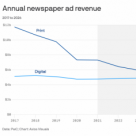
The United States "is expected to make history in 2026 when it becomes the first major media market in the world to see digital newspaper ad revenue eclipse print newspaper ad revenue, according to a new report" from Big Four accounting firm PricewaterhouseCoopers, Sara Fischer of Axios reported Tuesday. "It's not a difference in a willingness to digitally-transform, but a marketplace difference," said CJ Bangah, a PwC media principal who co-authored the report. Although "newspapers have been slower to migrate advertising revenues to digital than the broader publishing landscape because of their local footprint," according to Fischer, publishers will lose as much as $2.4 billion in ad investment between 2021 and 2026 "due to print advertising losses," with a -7.7% "compound annual growth rate (CAGR) [...] well ahead of the global average decline, which is -5.1% CAGR." Digital revenue "will expand 1% CAGR" to $5 billion, "adding just $251 million from 2022 to 2026" while narrowly surpassing print advertising's projected $4.9 billion valuation. Fischer added that PwC "categorizes a digital newspaper as any type of news outlet, whether it started as a print outlet or is a digital-first outlet," while print newspapers "include dailies and weeklies." In an interview at the Cannes Lion Festival, Bangah said that "newspapers [which] cater to local markets struggled to offer competitive digital advertising rates for local businesses online," prompting these businesses to employ "more cost-efficient options on Big Tech platforms." As a corollary, the study projects that digital and print newspaper circulation revenues will surpass advertising by the end of 2022.

Exclusive: U.S. targets Russia with tech to evade censorship of Ukraine news

U.S. Funds VPNs to Combat Russo-Ukrainian War Censorship:


The U.S. government "has pushed new, increased funding into three technology companies since the start of the Ukraine conflict to help Russians sidestep censors and access Western media," James Pearson and Christopher Bing of Reuters reported Wednesday. The financing is being directed to three companies (nthLink, Psiphon and Lantern) that "build virtual private networks," which enable users to "hide their identity and change their online location, often to bypass geographic restrictions on content or to evade government censorship technology." Executives at the VPN companies and the U.S. government-funded nonprofit Open Technology Fund (OTF) have confirmed that the "anti-censorship apps have seen significant growth in Russia since President Vladimir Putin launched his war in Ukraine on Feb. 24. In the period between 2015 and 2021, the three networks "received at least $4.8 million in U.S. funding, according to publicly available funding documents reviewed by Reuters. [...] Since February, the total funding allocated to the companies has increased by almost half in order to cope with the rise in demand in Russia, the five people familiar with the matter told Reuters." The funding is routed through the federal U.S. Agency for Global Media (formerly known as the Broadcasting Board of Governors), which supervises the Open Technology Fund alongside such broadcasters as Radio Free Europe/Radio Liberty, Voice of America and the Office of Cuba Broadcasting. OTF President Laura Cunningham said the nonprofit corporation increased funding to the networks because "the Russian government is attempting to censor what their citizens can see and say online in order to obscure the truth and silence dissent." More than 4 million Russian users employed OTF-backed censorship evasion tools last month, according to Cunningham. In a statement, an Agency for Global Media spokesperson said it was "supporting the development of a range of censorship circumvention tools," including additional VPNs. A spokesperson for the Russian government denied the allegations of censorship: "We don't censor the Internet. Russia regulates certain Web resources, like many other countries in the world." Although VPNs were formally criminalized by Russia in 2017 (precipitating a 2019 crackdown on notable services), many Russians have continued to "quietly use" the apps, Pearson and Bing added. Posters "advertising nthLink and other U.S.-government backed VPNs, as well as independent Russian-language media outlets, have appeared in Moscow since the start of the war, according to three people familiar with the matter."

Carole Cadwalladr wins libel battle with Arron Banks using public interest defence

Cadwalladr Wins Libel Battle:


2019 National Reporting finalist Carole Cadwalladr "has won her libel battle with Brexit donor Arron Banks using" Britain's public interest defense, Charlotte Tobitt of Press Gazette reported Monday. Banks, who has served as the owner or chief executive of several insurance firms, "sued freelance journalist Cadwalladr over this phrase in a TED Talk she gave in 2019: 'And I'm not even going to go into the lies that Arron Banks has told about his covert relationship with the Russian government.'" The businessman "also sued over a Twitter post on 24 June 2019 in which she repeated the allegation and shared a link to the talk: 'Oh Arron. This is too tragic. Nigel Farage's secret funder Arron Banks has sent me a pre-action letter this morning: he's suing me over this TED talk. If you haven't watched it please do. I say he lied about his contact with the Russian govt. Because he did." As of December 2021, the TED Talk "had been viewed 4.3 million times," with 1 million views on YouTube. In a Monday judgment, British High Court judge Dame Karen Margaret Steyn "said the TED Talk had caused serious harm to Banks' reputation but the tweet had not, dismissing the latter part of the claim" under the rationale that "Cadwalladr's Twitter followers of Banks would be 'of no consequence to him.'" Steyn added that "Cadwalladr had succeeded in her defense of the TED Talk by establishing that it was reasonable for her to believe publication of the allegation against Banks was in the public interest." According to Tobitt, Cadwalladr’s TED Talk "was based on years of reporting she had done for The Guardian and The Observer but Banks chose to sue only her. [...] Press freedom organizations and advocates therefore described the case as a SLAPP (strategic litigation against public participation) designed to intimidate her out of reporting. Banks subsequently "denied it was a 'vexatious' or 'bullying' claim. In a statement, Cadwalladr thanked her supporters and characterized the decision as a "huge victory for public interest journalism." Banks "has said he is 'likely' to appeal, adding: 'The judge said what she said was defamatory but no serious harm was caused, this was about vindication and it's clear what she said was wrong. The allegation about Russian money was always a hoax!'" 

Facebook Rethinks News Deals, and Publishers Stand to Lose Millions in Payments

Facebook Rethinks News Payments:


Facebook parent company Meta Platforms "is re-examining its commitment to paying for news, people familiar with the matter said, prompting some news organizations to prepare for a potential revenue shortfall of tens of millions of dollars," Alexandra Bruell and Keach Hagey of The Wall Street Journal reported Thursday. The social media platform "has paid average annual fees of more than $15 million to the Washington Post, just over $20 million to the New York Times, and more than $10 million to The Wall Street Journal" to showcase curated free articles in its News section. Additionally, the Journal fee "is part of a broader Facebook News deal largely negotiated by parent company Dow Jones & Co., including annual compensation worth more than $20 million." The publisher agreements were arranged in 2019 and are set to expire this year, Bruell and Hagey added. Alongside its more recent investments in virtual and augmented reality technologies (characterized by the company as a "metaverse," employing a term first used in Neal Stephens' 1992 postcyberpunk novel "Snow Crash"), the company is "looking to shift its investments away from news and toward products that attract creators such as short-form video producers to compete with ByteDance's TikTok." CEO Mark Zuckerberg also "has been disappointed by regulatory efforts around the world looking to force platforms like Facebook and Alphabet's Google to pay publishers for any news content available on their platforms, [...] [dampening] [...] Zuckerberg’s enthusiasm for making news a bigger part of Facebook's offering." Concurrently, news organizations "that have struggled to compete for digital ad revenue with Google and Facebook have criticized the tech giants for not paying for the [...] content that is featured and shared on their platforms," precipitating the creation of the News tab as an ameilorative measure under the aegis of former broadcast journalist Campbell Brown. "This spring," according to  Bruell and Hagey, "a revamped version of the U.S. legislation aimed at forcing the platforms to negotiate payment with publishers began circling in Congress, this time with a provision that would require the platforms to engage in baseball-style, 'final offer' arbitration—the same measure that prompted Facebook to pull news in Australia" in early 2021. 

The Billionaires Behind a Push to Reinvigorate U.S. Chip-Making

Thiel, Schmidt Envision Domestic Chip Resurgence:


Former Google Executive Chairman Eric Schmidt (a longtime Democratic donor who chaired the Defense Department's Innovation Advisory Board from August 2016 to September 2020) and entrepreneur-technologist Peter Thiel (who served as a delegate and speaker at the 2016 Republican National Convention) have jointly backed the America's Frontier Fund, "an unusual nonprofit venture capital fund to invest in chip-making across the country," Ephrat Livni of The New York Times reported Thursday. Augmented by a "cadre of former government officials, including Ashton B. Carter, [a] former secretary of defense, and H.R. McMaster, [a] former national security adviser," the fund has requested $1 billion in funding from Congress. Additionally, the White House has "directed the fund to lead the Quad Investor Network, which [it] describes as 'an independent consortium of investors that seeks to advance access to capital for critical and emerging technologies' across the United States, Japan, India and Australia." The fund's chief executive is Gilman Louie, "a gaming executive turned venture capitalist who led In-Q-Tel, a venture fund backed by the C.I.A." who also was "recently named to President Biden’s Intelligence Advisory Board and is expected to testify before senators on strengthening the supply chain." According to Livni, the "Schmidt-Thiel-backed organization is also raising more than a few eyebrows, and questions: What is it the billionaires want? Will they steer government dollars toward companies they've invested in or will benefit from?" In a statement to The Times, Schmidt said that "government, industry, academia and philanthropy must work together if we want free and open societies to lead this next wave of innovation for the benefit of all [...] America’s Frontier Fund is an important bridge in that effort." Although the world's first commercially available microprocessor was created by Santa Clara, Calif.-based Intel in 1971 (partially building upon earlier research conducted at Bell Labs in Murray Hill, N.J.), China's "recent investments in deep science and tech" could ultimately supplant the United States's protracted lead in the field, with America only accounting for "12 percent of global semiconductor manufacturing capacity" as of 2020. "In our current trajectory, the U.S. is losing its grip," said Edlyn Levine, a physicist and co-founder of the fund. "Whoever leads has a first mover advantage and actually will dominate in that sector the same way the United States did in early semiconductors." Last year, Intel "said it would outsource more production to Asia, most notably to Taiwan Semiconductor Manufacturing, an approach that some questioned amid pandemic supply chain struggles and that some believe led to the departure of [its] chief executive at the time, Bob Swan." While successor Pat Gelsinger "secured more than $43 billion from the company's board last year to build new chip fabrication plants, including a $20 billion investment in two new factories in Ohio" — a decision that elicted support from the Biden administration — "progress has stalled on measures that would help fund these efforts," notably exemplified by a lack of funding for the Creating Helpful Incentives to Produce Semiconductors ("CHIPS") Act "as lawmakers debate the details of the Bipartisan Innovation Act, which would provide over $50 billion for semiconductor production efforts, including for the kind of tech development that a venture fund like America's Frontier Fund is hoping to invest in." Co-sponsor Senator Sherrod Brown, a Democrat of Ohio, "[said] that members of Congress were working on getting it to the president's desk, though he did not say when that might happen." 

Freelance Isn’t Free Act Passes in New York State

New York State Legislature Passes Freelance Isn't Free Act:


The New York state legislature has passed the Freelance Isn't Free Act, a sweeping law "intended to establish and enhance the rights of freelance workers including authors, journalists, and other writers on contract," according to John Maher of Publishers Weekly. Sponsored by Democratic New York State Senator Andrew Gounardes and Assembly Member Harry Bronson, the law will "build upon" a similar law "previously instated in New York City, expanding the protections for freelancers state-wide." It is intended to "protect contract and freelance workers from wage theft by ensuring all freelancers receive appropriate contracts for their work, are paid in a timely manner, and have state support to recoup unpaid wages." Under its provisions, employers must "provide written contracts for all freelance workers and that those freelancers be paid by the agreed-upon date or within 30 days of the completion of the work." Additionally, freelancers will be able to "collect double the agreed-upon fee if employers do not satisfy those requirements." The law "also lowers the threshold for mandating additional financial remediation from contractors to contract workers, and makes the New York State Labor Department the regulatory agency for freelancers in the state." In a statement, Authors Guild CEO Mary Rasenberger said the professional organization "will continue to work with the National Writers Union, Freelancers Union, the Graphic Artists Guild, American Photographic Artists and other like-minded organizations to pass similar legislation across the country, starting with California, which, like New York, is home to many freelance creative workers."