For the Record


Facebook warns it could block news in Canada over proposed legislation

Meta Mulls Canadian News Ban:


Facebook "might ban news sharing in Canada if the country passes legislation forcing the company to pay news outlets for their content," Emma Roth of The Verge reported Sunday. In a Friday news release, parent company Meta said that Canada's proposed Online News Act "falsely presumes that it 'unfairly benefits from its relationship with publishers.'" Introduced in April, the legislation "compels online platforms like Facebook and Google to share revenue with the publishers they aggregate their news from," Roth added. "The goal of the bill is to ensure news outlets are fairly compensated for their work." While Canada's House of Commons Heritage Committee held a meeting about the legislation last week, Meta has maintained that it was not invited. The bill is similar to Australia's News Media Bargaining Code, which also requires the platforms to pay for articles featured in their services. Prior to the law's acrimonious passage, Facebook "switched off news sharing in the country in response," while Google "threatened to pull its search engine from the country." The purview of the temporary ban — which was only reversed following amendments to the original legislation — extended to such essential government services as health and fire departments, with a coterie of Facebook whistleblowers alleging earlier this year that the expansive merasure "was a negotiation tactic" contingent on an "overly broad definition of what’s considered a news publisher to cause chaos in the country." Meta has since maintained "the disorder was 'inadvertent.'" According to Meta, Facebook posts with links to news stories "make up less than three percent of the content on users’ Facebook feed[s], adding that the content 'is not a draw for our users' nor is it a 'significant source of revenue.'" The statement continued: "If this draft legislation becomes law, creating globally unprecedented forms of financial liability for news links or content, we may be forced to consider whether we continue to allow the sharing of news content on Facebook in Canada as defined under the Online News Act." Minister of Canadian Heritage Pablo Rodriguez condemned the threat in a statement to The Wall Street Journal, opining that the platform continues "to pull from" their Australian "playbook." He explained: "All we're asking the tech giants like Facebook to do is negotiate fair deals with news outlets when they profit from their work."


Pittsburgh Post-Gazette journalists go on strike

Pittsburgh Post-Gazette Journalists Begin Strike:


Journalists at the Pittsburgh Post-Gazette who belong to the publication's Newspaper Guild of Pittsburgh-represented bargaining unit "went on strike at noon Tuesday" following a Monday vote authorizing an unfair labor practice strike, according to Julia Felton of the Pittsburgh Tribune-Review. The union "sent a notice to Post-Gazette management demanding that the company 'end its illegally declared impasse to contract negotiations, lift the unilaterally imposed working conditions and reinstate the terms of the previous collectively bargained contract,'" Felton added. It "also said Post-Gazette management should return to the contract bargaining table to reach a fair contract for the 101 journalists represented by the Guild." In a statement, Newspaper Guild of Pittsburgh President Zack Tanner directly criticized John and Allan Block, whose family has owned the newspaper through its Block Communications holding company since the inception of its modern iteration in 1927, as exponents of "hostile and illegal treatment." The statement continued: "We, the workers, are standing together today, ready to fight to win back our contract and work toward signing a new collective bargaining agreement that preserves the Post-Gazette for the Pittsburgh region." According to Felton, the strike follows a work stoppage and proposed boycott by the Post-Gazette's production, distribution and advertising workers, who "protest what they viewed as unfair labor practices by company management." After this strike began, Post-Gazette journalists withheld their bylines in solidarity with their colleagues. The Newspaper Guild and the Post-Gazette began to negotiate a new contract in 2017. Negotiations continued for several years before the Post-Gazette's management declared an impasse in the summer of 2020, with the Guild maintaining that it would continue to negotiate. The newspaper's management "cut wages for journalists, took vacation time away from veteran workers and forced employees into a health insurance plan that offered less coverage for a higher price, the Guild said," prompting the union to file unfair labor practice charges. While the charges were argued before a National Labor Relations Board administrative law judge in September and October, a decision is still pending. "These journalists are just trying to do their jobs in service of the people of Pittsburgh," said NewsGuild President Jon Schleuss. "It's despicable for the Blocks to fight their own workers and disrespect their rights to have a union. They need to bargain in good faith now." In a statement, the Post-Gazette's management said it would “continue to serve the Pittsburgh community, our readers and advertisers, despite any work stoppage." The company "said it was confident that it would prevail in the National Labor Relations Board dispute, and noted that Guild workers’ top wage scales have increased 8% over the past three years," according to Felton. "It also said that unionized production, distribution and advertising employees were offered a 9% wage increase and the opportunity to enroll in the company's health care plan before they went on strike." 

Pulitzer-winning Kashmiri photojournalist says stopped from going to US

Mattoo Stopped From Attending Pulitzer Ceremony:


2022 Feature Photography winner Sanna Irshad Mattoo "said she was stopped from flying to the United States" to attend this week's Pulitzer Prize ceremony at Columbia University "by immigration authorities at the Delhi airport 'despite having a valid visa and ticket,'" according to a report from the Press Trust of India. "I was on my way to receive the Pulitzer award (@Pulitzerprizes) in New York but I was stopped at immigration at Delhi airport and barred from travelling internationally despite holding a valid US visa and ticket," Mattoo tweeted Tuesday. The photojournalist "said she was previously barred from traveling to Paris several months ago, adding: "Despite reaching out to several officials after what happened [a] few months ago, I never received any response. Being able to attend the award ceremony was a once in a lifetime opportunity for me." In a separate statement, Committee to Protect Journalists Asia Program Coordinator Beh Lih Yi (who is based in Frankfurt) condemned the action as "arbitrary and excessive," adding: "There is no reason why Kashmiri journalist Sanna Irshad Mattoo, who had all the right travel documents and has won a Pulitzer–one of the most prestigious journalism awards–should have been prevented from traveling abroad. [...] Indian authorities must immediately cease all forms of harassment and intimidation against journalists covering the situation in Kashmir." According to CPJ, Kashmiri journalists have told the non-governmental organization that they have been barred from traveling abroad since the Indian government "revoked Jammu and Kashmir's special autonomy status" in August 2019. This evening, Reuters addressed the matter in a statement to the Pulitzer Prize Office. "We are disappointed that Sanna Irshad Mattoo, a contributor to Reuters, has not been allowed to travel to the United States to receive her Pulitzer Prize in New York alongside her peers," the news agency said. "We have not been offered an official explanation as to why she has not been allowed to leave the country, but we believe that journalists should be able to travel freely."

Meta and news outlet’s spar deepens India’s trust deficit

Meta, Indian News Organization Spar Over Screenshot Authentication:


Indian news organization The Wire reported Monday that Facebook parent company Meta "has given [the governing Bharatiya Janata Party's] top digital operative an unchecked ability to remove content" from its platforms, as exemplified by the removal of as many as 705 posts from Instagram, according to Manish Singh and Zack Whittaker of TechCrunch. The report, which allegedly draws upon internal documents, "appears to advance [The Wall Street Journal's] reporting of an internal company program called XCheck, where Facebook shields millions of VIP users from the company’s normal enforcement process," Singh and Whittaker added. While Meta has contended that the XCheck program "has nothing to do with the ability to report posts" in addition to characterizing the alleged documents as fabrications, The Wire has since "doubled down on its reporting, claiming to include a picture that appeared to show an alleged email [Meta spokesperson Andy Stone] sent to internal teams where he is questioning members how the documents leaked." The picture also allegedly shows that Facebook maintains a "watchlist" of journalists. In a statement, Meta Chief Security Information Officer Guy Rosen said: "The supposed email address from which it was sent isn't even Stone's current email address, and the 'to' address isn’t one we use here either. There is no such email. That same story makes reference to an internal journalist 'watchlist.' There is no such list." Singh and Whittaker continued: "Facebook, like many other companies, does maintain dossiers on journalists. I (Manish) know this because they accidentally sent me the link to one about five years ago. Meta also does maintain email addresses with the fb.com domain. (The generic press contact remains a fb.com email. Though that’s not proof that Stone still actively uses a fb.com email.) Wire is standing by its reporting. However, if Meta is proven right, tricking a reputable outlet into running an explosive story that could've been easily refuted by a big megacorp like Meta would damage press credibility across India at a time when the country's media is increasingly grappling with a series of existential crises. Who would have the least to lose and most to gain here, especially if the goal was to undermine credibility in the press?"

Pittsburgh Post-Gazette production and advertising staff go on strike

Pittsburgh Post-Gazette Production and Advertising Staffers Begin Strike:


Dozens of "design, production, distribution and advertising staff at the Pittsburgh Post-Gazette went on strike Thursday in protest of the termination of their health care coverage," according to Angela Fu of Poynter. The employees (who are represented by various unions, including the Communications Workers of America, the International Brotherhood of Teamsters and the International Printing Pressmen and Assistants' Union of North America) "wrote in a press release that the Post-Gazette has refused to bargain in good faith and engaged in multiple 'unfair labor practices' against its unions," Fu added. The unions have worked without a contract for more than five years, while employees have not had a raise since 2006. "The last straw was the loss of their health coverage," Fu continued. "The workers say that their health insurance provider asked for an additional $19 per week in order to maintain benefits, but the Post-Gazette and its owner Block Communications refused to cover the increase in contributions. Employees were paying more than $7,300 per year for health insurance before they lost coverage on Oct. 1." In a statement, the workers said that "it is unconscionable that any employee has gone 16 years without any increase in pay and the employer refuses to pay an additional $19.00 per week so that the employers can maintain their current health program — a program they currently have and are paying a substantial price for out of their own pockets." The unions are imploring readers to cancel their subscriptions in solidarity with the strike and have enjoined businesses not to advertise in the newspaper. Additionally, unionized journalists at the Post-Gazette (who are represented by the NewsGuild) have withdrawn their bylines in support of their colleagues. "The Pittsburgh Post-Gazette has offered the unions several options that would ensure the continuation of the affected union employees' healthcare," said Allison Latcheran, the newspaper's director of marketing. "One of these proposals included a 9% wage increase and enrollment in the company’s healthcare plan, which currently covers 2,600 Block Communications employees, including several unions, company executives and staff at the PG. It is not clear why this proposal, nor any of the others, is unsatisfactory to the unions and their membership." However, the unions have asserted that "their members would not see much benefit from a 9% wage increase since 8% of their wages already go to health care coverage," while they also would be "required to join a high deductible plan that could double what they currently pay, and the company would have the power to unilaterally change or terminate parts of their plan." The National Labor Relations Board "has issued multiple complaints against" Block Communications (which also owns the Toledo Blade), as exemplified by an April determination that the company "had 'bargained with no intention of reaching agreement' during contract negotiations with its unionized journalists." Reporters at both publications also have "accused the Block family of political bias and have cited their leadership as the reason for mass resignations at the papers"; according to the Columbia Journalism Review, 40% of the unionized reporters employed by Block Communications resigned between 2019 and 2021.

Charles Fuller, Playwright and Screenwriter Behind ‘A Soldier’s Play,’ Dies at 83

Charles Fuller (1939–2022):


1982 Drama winner Charles Fuller, who "explored racism and the Black experience" in such works as "The Brownsville Raid" (1976) and "Zooman and the Sign" (1980), died Monday in Toronto, according to Mike Barnes of The Hollywood Reporter. He was 83. Premiered by the Negro Ensemble Company at New York's off-Broadway Theater Four in November 1981, Fuller's Pulitzer-winning "A Soldier's Play" is a reimagining of Herman Melville's novella "Billy Budd" centered around a "racially charged investigation by a Black captain for the murder of a Black sergeant on a segregated U.S. Army base in Jim Crow Louisiana in 1944." The original production, which ran for 600 performances through January 1983, "starred Charles Brown as Capt. Richard Davenport and Adolph Caesar as the murdered Sgt. Vernon C. Waters"; struggling actor Samuel L. Jackson also appeared as a private in a secondary role and met recent NYU film master's graduate Spike Lee following a 1981 performance, initiating a prolific collaboration that has endured to this day. Save for two 1988 plays, Fuller largely pivoted to film and other media following its success, earning an Edgar Award and an Academy Award nomination for scripting "A Soldier's Story" (1984), Norman Jewison's film adaptation of the work. In January-March 2020, a revival of "A Soldier's Play" was staged on Broadway before the COVID pause, earning Tonys for best revival of a play and best performance by an actor in a featured role in a play for David Alan Grier, who also appeared in a smaller role in the Jewison film. "It has been my greatest honour to perform his words on both stage and screen," Grier tweeted Monday. "[His] genius will be missed." Born to a printer's family in Philadelphia, Fuller attended Roman Catholic High School and thence Villanova University (1956–1958) before completing his Army service obligation in Japan and South Korea. Following his discharge, he returned to Philadelphia and his schooling, ultimately earning a doctor of fine arts degree from La Salle University in 1967. During this period, he co-founded the Afro-American Arts Theatre Philadelphia in 1967 and first garnered critical acclaim in 1969 with "The Village: A Party," a drama about tensions in a group of mixed-race couples. He later earned an Obie Award in 1980 for the aforementioned "Zooman...", which featured theatrical eminence Mary Alice (and a young Giancarlo Esposito in a breakthrough performance) during its Negro Ensemble Company-produced run at Theater Four. In addition to his son, David, Fuller is survived by his wife, Claire; a daughter-in-law; four grandchildren; and three great-grandchildren.

California Restricts Use of Rap Lyrics in Criminal Trials After Gov. Newsom Signs Bill

Newsom Signs California Lyrics Legislation as Federal Bill Gains Momentum:


Gov. Gavin Newsom (D-California) signed the Decriminalizing Artistic Expression Act, which "restricts the use" of hip-hop lyrics as evidence in California courts, at a virtual signing last week, Ethan Shanfeld of Variety reported Friday. In a press release, the Black Music Action Coalition (which sent a delegation to the signing alongside such figures as hip-hop artist Killer Mike and Recording Academy CEO Harvey Mason Jr.) "called the bill a 'crucial step in the right direction' of not injecting racial bias into court proceedings," citing the use of lyrics by artists Young Thug and Gunna in prosecutorial arguments at an ongoing RICO trial. "For too long, prosecutors in California have used rap lyrics as a convenient way to inject racial bias and confusion into the criminal justice process," said Dina LaPolt, an entertainment attorney who co-founded Songwriters of North America. "This legislation sets up important guardrails that will help courts hold prosecutors accountable and prevent them from criminalizing Black and Brown artistic expression. [...] We hope Congress will pass similar legislation, as this is a nationwide problem." Reps. Hank Johnson (D-Georgia) and Jamaal Bowman (D-New York) recently introduced the analogous Restoring Artistic Protection Act in the House of Representatives and spoke about the proposed legislation at a September 29 RIAA panel in Washington, D.C. According to Shanfeld, the "wide-ranging discussion addressed the dangers to the constitutional rights of free speech and to a fair trial." 300 Electric Entertainment CEO Kevin Liles, who participated in the panel and "testified on behalf of jailed rap artists Young Thug and Gunna during their bond hearings, connected what’s happening today to decades of systemic racism that disadvantages Black men," while Johnson credited LaPolt with bringing the matter to his attention. "I saw the possibilities of it, but I was unaware of the scope of the problem that then existed,” he said to Variety. "We started talking about the need for some federal legislation, and fast forward a few years and we get to actually drafting the RAP Act and introducing it at a time when the Fulton County prosecutor was bringing charges against Young Thug and Gunna based, in part, on their lyrics. [...] I've always prided myself as a politician and elected official with having a sense of timing about things, and it just so happened that the time was now and this issue was ready to explode on the national scene."

How subscriptions are lighting way to brighter future for local US news publishers

Forecasters: Digital News Subscribers Will Outpace Print in 2023:


Business consultancy Mather Economics has projected that "the volume of digital subscribers" to local U.S. news publications "will surpass print subscribers in 2023," Aisha Majid of PressGazette reported Thursday. "If you think of the share of the subscriber base, they’re going to cross over next year," said Peter Doucette, a senior managing director at the firm. "Digital subscriptions are clearly the biggest growth driver." While major metropolitan bastions like the Los Angeles Times and The Boston Globe "unsurprisingly top the list with over 500,000 and 244,000 digital subscribers respectively, lesser-known names [...] are also doing well," with the Twin Cities' Star Tribune boasting more than 100,000 digital subscribers and Newsday (which primarily services metropolitan New York's suburban Long Island region) garnering 50,000 digital subscribers after beginning to offer the service "in earnest" three years ago. Following a surge of interest at the beginning of the COVID-19 pandemic, the independently-owned Seattle Times "has doubled its subscriber count in three years, crossing 81,000 earlier this year." Some large chains also have enjoyed growth, with Gannett reporting a 44% quarter-on-quarter increase in digital subscribers in Q1 2022. However, according to Majid, "while subscriber counts are encouraging, revenue still lags," with the "revenue split between print and digital subscriptions remain[ing] in the region of 85% to 15%, in favor of print." Nevertheless, Doucette opined that the news organization's content remains "critical" despite a continuing emphasis on page speeds and search engine optimization (SEO). "The most important thing is to have quality news and then you have to have some level of what I would call exclusivity, where you are the only one covering an issue, an event or a sports team for example," he said. "There is no magic formula." Matt Broad, a vice president of strategic services at revenue analytics company Piano.io (which is retained by a variety of local publications, including The Baltimore Banner, The Colorado Sun and The Salt Lake Tribune) added: "If [a customer] hits a wall on a national site, they can go somewhere else and maybe have [a] few articles there to read and so forth. But for local news, if there's only one or two outlets that they can get that information from that's what these outlets need to be promoting and pushing. We're finding that more regional publishers are providing more local relevant content to to build that relationship with their users and push it that way."

TikTok Seen Moving Toward U.S. Security Deal, but Hurdles Remain

TikTok, Biden Administration Continue Security Negotiations:


ByteDance-owned social video platform TikTok and the Biden administration "have drafted a preliminary agreement to resolve national security concerns posed by the Chinese-owned [...] app but face hurdles over the terms, as the platform negotiates to keep operating in the United States without major changes to its ownership structure," Lauren Hirsch, David McCabe, Katie Benner and Glenn Thrush of The New York Times reported Monday. Although both parties "have hammered out the foundations of a deal in which TikTok would make changes to its data security and governance without requiring" ByteDance to sell the app, Deputy Attorney General Lisa Monaco "has concerns that the terms are not tough enough on China," while the Treasury Department "is also skeptical that the potential agreement with TikTok can sufficiently resolve national security issues." Since its 2016 launch — and belying its increasing prevalence as a messaging tool for political campaigns attempting to target younger demographics — TikTok has elicted bipartisan data and privacy concerns from various lawmakers. In 2020, the Trump administration "tried to force ByteDance to sell TikTok to an American company in 2020 and threatened to block the app," culminating in the implementation of an executive order (subsequently revoked by President Biden) banning U.S. transactions with TikTok. The app also has been banned in India (which cited privacy concerns), while a Pakistani ban predicated on perceived indecency was reinstituted by the South Asian state's judiciary in March 2021. "If completed, an agreement with the Biden administration is likely to be highly scrutinized, as TikTok has become a symbol of the Cold War-like atmosphere in relations between Beijing and Washington," the reporters continued. "As part of the tit-for-tat, the nations are battling over primacy in technology and digital data. Skepticism toward China is a built-in feature of U.S. politics, and the talks are taking place just weeks before November’s midterm elections. Completing an agreement may also be difficult at a tricky political moment for the Biden administration, which has stepped up its cadence of criticism and executive actions addressing China. The policy toward Beijing, while expressed in more diplomatic language, is not substantially different from the posture of the Trump White House, reflecting a suspicion of China that now spans the political spectrum. Nevertheless, Republicans have criticized the administration for being too soft on China." In a statement to The Times, Senate Intelligence Committee Vice Chair Marco Rubio (a Republican from Florida) said that "anything short of a complete separation” of the app from ByteDance "will likely leave significant national security issues regarding operations, data and algorithms unresolved." Under the proposed agreement's terms, TikTok would "store its American data solely on servers in the United States, probably run by Oracle" — which previously partook in a thwarted agreement to buy part of the app amid the 2020-era litigation — "instead of on its own servers in Singapore and Virginia." Oracle (which "is not directly involved in the negotiations but has been consulted by the government" despite declining to comment) also would "monitor TikTok's powerful algorithms that determine the content that the app recommends, in response to concerns that the Chinese government could use its feed as a way to influence the American public." Finally, TikTok would "create a board of security experts, reporting to the government, to oversee its U.S. operations." 

News Platform Fact Sheet

Pew Releases News Platform Survey:


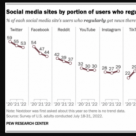
Although an increasing majority of Americans (60%) say they often get news from a smartphone, computer or tablet" compared to television (40%), radio (16%) and the print iterations (10%) of news publications, roughly a third of U.S. adults (31%) "say they regularly get news from Facebook," according to a Pew Research Center survey released Tuesday. Despite the increasing prevalence of such platforms as TikTok (10%), Reddit (8%) and Twitch (1%) among younger users for such activities as niche socialization (with Reddit reviving the subtopic-based discussions of early Usenet fora and bulletin board systems) and esports (recent New York Times and USA Today articles also have explored TikTok's emergence as a de facto search engine in the Generation Z cohort), these platforms continue to lag behind YouTube (25%), Twitter (14%) and Instagram (13%) as sources among adult U.S. news consumers. "When looking at the proportion of each social media site's users who regularly get news there, some sites stand out as having a greater portion of users turning to the site for news even if their total audience is relatively small," the report continued. "For example, while Twitter is used by about three-in-ten U.S. adults (27%), about half of its users (53%) turn to the site to regularly get news there. On the other hand, roughly the same share of adults (31%) use LinkedIn, but only 13% of its users regularly get news on the site." Notably, "half or more of regular news consumers on Snapchat (67%), TikTok (52%) and Reddit (50%) are ages 18 to 29," while "women make up a greater portion of regular news consumers on Facebook" despite the opposite being true for Twitter and Reddit. Additionally, "some partisan differences also arise when it comes to who regularly gets news on some social media sites"; the majority of regular news consumers identify as Democrats or as independents who lean Democratic, while no social media site in the report "has regular news consumers who are more likely to be Republicans or lean Republican," possibly reflective of the rise of alternative platforms (such as Parler and Rumble) that primarily market to Republicans and independent conservatives. The percentage of each platform's users who regularly get news there also has declined nearly across the board since 2020, with Twitter (59%-53%), Facebook (54%-44%) and Reddit (42%-37%) posting declines of 5% or more. Conversely, TikTok (22%-33%) is the only platform to register a major increase, while Twitch has plateaued at 13% after a 2% gain last year.