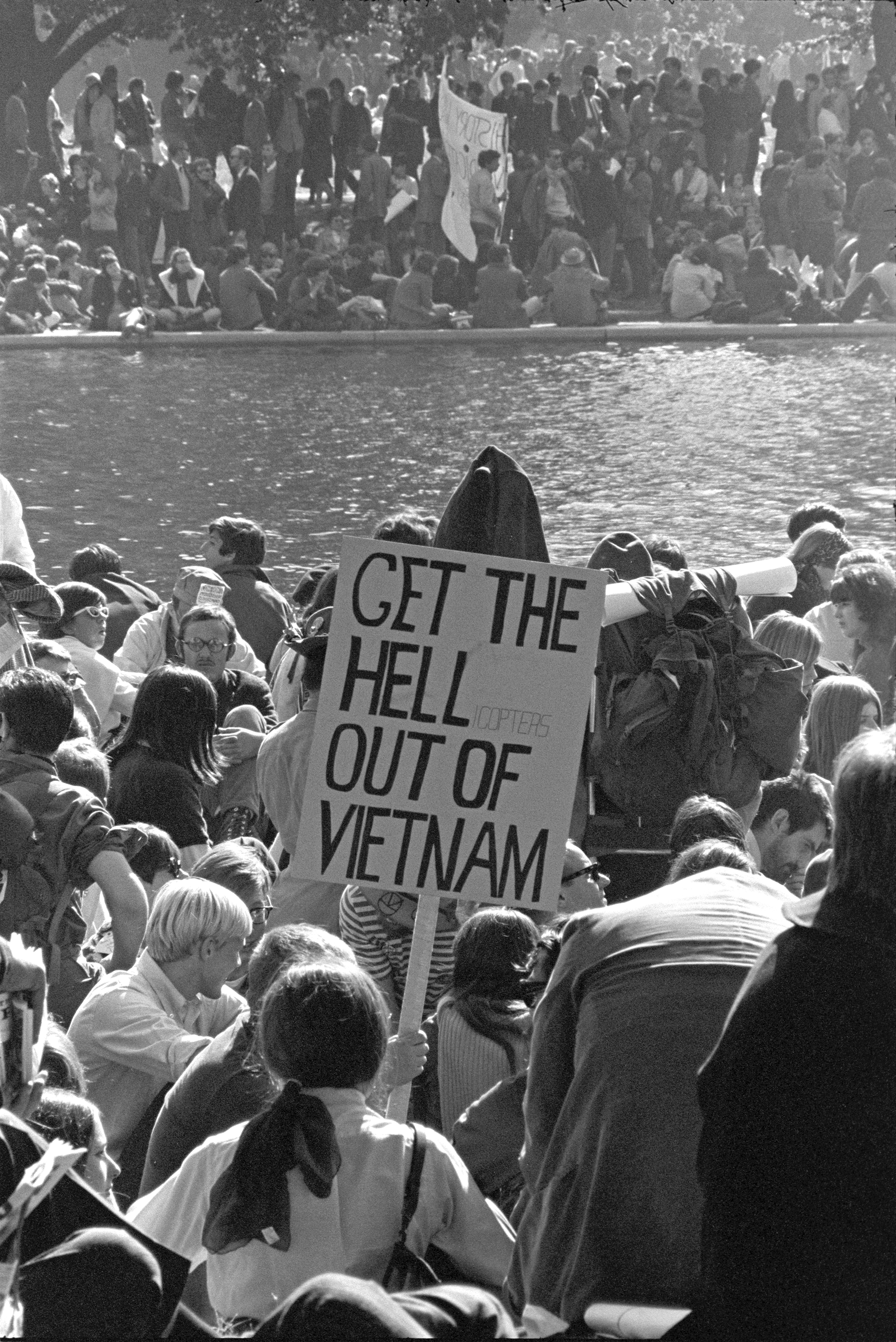
Protesters convene at the October 21, 1967 march on the Pentagon (Wikimedia Commons). Following a conventional rally of 70,000 demonstrators at the Lincoln Memorial that included a performance by singer-songwriter Phil Ochs and speeches by Dave Dellinger and Dr. Benjamin Spock, activist Abbie Hoffman led 50,000 of the attendees (including two-time Pulitzer Poetry Prize winner Robert Lowell) to the Pentagon in nearby Arlington, VA; there, 650 attendees (including Mailer; Lowell was suppressed by the police) were arrested for civil disobedience as some of the luminaries attempted to "levitate" the building to "exorcise the evil within."
Much of The Armies of the Night (save for "Battle of the Pentagon," the book's 25,000-word epilogue) was published in the March 1968 issue of Harper's as "The Steps of the Pentagon." Initially contracted to write a 20,000-word article on his experiences (culminating in a civil disobedience arrest) at the October 21, 1967 march on the Pentagon following a rally by the National Mobilization Committee to End the War in Vietnam, Mailer instead delivered a book-length provocation of the New Journalism; notably, he included himself in the third person as the text's protagonist (a device later employed by contemporaries like Gay Talese and Hunter S. Thompson) and, save for a memorable passage in which he "use[d] asterisks for these obscenities to emphasize how happily [Lyndon Johnson] used the words," did not refrain from including expletives.
Despite Mailer's largesse, editor Willie Morris decided to run the piece in its entirety. According to Morris, "[T]hat piece broke new ground for American letters; it was a watershed issue because of the language. I knew that when I read it that this was going to be a singular leap, but I also knew that we would have to go all the way and not compromise." Although it is difficult to obtain accurate statistics, "The Steps of the Pentagon" was heralded as the longest magazine piece ever published at the time of its publication (having eclipsed John Hersey's "Hiroshima" and an excerpt from William Styron's The Confessions of Nat Turner published in Harper's in September 1967) and likely retains that record in the mid-2010s.
Among Mailer's "establishment" New York Intellectuals milieu, only neoconservative lodestar Irving Kristol declared the work to be "irresponsible," with moderates such as Norman Podhoretz (an incipient neoconservative who had "already begun the process of breaking ranks with the political perspective from which it was written") and Diana Trilling (who opposed the war while advocating against America's unilateral withdrawal, a common stance among the liberal anticommunist intelligensia of the era) lauding the book as Mailer's finest since 1959's Advertisements for Myself (Podhoretz) and "his greatest book without any question" (Trilling).
Read "The Steps of the Pentagon" here. (Please note that personal or institutional access to the Harper's archive may be required.)