The New York Times, by Ada Louise Huxtable
Winning Work
By Ada Louise Huxtable
The one word to describe Washington's Hirshhorn Museum is formidable.
It will be marble. It will be round. And it will be 231 feet in diameter or greater in size than a city block. lt will sit on a podium 300 feet wide and 400 feet long - two city blocks - enclosed by an 8-foot high wall. There will be no windows or any break in the marble except for a ceremonial balcony. The Guggenheim Museum would fit inside the building's hollow central court. It will be the biggest marble doughnut in the world.
The new museum will line up solidly, and formidably, with the crushing phalanx of marble mausoleums devoted to the endless aspects of American art, culture, history and technology shepherded along both sides of the Mall by the Smithsonian Institution.
It will also cross the MaII with a sunken sculpture court and reflecting pool to make a major north-south axis to the Archives Building. The court will be 9 feet below grade so that its monumental outdoor statuary - 150 pieces of sculpture over 6 feet tall - will not interfere with the vista of the Washington Monument. (There were a few discreet skirmishes among Washington's numerous reviewing agencies on that one until it sank deep enough.)
Meaning to Architects
The sculpture court, or garden, will be 55 by 170 feet and the reflecting pool will be 80 by 450 feet, a bit longer than the Onassis yacht. Altogether, the museum and sculpture garden will cover 12 acres. Only Louis XIV could have called it in time.
But then there's nothing intimate about the Mall or any of its buildings. The scale is megalomaniac and the style is colossal funerary. Superscale meets Superbuilding. There is a touch of the surreal in the vastness of these dinosaurs of American culture disposed to infinity.
It is Superclassicism, but instead of Grecian pyres and catafalques there are tourists in shorts.
What the Mall lacks in gaiety it makes up in grandeur. It is impressive through sheer size and dead weight and it will be even more impressive to the archeologists of the future. It will be the biggest dig since Schliemann's Troy.
The other museums in the line-up, such as the National Gallery and assorted Smithsonians, tend to be 800 and 900 feet in length, or four city blocks a building. The Mall itself is an open, two-mile vista. The architect of the Hirshhorn Museum, Gordon Bunshaft of the firm of Skidmore, Owings & Merrill, offers a pertinent comparison. "The Champs-Elysees," he points out, “is peanuts."
Opulence of scale will be matched by opulence of the building. Budget permitting, its marble will be travertine, the creamy stone with the blue cheese texture that envelops Lincoln Center.
Behind the wraparound marble is a bold structural design concept of reinforced concrete. The round building is to be raised on four piers, 14 feet off the ground. Each pier is 20 by 30 feet. The piers will contain stairs, elevators and mechanical services in addition to providing support.
The wall of the drum is actually a massive, 65-foot-high concrete girder, spanning 120 feet between the huge concrete piers. The marble sheathing starts 6 feet up from the bottom, so that supporting piers and a structural concrete coffered ceiling formed by the elevated base of the building wiII be visible. They will be of creamy, bush-hammered concrete.
At the ground-floor plaza level - all marble - only the four immense piers and a glass lobby will greet the visitor. Below this plaza another level will connect with the sunken sculpture court that crosses the Mall. lt will contain a restaurant and 20,000 square feet of changing exhibition space.
Above the ground-floor entrance will be two floors of galleries for the permanent collection. These floors are planned in concentric rings. An outer ring, windowless, is to be for painting and sculpture. An inner ring, glass-walled to the central court, will serve as a corridor and lounge. The top floor will have offices and study and storage areas.
The width of the doughnut is eccentric, or wider at one part, throwing the court deliberately off center. The bronze fountain in the court will be 60 feet in diameter and have a jet 25 feet high. The fountain and the building's piers will challenge anything in the sculpture collection. Problems of hanging paintings on curved walls have been studied in full-size mockups.
Joseph H. Hirshhorn has not done much foot-dragging in the matter of insisting that the Hirshhorn Museum be called the Hirshhorn Museum. It is stipulated thus in perpetuity. There has been some discussion about the relative permanence of bronze versus chiseled lettering. According to close associates, he frankly considers his Museum a happy testament to the fact that in the United States of America a once-poor Jewish boy can get his name on the Mall as well as get rich enough to provide a permanent, national home for the warehouses full of passionately-collected modern art that he has given to the Government. It may turn out to be a splendidly engineered tomb second to nothing else on the Mall for Pop pomposity, but that is another American tradition and you can chalk up a big one for the American Dream.
By Ada Louise Huxtable
THE latest word on the Lower Manhattan expressway is that it is going to be poisonous. Well, that is no surprise to a lot of us who have considered the whole idea of a Lower Manhattan expressway poisonous for some time. The warning now Is that its covered stretches - which represent the result of a long and bitter battle to depress the road rather than rend Manhattan asunder with an elevated Chinese wall - will produce air polluting fumes of more than acceptable noxiousness. One could probably do a dandy dissertation on levels of acceptable noxiousness in overpolluted New York.
The battle of the Lower Manhattan expressway, which has raged for 28 years, was "settled" by the incoming Lindsay administration's "acceptance" of the road on the condition that it be built as a depressed highway, recasting it in the role of urban benefactor instead of urban assassin. (The cases of inner-city destruction by expressway are too numerous and well-known to recount. Almost every one is a demonstrated environmental catastrophe.)
The in-and-out, over-and-under proposal that has come out of this attempt to defang the monster makes no one very happy. Ducking subways, utilities and the water table, it struggles above and below ground in a series of curious compromises of torturous complexity, complete with enough entrances, exits and connections to turn Lower Manhattan into a concrete no man's land. Displaced people will now number in the low thousands rather than the high thousands. It is a question of degree; do you kill a city or maim it?
At present, the mess - and all except die-hard road lovers admit it is one - is undergoing a year's special planning study. The administration has given the problem to a highly creative architect, Shadrach Woods, hoping that the application of genius may turn up a miracle of some sort. Anyone who thinks New Yorkers lack faith has no idea of how many miracles are prayed for every day.
Meanwhile, the traffic studies pile high. One thing is quite clear, with or without them; you can go uptown and downtown some of the time with luck, but you can rarely go across town. That is a truth of New York life, but it is particularly true of Lower Manhattan. Cars and trucks pour off the bridges and struggle gelatinously to the tunnels and vice versa.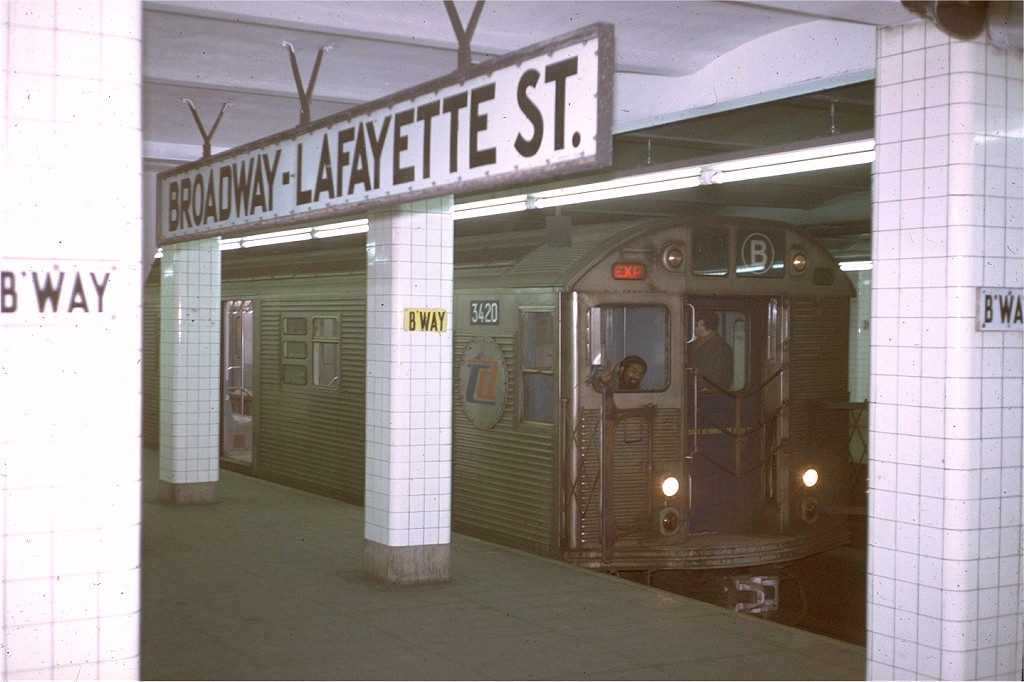
Broadway-Lafayette Street IND subway station in the then-Cast Iron District, January 23, 1971. (Photo by Joe Testagrose; courtesy of nycsubway.org.)
The traffic studies prove that most of Lower Manhattan crosstown traffic is interstate, which means that 90 per cent Federal funds are available for the expressway's construction. Then they prove that most of the traffic is local after all, and that the expressway is needed primarily just to get to the other side. They prove that traffic will be routed around, rather than through Manhattan, as a result of building the expressway, and they also prove that traffic will go directly to Manhattan destinations because of it. Slice it any way you want.
Only one thing is really proved - that there is a monumental and complex traffic problem for which Nostradamus might reliably predict a future pattern. And one thing Is not proved at all - that the expressway, at the expense of city-maiming, is going to solve it.
There is a Parkinson-type law that once you provide a super-route you do not just speed the already stuck cars and trucks on their way; you acquire a lot of new traffic. How much more non-Manhattan traffic will be attracted that would, or should, use Lower Manhattan as an interstate shortcut is a question that just won't go away. Or why that traffic should be dumped in Brooklyn. What will happen to the capacity of the Lincoln and Holland tunnels is another. How much more traffic can be shunted to still other congested Manhattan streets is one more.
A Port Authority statement made in favor of construction of the expressway some years ago claimed that the tunnels could, at that time, handle all traffic "which must travel between New Jersey and Manhattan." (Port Authority italics. Motorist vows on the necessity of their trips would ostensibly be handled by Port Authority toll collectors.) It was explained that nothing would be helped by enlarging the tunnels "and so dumping more traffic on the already overburdened streets of Manhattan."
The Port Authority's reasoning is incontrovertible. It applies equally well to the Lower Manhattan expressway.
What concerns this department most of all is something that has been least discussed: the destruction of the fabric of the city along the expressway route. There is a prevalent thought that depressing the road eliminates blight. This is not so, or only relatively so, to the degree that getting rid of a city-dividing superstructure is an improvement. But the social and physical fabric of the city along the proposed route has been deteriorating for the past 28 years. This is the blight that comes from being fingered for an expressway route, with the uncertain future of the area its only certainty.
Properties are not kept up; improvements are not made. Residential and business tenants share the insecurity that sends everything downhill. Twenty eight years of this can do a lot of damage. Along the Lower Manhattan expressway route there once was a healthy community and its remains are still there, blighted by the expressway before it ever got built.
The route is fixed where it will do the most possible historical and architectural damage. A line on a map does not begin to indicate the amount of destruction that will take place. To get the cars on and off that “line,” supporting and servicing construction must extend far beyond it. Not only will the entire north side of Broome Street go for the expressway's cross island path but sections of many streets beyond.
The area is known to historians as the Cast-Iron District, a mid-to-late-19th century structural and architectural development of particular importance to American building. Part will be destroyed and the rest irreparably damaged. The Haughwout Store on the northeast corner of Broome Street and Broadway, noted in many histories of architecture, is doomed. Greene Street, a uniquely intact enclave of iron architecture, will be hopelessly mutilated. One of the most respected critics and historians, Nikolaus Pevsner, informed a group of Americans
visiting England that "there is a veritable museum of cast iron architecture in downtown New York, a greater concentration than anywhere else in the world."
"Are you aware of this?" he asked. ''Do you recognize its unique quality? Are you letting the public know about it?"
The answers to Dr. Pevsner's questions are no, no and no. The Landmarks Commission has designated the Haughwout Store and held other hearings. The highway people did go so far, a few years ago, as to commission a survey of the buildings. The city knows that some of them contain flammable materials of industries of less than good housekeeping habits, which has led to some particularly tragic fires. Hell's Hundred Acres is the catchy popular name given to the district as a result, ignoring its history, culture, and some important economics.
For still another city survey came up with the information that this near miraculous 19th-century survival forms a valuable economic neighborhood. Small businesses of above average stability occupy irreplaceable low-rent loft space behind those handsome, rhythmic, cast-iron colonnades of shabby Victorian elegance. These necessary businesses, of the kind that the city has been losing, also give essential, hard-to-find employment to marginally skilled minority workers.
So - stack up economics, environment, sociology, art, history and people against that line across the map. If there is no guarantee, there must at least be a reasonable certainty that some problems are really going to be solved by the huge expenditure of funds and urban assets. We wouldn't bet our money on it, and what is being gambled with is the city itself.
By Ada Louise Huxtable
BOSTON, Feb. 4 - "Whatever it is, it's not beautiful," said the Boston cab driver taking the visitor to the new City Hall. "What would you call it, Gothic?" asked another. Which about sums up the architectural gap, or abyss. as it exists between those who design and those who use the 20th century's buildings. The new $26.3-million Boston City Hall has been an object of internationa attention and debate since the architects, Kallmann, McKinnell & Knowles, won the competition for its design in 1962.
A week of festivities marking its opening starts Saturday, with the official dedication on Monday. The move is virtually complete from the 1862 Civil War City Hall a few blocks away.
Boston can celebrate with the knowledge that it has produced a superior public building in an age that values cheapness over quality as a form of public virtue. It also has one of the handsomest buildings around, and thus far, one of the least understood. It is not Gothic. ("No kiddin'," said the cab driver.) It is a product of this moment and these times - something that can be said of successful art of any period. And it is a winner, in more ways than one.
Not only cab drivers are puzzled by the unconventional structure. Cultural and community leaders who are also society's decision makers and a public with more and higher education than at any time in history also draw a blank. Too bad about that architecture gap. It has a lot to do with the meanness of our cities.
Boston's new City Hall is a solid, impressive demonstration of creativity and quality - uncommon currencies in today's environment. A powerful focus for the new Government Center that has replaced the sordid charms of the old Scollay Square, it makes a motley collection of very large, very average new buildings around it look good. It confers, in a kind of architectural status transferral, an instant image of progressive excellence on a city government traditionally known for something less than creativity and quality. That is an old trick of architecture called symbolism.
The New Boston
They call it the new Boston, but inside the new structure Councilors Saltonstall and Timilty work side by side at old desks moved from the old City Hall that suggest the old politics. The City Council gave itself a raise but voted down the $24,000, room-size, horseshoe installation that would have completed the Council Chamber and accommodated all its members in the new style.
The Mayor, Kevin White, (ambivalent about the building), and the City Council (mixed reactions from approval to acute denunciation) are fighting over space now used as an exhibition gallery. Tradition dies hard in Boston.
The building will survive the councilors' objections and the Mayor's ideas of decoration. Its rugged cast-in-place and precast concrete and brick construction, inside and out (the New Brutalism, for those who like stylistic labels) is meant to be impervious to the vicissitudes of changing tastes and administrations.
The monumentality of this public building - and it is magnificently monumental without a single one of those pompous pratfalls to the classical past that building committees clutch like Linus's blanket - is neither forbidding nor austere.
It is an "open" City Hall. At ground level, it is meant to serve as a concourse to other parts of the city, and there are views of the city from every part of the structure. The visitor is made aware of the city in a very special way - of its history, in the architects' sensitively glass-framed vistas through deep concrete modular window reveals of adjoining Federal brick buildings and Faneuil Hall and the granite Quincy Market and waterfront to the east, and of its burgeoning growth in new construction to west, north and south.
No Small Achievement
This appropriate and finely calculated sense of historic continuity is no small architectural achievement.
Today's buildings rupture historic scale and this one was placed in the heart of historic Boston. But there is no "style-dropping" here. The architects have neatly disposed of Preservation Fallacy Number One. There are none of the overblown 'vestigial traditional details or "recalls” considered "appropriate" in such situations, milked of architectural meaning and offered as pious ligaments between old and new to create caricatures of both. This is subtle, dramatic, respectful homage to the past by an uncompromising present. It is a lesson in proper preservation philosophy and esthetics.
There is also a lesson in that basic element of building, the use of space. The entire structure is conceived as a progression of functional and hierarchical spaces. Its striking exterior reflects this arrangement.
A Molding of Space
This is not space as a container. See any office building for that. It is space molded to function, form and expressive purpose. The striking irregular shapes and surfaces that show the functions and mechanical services, all of which are more commonly hidden behind flat walls and ceiling slabs, are part of the visual and sensuous impact.
The building is a hollow rectangle around a court. Its focus is the lobby, which rises a dramatic nine stories on two sides to skylights, and centers on a platform of ascending brick steps. This is a space equally satisfactory to connoisseurs of the art of architecture and the art of sit-ins, and that is exactly what the designers had in mind as public architecture.
Above the lobby are the Council Chamber and offices and the Mayor's quarters. These large, ceremonial rooms are visible outside as rugged projections on the building's east and west facades, and as strong, broken wall planes inside, within the soaring skylight shafts. The upper levels are office space. This also shows clearly on the outside, as a massive, stepped "cornice" at the top.
In a Brick Plaza
The building stands, not in isolation, but on a still-unfinished fan-shaped brick plaza of stepped levels that will embrace the neighboring structures. This promises to be one of the more impressive of today's urban spaces.
It is as certain as politics and taxes that without the national competition that was held for this building nothing like it would have been designed or constructed. Mr. Kallmann and Mr. McKinnell were young and unknown as architects when they won. The usual route of public building commissions is through political patronage or to familiar, established names.
The architects have devoted seven years to the project, working with the Boston firm of Campbell, Aldrich & Nulty, and Le Messieur Associates, structural engineers. Virtually no changes have been made in the prize-winning design. The result is a tough and complex building for a tough and complex age, a structure of dignity, humanism and power. It mixes strengths with subtleties. It will outlast the last hurrah.
By Ada Louise Huxtable
THERE was an architectural "confrontation" recently - a meeting of the New York Chapter of the American Institute of Architects (Establishment) with representatives of the architecture students of Columbia University (Revolution). It was held, in part, as a result of last year's "events" at Columbia, in which the architecture school participated conspicuously and which led to the “restructuring" of the school's aims and curriculum.
The simply stated theme of the evening was that "The American Institute of Architects is Irrelevant." By the end of the evening the students had made it quite clear that they considered not only the A.I.A., but architecture as practiced by the A.l.A., irrelevant. More of that later.
The meeting was called by the Student Chapter Committee of the A.I.A. Since the Student Chapter Committee finds that it has no student chapters, it has “restructured" itself as the Student Affairs Committee of the A.I.A.
The meeting's announced purpose was to "let the members of the Chapter know what is happening to student and faculty attitudes, ideas. ideals and current thoughts." It was noted that in previous encounters the generations had “talked past each other.” The suggestion was made that those members of the A.I.A. wishing "to stay in touch with the 20th century attend."
Panelists were Percival Goodman, long-time liberal, practicing architect and professor at the Columbia School of Architecture, a man who has scrupulously steered clear of the Establishment; Mario Salvadori, a pioneer of modern reinforced concrete technology and chairman of Columbia's Division of Architectural Technology; and two Columbia architecture students as spokesmen for revolt and relevance, Peter Szego and Alan Feigenberg.
It was Hair versus Sideburns. This is a society that dresses for the part - even for throwing itself over.
The students were tieless, wash-'n'-wear revolutionaries, blue-jeaned or corduroy-panted and luxuriantly hirsute. They carried themselves with that slim, hard ease that none of the rewards of mature success make up for the loss of in middle age. Part of the generation gap is envy.
The architects, known for years for their button-down oxford personalities, dark knit ties and tweed jackets, have acquired a new image: modified Cardin-Edwardian with suppressed waists, discreetly rich silk ties and handkerchiefs, hair curling toward collars and, naturally, sideburns. Clothes may or may not make the man, but they are a dead giveaway of political and social stance.
To no one's surprise, the two groups talked past each other. The occasional, tangential breakthrough in which feelings or attitudes touched briefly seemed, somehow, sadder than no contact at all. A low-keyed bitterness built up in the paneled clubroom as the old groped toward the young (we are not all bad; accept us and what we have learned so painfully from life), and the young rejected their elders (what you call your knowledge is only fatigue and corruption and we do not want your world).
The Columbia students explained that as a result of restructuring the architecture school they were setting their own projects and defining their own goals, while working as advocacy planners in the ghettos. "But a restructuring device doesn't do a damn thing if attitudes don't change,” said Peter Szebo. The implication was clear that their elders had achieved no particular relevance or absolution by educational cooperation. The revolution was not called off.
Professor Goodman delivered a lengthy "J'accuse" to his fellow A.I.A. members. The Institute was irrelevant, he said, because it took no moral or political positions; it fought for no causes; it had no stands, for example, on master plans, expressways. preservation. Politicalize architecture, he said, to support issues. This was the familiar, rational intellectual liberalism of the 1940's and 50's, not the gut-ghetto radicalism of the 1960's. It sounded, horrible dictu, irrelevant. It was no longer on the student wavelength.
Professor Salvadori offered his credentials: a son in the S.D.S.; a tacit, warmly personal humanitarianism; an open mind. He had been teaching a class about one of his structural triumphs - the tallest concrete building in the world. "What's so good about the tallest concrete building in the world?" a student had demanded. "There's nothing so good about it,” he had admitted, forced to a radical reevaluation.
A beard-and-blue-shirt rose on the floor. “Where is the tallest concrete building in the world?"
"Johannesburg," replied Professor Salvadori.
"Where the blacks are held in bondage by the white power structure," rejoined beard-and-blue-shirt. “Architects lack a sense of human decency." The professor stood impaled. He explained that as an anti-fascist he had made the hard moral decision to leave family, country and livelihood before beard-and-blue-shirt was born. He suggested that hues of gray shadow black and white. "What's wrong with me," he said, "is that I'm 61."
A young stand-up comic from Cooper Union took the floor. Tension abated. "A builder named Arthur Roseman (name changed here) came to class and told us, ‘The cities aren't decaying; I'm building half of New York right now.'” (Laughter) “‘I use architects. I go to Emery Stone!’” (Laughter) “‘Why don't you go to Lou Kahn?’” (Laughter) “‘The point is” - pause for the point - "it wouldn't make any difference. Arthur Roseman makes the difference." (Relieved, cathartic laughter.)
"That kind of architecture isn't by architects," said Alan Feigenberg. "It’s by accountants."
"Your kind of architecture is irrelevant while we need housing,” said Columbia to the A.I.A.
"Are you going to build 10 million houses?" asked Cooper Union. "No, you are not going to build them because no one is going to give you the contract to build them. The enemy is the social system that will not bring you the contract for 10 million houses."
"You're a gentleman's club.'' said the students. “Labor union.” "Job insurance." "You're nowhere."
Stung, chapter officials cited a $10,000 grant given to Howard University by the A.I.A. Executive Committee for experimental low-cost housing for black communities to be carried out by an architect of the university's choice. A study committee for advocacy planning was described.
“Irrelevant," said the students. ''You can only be part of the times by being part of the times - not by study committees. We're action freaks.''
"Patience, gentlemen," said a gentlemanly senior architect.
"Power," said the students, with the sublime intolerance of the idealistic young. "You have abdicated your power by prostituting yourselves to businessmen and you have lost the public, your constituency. Politicalize. Radicalize."
"History has only one direction and it moves at a very high rate," Professor Salvadori cautioned the obviously disturbed architects.
At the end of the evening the gap was wider than ever. The young knew, with messianic assurance, that they were right about where the world went wrong; some of their elders knew they were right, and the old knew that the world beyond the ghettos would suffer terribly for their Rightness.
Values of civilization measured in hundreds and thousands of years and through just and unjust societies would suffer - and the keepers of those values would suffer from the omissions of youth’s non-negotiable crusade. Relevance was short-changed.
For the revolution is non-negotiable. And this column, of course, is irrelevant.
By Ada Louise Huxtable
It may be the time of the year or the state of the city or a combination of both that induces the doldrums, but this columnist is about to disappear briefly in search of nepenthe or restructuring of the soul. We will be back, but we leave with you the case of the Brooklyn meat market site as an example of what finally breaks the New York spirit, which can take a good deal more punishment than most. Such tales have or need no moral; they simply show the city as it is.
The Brooklyn meat market, about to be moved from the Fort Greene or Atlantic Terminal area, will be located on virtually the last prime piece of New York's unbuilt, "in-city" waterfront land: 13 acres of Brooklyn shore between the Brooklyn and Manhattan bridges, opposite the spires of lower Manhattan, with one of the most spectacular views known to history or man.
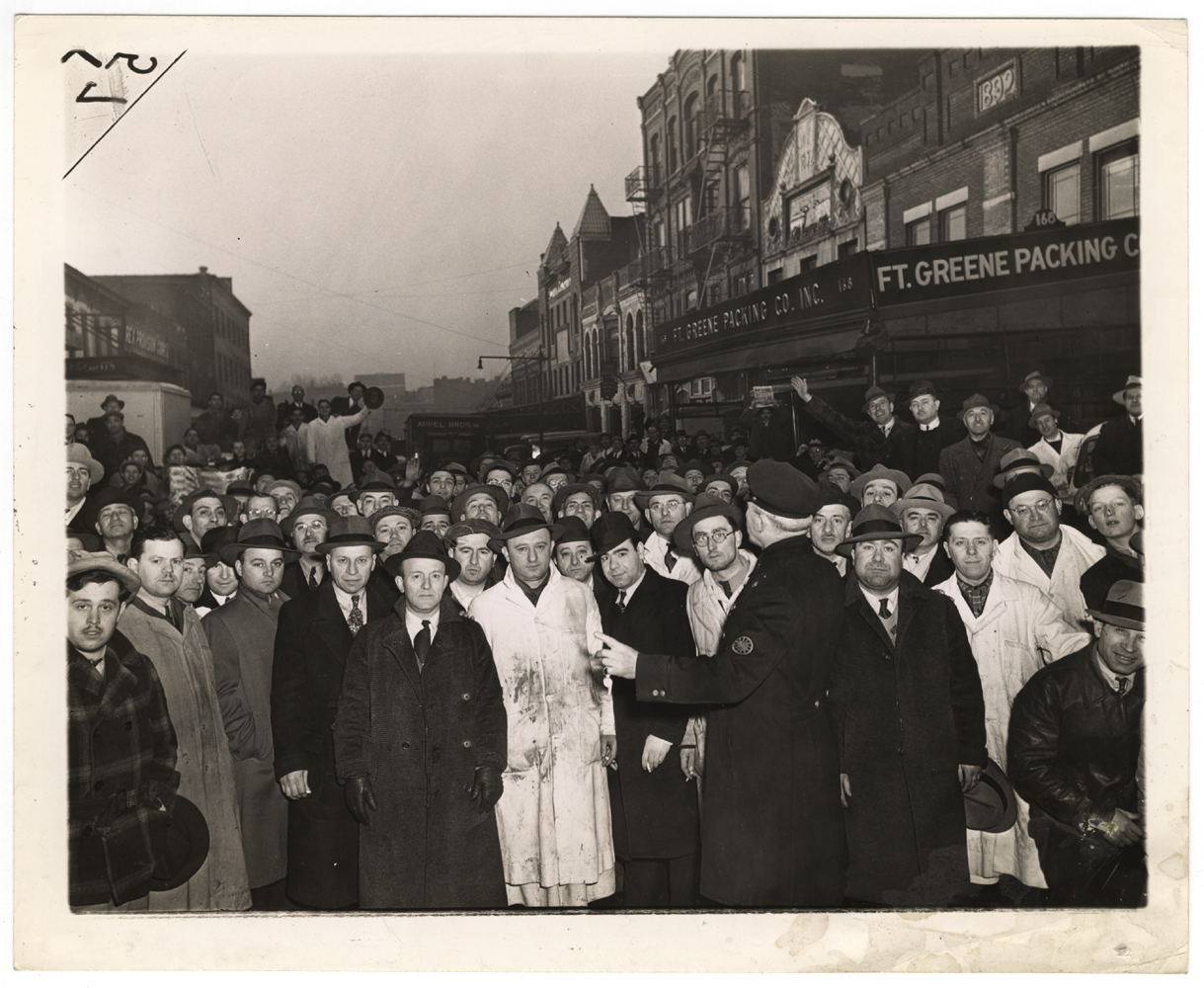
This c. 1940 Weegee photo offers a rare glimpse at the now-defunct Fort Greene Meat Market.
How and why this site was chosen - it was an action of the Site Selection Board, not an act of God - is not a story of corrupt or wrong-headed decisions by evil men, but of how events and circumstances in this city conspire to trap and lock decent people into actions that seem obviously and ludicrously wrong by any objective standard. Examined carefully, these "solutions" lead back into a miasma of conflicting political, economic and human claims, all of which combine to give reason a total pasting, and which add up, step by step and compromise by compromise, to decisions of pure and inevitable disaster.
The meat market is to be moved as part of the Atlantic Terminal renewal plan. An essential supplier of food and employer of minorities, the market is also rat-infested and neighborhood-blighting, and has a deadline to meet Department of Health regulations.
Removal of the market, basic to the area's rehabilitation, has been talked about since the late 1950's. The renewal designation of the Fort Greene-Atlantic Terminal area was made in 1963, and renewal plans were finally approved in 1968. The Site Selection Board, which has been considering possible market locations since October, 1967, introduced the present site in May, 1968 and approved it in October, 1968. Bedlam has accompanied the process every step of the way.
The Atlantic Terminal is a black community suffering from a number of serious environmental, economic and social ills, including the customary long delay between the city promise of delivery by renewal and any visible action. The slowness of the market's removal has become an inflammatory issue. There have been demonstrations and threats of violence.
Sites have been proposed and rejected. Canarsie and Gowanus, to put it mildly, were unreceptive. Each nomination was fought to a political standstill locally, as cries for action grew louder. And so the city acted. It picked the waterfront site between the bridges. It seemed a foolproof answer: an almost empty, largely city-owned, area with minimum relocation, containing little except a few 19th century warehouses, a ferry station, a city building of the 1930's, and truck parking, backing onto an area of light industry.
There were only a few things wrong. It was one of the city’s last pieces of undeveloped central, waterfront land, and an official policy of using or reclaiming the waterfront for people had been announced bv the administration with considerable fanfare. It was an irreparable loss, in this context, for waterfront housing and recreation.
The adjoining Brooklyn Heights community pointed out that it was also the last chance to integrate its neighborhood and the low-income Farragut houses beyond with a joint-use school that both blacks and whites had requested - uniquely in the city - and to provide a linking shoreline park and recreational area between them, according to the most desirable planning principles. With the housing crisis making headlines, it was also clear that an impressive number of incomparably located apartments could be accommodated. And there was that million dollar view of the river and the Lower Manhattan skyline, unparalleled by anything short of coming in by ocean liner.
A public increasingly sophisticated in urban matters and desperately concerned about housing mounted a protest. The city's site selection was scored as a tragic misuse of waterfront land; an expeditious political settlement born of familiar civic desperation; a short-term compromise that would be a long-term, locked-in mistake.
A crash study was embarked on by the Housing and Development Administration to prove to critics that everyone could have his cake and eat it, too - that the site could be developed for dual use, combining the meat market and recreation. But in a curious and quite unprecedented case of bureaucratic non-conformity, sone HDA people came to the conclusion that the two uses were not compatible. Convinced that the site should be used for housing, a school and a park as the critics maintained, they prepared a study model accordingly. It was schematic, but it made the point. If there is no medal for this kind of apolitical behavior, one should be struck by an appropriate citizens’ group immediately.
HDA was not being captious. Part and parcel of its scheme was the apparent willingness of the Bethlehem Steel Company to trade another site, adjacent to the Brooklyn Army base and the heavy industry of Bush Terminal, for the site between the bridges. The Bethlehem land would then be used for the meat market, and Bethlehem, which has been eyeing the construction field, would build housing on the liberated waterfront.
One of those really colossal meetings that only government is capable of was held, replete with HDA, City Planning Department and Economic Development Administration officials and Bethlehem representatives, and the city said no. A spokesman for the Planning Department explains that the land preparation of the Bethlehem site would be more expensive and take longer. This added preparation time. plus a repetition of the site selection process, would mean at least eight months' to a year's further delay. Redoing the site selection alone would take a procedural minimum of four months - count them, four - assuming no political complications. A spokesman for EDA says the money doesn't really matter: the only deciding factor is time.
There is still one other real and rational possibility - putting the meat market in the Brooklyn Navy Yard, which is being developed for industrial uses. This alternative was eliminated in earlier considerations because the Federal government was playing interminable footsie at that time over the transfer of the yard to the city. With the change in administration, the Navy Yard was dropped suddenly and magnanimously into the city's lap.
EDA Commissioner Richard Lewisohn tells the city that the market cannot go in the yard. He has told this reporter that the possibility is being "re-researched." All agencies now pass the buck to CLICK, the community-based Brooklyn organization to which the city has given the yard for development, and which has absolute authority in its charter to decide who the occupants will be. No time-consuming site selection process would be necessary. CLICK has yet to be heard from. The market, desperate but still cooperative, simply wants “to have the city stop waltzing it around.”
The Bethlehem solution would provide both a market site and new housing. The delay - eight months after eight years - seems a viable tradeoff for proper land use and the alleviation of a desperate housing need.
If the Navy Yard group relents, relocation of the market could be even quicker. And if Ed Logue's State Urban Development Corporation would build housing on that showpiece site between the bridges - something it is eminently qualified to do - New York could be a winner, for once. That is the way to have one's cake and eat it.
By Ada Louise Huxtable
THE British, given to understatement, call it Outrage. Americans persist in calling it progress. We are just beginning to recognize it for what it is - piracy of our patrimony. Demolition of the past goes beyond the destruction of history and art to the impoverishment of the environment and the loss of those physical factors that nourish the sense of identity and worth of individuals and a nation.
Take New York State. Anyone who wants to can add bulldozer-watching to foliage-watching this fall. If you're in the vicinity of Hudson, N. Y., this weekend, for example, you might warm up by attending the Sept. 15 hearing of the Hudson River Valley Commission. It has been called, with the National Trust for Historic Preservation, the New York State Trust and the Historic American Buildings Survey as interested parties, to consider the impending demolition of Hudson's General Worth Hotel.
This classical building, erected as the Hudson Hotel in 1837, is illustrated in Talbot Hamlin's definitive work on The Greek Revival in America. It is on the National Register; a landmark listing maintained by the Department of the Interior that represents the ultimate attestation of a building's historical or architectural value. It has been abandoned for the past six years and the city of Hudson plans to tear it down.
Hudson is a historic town caught typically in the dilemma of renewal. Laid out in the 18th century with a rare riverfront park, it was built substantially and beautifully in early 19th-century styles. Many of these buildings still stand. Some are beyond salvation, their ruin accelerated by slumlord abuse. A few are kept in the renewal plan. The hotel will go, not for new construction. however. but merely as spot clearance. It is part of a sadly deteriorated 19th-century block that the city wants to raze as a fire hazard, and. curiously enough, Federal funds will pay two-thirds of the demolition cost. Federal funds are also available for preservation.
The State Trust has offered a matching grant to the community to pay for half of the cost of rehabilitation, if the remaining half is raised in any fashion. But Hudson is also typical in its apathy toward the past. It exemplifies the common local lack of interest versus national, or "outside,'' concern.
In fairness, historic cities are in a dreadful bind. Federal aid for preservation in urban renewal areas has been too little and too late, with legislation enacted only after the national scope of the damage of total bulldozer plans became tragically clear.
But on the other hand, local plans almost universally ignore local assets of place, history and architecture. There is a sublime blindness in local programs and in consultants’ reports (big business now) that cannot be excused even in view of the obstacles of money, legal procedure and bureaucratic administration that seem stacked against a sensitive solution. There is a case to be made for at least starting by knowing what should be done. Lack of vision or even simple architectural incomprehension is reinforced by the pressing immediacy of problems ofphysical deterioration and economic crisis.
The renewal formula, repeated over and over, is the destruction of indigenous character and assets for a rubber-stamp commercial replacement of the most mundane kind of construction with no sense of place, quality or identity at all. The magic word is “new,” a magic that wears off quickly and disastrously. And thus we lose the only heritage the country will ever have.
That is the way we lose it officially. Another way is through private development. While you are in lovely Columbia County you might take a last look at a superbly sited historic mansion with sweeping valley views called The Hill, about four miles south of Hudson. It is a colonnaded beauty begun by Henry Livingston in 1796 and completed in 1801, modeled after a Palladian villa, or, more likely, Philadelphia's Woodlawn, with oval salons and Italianate detail. The authoritative WPA Guide to New York State, after describing Boscobel, which has been well restored and highly publicized, goes on to say, "Even more remarkable is The Hill…”
You can see The Hill until November, if the developer who owns the house and land keeps his word about the demolition date. Landmarks have a way of disappearing on development property if not watched. The developer, a Long Island real estate man, William Raganella, Jr., is obviously anxious to get the wrecking over with, although he has an abstract kind of sympathy for the quality and historic value of the house. But it could be quite a headache if it is still up when he takes his development scheme to the local planning board for approval, particularly if the State Trust's application for National Registry listing has come through.
His plan is to raze it before then. After all, he has an investment in a 60-acre lake, stream and highway frontage ripe for houses, apartments and industrial use, and if landmarks aren't sacred, investments are.
He says that the site is perfect for apartment houses. And irony of ironies, he points out that the nearness of the planned community college at Olana will create the housing market that he anticipates. The preservation of Olana, the home and studio of the Hudson River painter Frederick Church, has sealed the doom of The Hill.
Mr. Raganella is willing to sell the mansion, with five acres of land and no guarantee of what will happen on his acreage around it, for $75,000. It has been advertised in The Times, and a Hudson broker, Peter Drew, is handling it. The period furnishings were auctioned off “very successfully" this summer.
It would be nice, Mr. Raganella says, if the landmark could be saved, as long as it doesn't interfere with his plans. He suggests a country club or restaurant, but he has no intention of sponsoring it or proposing its community use tor the new, town-size development, under either his own or the county's responsibility. It is sell or raze, period.
"It's a white elephant as far as I'm concerned,” he says. "'There are potentials for this place - but I’m not the fellow who's going to save it."
Unless some fellow or some group does, The Hill will be reduced to rubble even before the development scheme is completed or approved. This raises some large questions for the Livingston or Columbia County planning boards or officials - now, not when it is too late - from the optimum development of this large tract of land to the best planning use of its natural, historical and architectural assets. Answers will be in the public interest.
If you still have the heart to follow the bucolic bulldozer trail, you could go north to Burlington, Vt. On the east side of City Hall Park are three buildings, a bank, an old fire station and City Hall. They form a containing wall for the open space of the park; something that urban designers know has the effect of stabilizing that space so that it does not "leak" off into traffic on all sides.
The building with the most character is the Ethan Allen fire station, a severe brick volume of considerable style and strength in the center of the row, that ties the two lesser volumes of the architecturally nondescript bank and City Hall together. In a sense, it saves them. But it is about to be torn down for a gap-tooth parklet between the buildings.
The reasoning is completely routine. It is cheaper to raze than to save, and apathy toward the building is matched only by bland unawareness of its architectural and urban role. It could be partially remodeled, as a holding operation at minimum expense, until further space is needed. But American cities seem bent on destroying themselves for the chimera of progressive change. If it is not profit, it is pragmatism, and both are the enemies of environmental excellence.
By Ada Louise Huxtable
ALTHOUGH the Juilliard School won't open formally till the end of the month classes have started and the first of its four theaters, Alice Tully Hall, is on a full-time operating schedule. It is now time to take a look at the last of the buildings of Lincoln Center. You can't hit sour notes all the time. The Juilliard School is a good building, free of the uncertain pretensions and pomposities of the Metropolitan Opera House, the New York State Theater and Philharmonic Hall. With. the Vivian Beaumont Theater, it forms the one corner of the Lincoln Center complex that makes a case with some conviction for the contemporary arts. It is also free of fake gold leaf.
A cultural truth that seems to have eluded the builders of most of today's cultural centers is that culture is all one thing. The art with which you house the other arts is part and parcel of the art of our time, and the buildings set an intellectual and sensory standard for all the rest. As one approaches, there is the exhilaration of greatness or the letdown of mediocrity. The tone and the mood are set.
Playing It Safe
It has been sincere, play-it-safe, gussied-up mediocrity almost all the way at Lincoln Center. The unsureness with which the committees of planners, sponsors and architects have dealt with this basic art and building truth, and the manner in which it has been compromised with pretty banalities and backswipes at tradition, with the intention of invoking the glamour of things past, makes Lincoln Center a cruel disappointment as a modern monument.
Turn right beyond the fountain, then, for the art of our time. The spaces you pass through are the most felicitous part of the plan; the main plaza relates happily to the secondary one to the northwest for those rarest of New York pleasures, pedestrianism and a touch of sky.
Travertine facing is the one tie between the subsidiary grouping of the Beaumont Theater and Juilliard School that adds variety to the static symmetry of the main trio. These two are stronger, better buildings than the tiresomely, tentatively traditionalized star structures. They have been released from the formula, and the formalism, of pseudo-classicism and mock colonnades. At least they know what they want to be.
Costly Equipment
My music colleague, Harold C. Schonberg, has called the new Juilliard the Taj Mahal of conservatories. It is a big, handsome building, 355 feet long by 200 feet wide (a city blockfront is 200 feet) and crammed with lavish facilities. There are five stories above ground and four below. The architects are Pietro Belluschi, with Eduardo Catalano and Helge Westerman associated. Its luxury, however, is in space - measured today by the solid gold foot - and equipment, not in materials and details. This is the era when status office buildings hover at $100 million. Juilliard is the Taj Mahal on a budget.
Close to $30 million has bought 490,000 highly specialized square feet, including equipment and furnishings. There are Juilliard's three theaters and Lincoln Center's Tully Hall, served by the most complex and advanced machinery, special orchestra and choral rehearsal rooms. 15 large dance, opera and drama studios, 3 organ studios, 84 practice rooms, 27 classrooms and ensemble studios, 30 private instructional studios, profligate scenery and costume studios and workshops, a library, lounge, snack bar and administration offices.
Beauty of Wood
If you look beyond the wall-to-wall carpeting, this large, institutional structure is stripped to a sp:utan simplicity. Surfaces meant to be wood-faced have been leit as bare concrete aggregate - sometimes an esthetic gain rather than a loss, although the concrete work often leaves something to be desired.
Wisely, there has been little skimping on the theaters, and they promise to be the best in town. Tully Hall has already been judged an acoustical pleasure, and Heinrich Keilholz, the acoustician, has been the consultant on the whole building.
Tully is attractive, with its wood walls, wood and plaster ceiling and lavender carpet casting 1930's-ish mauve lights in the foyer. But the Juilliard Theater opposite, not yet open, promises to be even better.
The entrance to the Juilliard Theater, red-carpeted, ringed with huge, clear glass globes of sparkling light, will have a wall-length Louise Nevelson construction at the foyer's west end. It is theatrically handsome without overreaching. Overreaching and underachieving have been the twin design hazards of cultural center committees.
Inside, black seats temper red carpet. This theater holds 961, as against Tully's 1,060, but its near-circular shape promises greater intimacy and liveliness than Tully's long, deep plan.
Meant for multipurpose use, it has an overwhelmingly complex, adjustable wood ceiling.
The two other theaters are the Drama Workshop and Paul Recital Hall, each with 277 seats. Paul Hall is a lovely cherry-wood miniature marred only by plastic seat covers (for economy), with an organ on stage - without the usual covering - that is an abstract sculpture hard to beat.
Theaters and working floors are tied together by a simple, dramatic architectural device: an open, central entrance court rising several stories, that gives focus and orientation to the building. Further focus will be given by a stone arch by the Japanese sculptor Masayuki Nagare.
The style, guided by Mr. Belluschi, an architect of notable sensibility who has worked most beautifully, in wood, for almost 40 years, is a kind of restrained establishment modern. It is not avant-garde, but its refinements and simplicities are timeless. With the Beaumont Theater, Juilliard offers architectural and esthetic reality to the cultural confusions of Lincoln Center, ending 14 years on an upbeat.
By Ada Louise Huxtable
THE case of the State Office Building, known in Harlem as the SOB, has turned into Governor Rockefeller's Vietnam. It is mired in the question of community participation, or the complex matter of who speaks for the real needs and wishes of the Harlem community, or even if anyone can. And it focuses on the basic problem of physical planning: how it can meet needs and desires on the local level if it is to have any degree of environmental success.
The great disaster of "planning," for black and white communities alike, is that in the past it has almost wholly failed to do this. Meant to create a bright new world for everyone, it became, through no consciously evil act but simply by following a kind of conventional real estate wisdom, a discriminatory operation. Called renewal or redevelopment, it has been an economic rather than a social tool, aimed at a set of limited economic objectives that have been essentially destructive of anything that does not fit into a preconceived pattern of certain types of acceptable financial benefits, largely to business and the tax structure.
What was destroyed in the process, in too many cases, were neighborhoods, such as Boston's West End, a now-classic urban renewal catastrophe, housing that the poor could afford, which was never replaced, and the variety, humanity and stability of older sections of any city that had worked out their own modest destiny. It bulldozed the shaky structure of the "underclass," and added fuel to minority fires.
That is why the case of the State Office Building has a particular importance. It goes to the root of planning practice.
The project was headed for trouble from the time Governor Rockefeller announced it in 1966, because he was operating under an old and already dangerously outdated set of rules. The assumption then was that all major revitalizing investments were going into other parts of Manhattan, with attention turned particularly to the huge expenditures of the World Trade Center, and that Harlem should get "a piece of the action." And so the Governor announced a State plan for the 125th to 126th Street block between Lenox and Seventh Avenues, with half of the site to be a State Office Building and half a cultural center.
At the time it seemed a courageous act for the State to go in where real estate men feared to tread. And the idea of economic and social integration still had considerable general currency; it was just the Governor's bad luck and timing that black self-determination was on the rise. It was further bad luck and timing that a group of Albany legislators promptly cut the cultural center out of the plan.
Opposition started immediately and grew in 1968. In the summer of 1969 a group of activists, the Community Coalition, occupied the site to prevent construction. The State's Urban Development Corporation then offered to finance the half-block of cultural or other neighborhood facilities that had been dropped, contingent on finding "a representative community advisory committee to work with." In September the police removed the squatters and the Governor announced that he was going ahead with the office building.
In October, three proposals for housing, a school, and a variety of social and commercial services for the entire block were unveiled by ARCH, the Architects' Renewal Committee in Harlem, a group of young black advocacy planners. Advocacy planners are a new breed of professionals that works within a community to express, and advocate, its wishes, often in opposition to government or official plans. ARCH has announced itself as unalterably against a State Office Building in any form, which it considers "in clear contempt of the needs and desires of the Harlem community."
A group of Harlem businessmen proposed a development corporation. CORE offered a compromise: state offices in a tower above a substantial community center that could be "built as far as the heavens,'' says Roy Innis, “barring negotiations with God.” Negotiations with God would appear to be easier than negotiations on the ground. It ds apparently as hard to get all the factions together in Harlem as it is in Paris, and peace seems equally far away.
A few facts about the controversy won't hurt. First, the State Office Building and cultural center project as originally conceived and released by the Governor’s office had about all the sparkling wannth and potential community vitality of a typical old-style urban renewal proposal. Color it black or white, that kind of block is devitalizing cities everywhere.
Second, there is that most interesting and sensational of charges hurled by the black activists - that the State Office Building presages a white takeover of Harlem. Actually, that's not nearly as far-out as it sounds, if you remove the grotesque implications of white establishment conspiracy.
What it really means, is that the routine redevelopment of parts of Harlem, as such development has occurred in other marginal neighborhoods, “upgrades” land potential in a way that it makes it profitable for real estate speculators to follow. What happens then is, in a sense, "takeover"; the residents are bulldozed out for an entirely different kind of institutional, commercial and residential community. Again, color it black or white; that is precisely what has happened in some of the city's other marginal neighborhoods.
To understand that this is not pure paranoid fantasy, one must think of those parts of Harlem close to universities or hospitals, or prime transportation centers such as 125th Street. The Harlem protesters are sophisticated enough to know that the prospect of the State Office Building was already attracting other potential outside investors. And when they question this kind of “revitalization" by asking "For whom?" - it is the same question being asked by social planners who have watched the process of dispossessing neighborhoods before.
Fact number three: the state has radically revised its position as to what can and should be put on the 125th Street block, even to the extent of considering the interiors of the State Office Building almost as a blank check for community-oriented services. Moreover, the state, in the form of the Urban Development Corporation, is now in virtually complete agreement with most of those who are claiming to speak for Harlem in the only area of general consensus - definition of what the community needs. That is housing and community and commercial facilities. Both sides suffer from a current malady: intransigence. Apparently the Governor has to have a State Office Building, no matter what the four walls contain, in part because he has already spent so much money on it. For the community it has become an odious symbol that must go.
Which leaves the Governor with his Vietnam. If he withdraws, and plans the development of the block without the State Office Building, he loses. Or does he? If the building is accepted by Harlem but used as a chance to drive a bargain for what it wants, the community loses. Or does it? Can there be an honorable, negotiated peace? Must there be unilateral withdrawal?
There is much to be gained for self-determination if the extraordinary legal and financial resources of the UDC available to Harlem can be used to carry out the projects that everyone wants. But the terms being dictated by activist leaders and the inability to unify community sentiment and representation into a working tool could weary the patience of God (mentioned by Mr. Innis but would He be acceptable to all other participants?) if they ever got that far. It is quite possible that the significance of the building is far less than whether the state and the community can get an effective partnership going. Both practically and symbolically, a lot of the American future rests on that.
By Ada Louise Huxtable
ERIC MENDELSOHN, the man who probably built more "modern architecture” more conspicuously in Europe in the 1920s than any of his fellow pioneers of the modern movement, settled on his style in 1914. "Guided by the conviction that the 20th century ushered in a new age replete with new laws," writes Susan King, "Mendelsohn elected to ignore the prejudices of traditional esthetics by venting his energies on architectural designs for a highly visionary future." These visionary designs, begun as thumbnail sketches of startling fluidity in the trenches of World War I, have become part of the legend and iconography of modern architecture.
Eighty of these drawings, in pencil, ink and crayon, done between 1914 and 1919, can be seen at the Museum of Modern Art through December 28. The exhibition, "Architectural Drawings of Eric Mendelsohn,'' installed by Ludwig Glaeser, curator of the Department of Architecture and Design, has been culled from a larger show at the University Art Museum at Berkeley prepared in cooperation with the Graham Foundation for Advanced Studies in the Fine Arts. The quotation is from Miss King's essay in the catalogue that accompanied the California show.
It is a shock to find that the famous drawings are tiny - many of the most dramatic measure only three to six inches - and yet they suggest huge buildings in a few broad, bold strokes. Seen now as calligraphic curiosities, they were then genuine visions of the future. In this remarkable graphic shorthand Mendelsohn offered miniatures of modern monuments: imaginary factories, railroad stations and grain elevators in steel and concrete. It was an architecture of new forms and materials, in flowing contours often packed with power, for a new age and a new art. "Look at my sketch." he has been quoted as saying, "there is everything in it."
The most curious of all these designs was actually built. The Einstein Tower, a solar observatory near Potsdam constructed in 1920-21, brought Mendelsohn immediate fame and numerous commissions. It is pure romantic expressionism, and he never built anything quite like its plastic, sculptural fantasy again. (I have always thought of it as a kind of Art Nouveau illustration for the old woman who lived in a shoe.) But no one who has seen it in pictures or actuality has ever forgotten it, and the building has continued to catch the imagination of architects and historians - used as a rebuke to "functionalists,'' championed by exponents of "organic architecture," and serving as timeless fuel for polemicists. It is still standing, and still fascinating, as evinced by the recent photograph on this page.
As a result of this instant monument, Mendelsohn built a great many structures, through which the style caiied "modern" became known to a great many people. More saw his department stores and office buildings in Berlin, Stuttgart and other German cities than were familiar with the scattered work of Mies or Le Corbusier, and the curved facades and ribbon windows that became his almost too facile signature were later run into the ground as ''modernistic" cliches.
He was far less successful in the United States, when he came in 1941, after eight years as a refugee in Holland, England and Palestine, and where he died, in 1953. There is an interesting analysis to be made of what happened to the work of such able men as Mendelsohn and Neutra when they were transplanted from the historical moment and the European milieu that nurtured their contributions to the different conditions, requirements and atmosphere of American life and environment. It is not how much they built, or even how well they built that counts; it is the changed significance and relationship of their buildings to the mainstream of history and culture, and even of art. Somehow, they always seem out of context.
But these vital and delicate relationships are not the only factors involved in reputations, or even in immortality. Taste, as is well known, also changes. It has been fashionable to look down on Mendelsohn's obvious style and too easy and early success. According to Wolf Von Eckardt in his sympathetic 1960 Braziller monograph on Mendelsohn, the rational rather than the intuitive architect has been more admired. Today Mendelsohn fits almost uncannily into the preferences of the younger generation, and is probably due for stylish, or campish revival.
Unfortunately, the Modern Museum's exhibition is not the historical exposition and evaluation that would be both desirable and timely. Mendelsohn was a member of "The Ping," the Berlin architectural group of avowed activists that included such disparate talents as Gropius, Mies and Bruno and Max Taut. The 20th-century architectural reformation included other groups, and a wide range of abilities and philosophies within its shared, quasi-religious conviction of the moral and esthetic necessity for a new order. But the tendency, still, is for historians and critics to do rigid "editing" in terms of their own conditioning and preferences. (Mendelsohn is not even mentioned in Sigfried Giedion's classic reference with its equally classic lacunae, Space, Time and Architecture.)
No institution has been more dogmatic, in this sense, than the Museum of Modern Art. It pursues its severe and absolute standards, measuring each exhibition candidate on an inflexible scale of "greatness" with the tunnel vision of true faith. Many a potentially valuable subject flunks when it is graded by this inexorable single standard and in this frustrating vacuum. However, with history, art and environment increasingly revealed as a many-faceted interlocking of values and relationships, the method becomes more sterile and useless and consistently less revealing of anything except the most dated concepts of art and life. It is, of course. awfully safe. That is a sad commentary on a once-revolutionary institution.
The reality gap at the museum, in fact, is not unlike the reality gap of Mendelsohn's generation. It is even a kind of hangover from it. The new world was to be created in an approved image, and anything else was simply not there. To bring that new world into being it was only necessary to embrace technology and set the mind resolutely free of the baggage of the past. As can be seen in such examples as Le Corbusier's Voisin plan for Paris, these men would have been ruthless with the bulldozer.
I do not write this with cynicism, or lack of appreciation for the achievements of great men, but with half a century of hindsight. The pieces of past and present are only now being understood in terms of the future, and put back together again.
To Mendelsohn and his fellow innovators architecture was simpler then; the artist believed that he was in total control of his art and his universe. What didn't fit was ignored. It seems almost touchingly arrogant. "What dominates the artist in the present is at the same time the medium through which he dominates the future,” Mendelsohn wrote from the front in 1917. "And so the world compels him to shape the world.''
By Ada Louise Huxtable
The bulldozer approach, say the official renewal pronouncements, is a thing of the past. Total clearance is dead. We are going to save our cities and spare our pastoral splendors and make an environment that is civilized and humane.
Or are we? Everyone who believes in fairies raise his hand and Tinker Bell will live. There is no corruption in Vietnam, no Mafia in Sicily, and there are no bulldozers anymore.
They’ve all gone to Lexington, Ky., where they moved in at night to start demolition of a three-block historic district, or they work weekends to insure the reduction of landmarks to rubble in Santa Fe. They stand poised to demolish everything around a few token preservation blocks in Denver; they wait to level 148 acres in Pittsburgh; they bide their time for the heart of the historic communities of Salem, Mass., and Hudson, N.Y.
Nothing much has changed except the statements of Federal policy that somehow get lost in the translation at the local level, and the increasingly pious use of the word environment — a poorly understood concept at best.
We know that our cities are decaying, our skies are shadowed, and our ecology is threatened. That word environment gets a fast response now; almost as fast as the bulldozer. The protests of “consumerism” are being directed to conservation – against those who consume and exploit the land and its resources.
But conservation is only half of the environmental picture. The bulldozer that tears up the farm or forest for the superhighway or the speculator’s sprawl with its inadequate sanitation and services is clearing the way for more than the irreversible loss of the country’s natural assets.
It is turning the first earth for an inexorable series of environmental disasters. It is the same bulldozer that pulverizes the urban neighborhood. What is begun with the despoliation of the land ends in the city slum. What is initiated with industrial waste finishes with industrial blight. What starts as an affront against nature becomes an affront against man.
Conservation and community are the two sides of the environmental coin. For the crisis of the environment is also the crisis of cities and of the man-made world. It is a crisis of survival and the soul — and of conscience, as well.
It is odd that this rich and pragmatic country should be having a crisis of conscience. It is even stranger that the awakening of conscience should be led by its youth. The issues of conscience have been civil rights, hunger and Vietnam. Now it is the turn of the environment.
In the cities, the giant social issues of justice and opportunity for the underclass have obscured some of the specific causes of physical and human desolation. They are also issues of conscience.
There are the asocial values of real estate, for example, on which our cities are built. It is traditional to treat shelter and society as negotiable commodities; so many bags of beans to be dumped when the price is wrong. The construction on which people depend for their homes and work is conceived not as environment, or as the shaper of cities, but as cash flow. Pollution and the cash flow environment have a lot of ugliness in common.
Add the high cost of land, labor, materials and money, the unrealistic cost ceilings on Federal aid — and the possibilities grow dim for building a proper environment at all. The only kind of housing still feasible economically is barbaric environmentally: the kind of massed, institutional barracks that have given Chicago, to cite one monumental instance, a new city-size set of social problems in its “safe and sanitary” superslums.
The renewal process has developed a curious corruption of its own. There is the game of Federal program musical chairs in which local administrators of smaller cities move from one to another in an easily traced route of weekend demolition and parking lots, carrying their blinders and bulldozers with them. You might call it a new kind of professionalism. And there is the sinister and sinuous web of municipal indifference, ignorance or malpractice that feeds on renewal needs and programs, as in the searing example of Charleston, W. Va., detailed in a recent Architectural Forum.
These private and public practices have gotten by because they are so firmly entrenched as the economic and bureaucratic verities, and the conventional American wisdom says don’t fight money or City Hall. But the verities and wisdom are being shaken up because the question is survival. What is needed is a brand of “environmentalism” akin to the current “consumerism.” A nation sick to death of the kind of “progress” that exacts a terminal toll from the environment could make it stick.