
Pulitzer Presidential Biographies to Read This President's Day

From Jimmy Carter's boyhood memoir to an early biography of Theodore Roosevelt by a Columbia Journalism School professor, discover these Pulitzer winners and finalists.
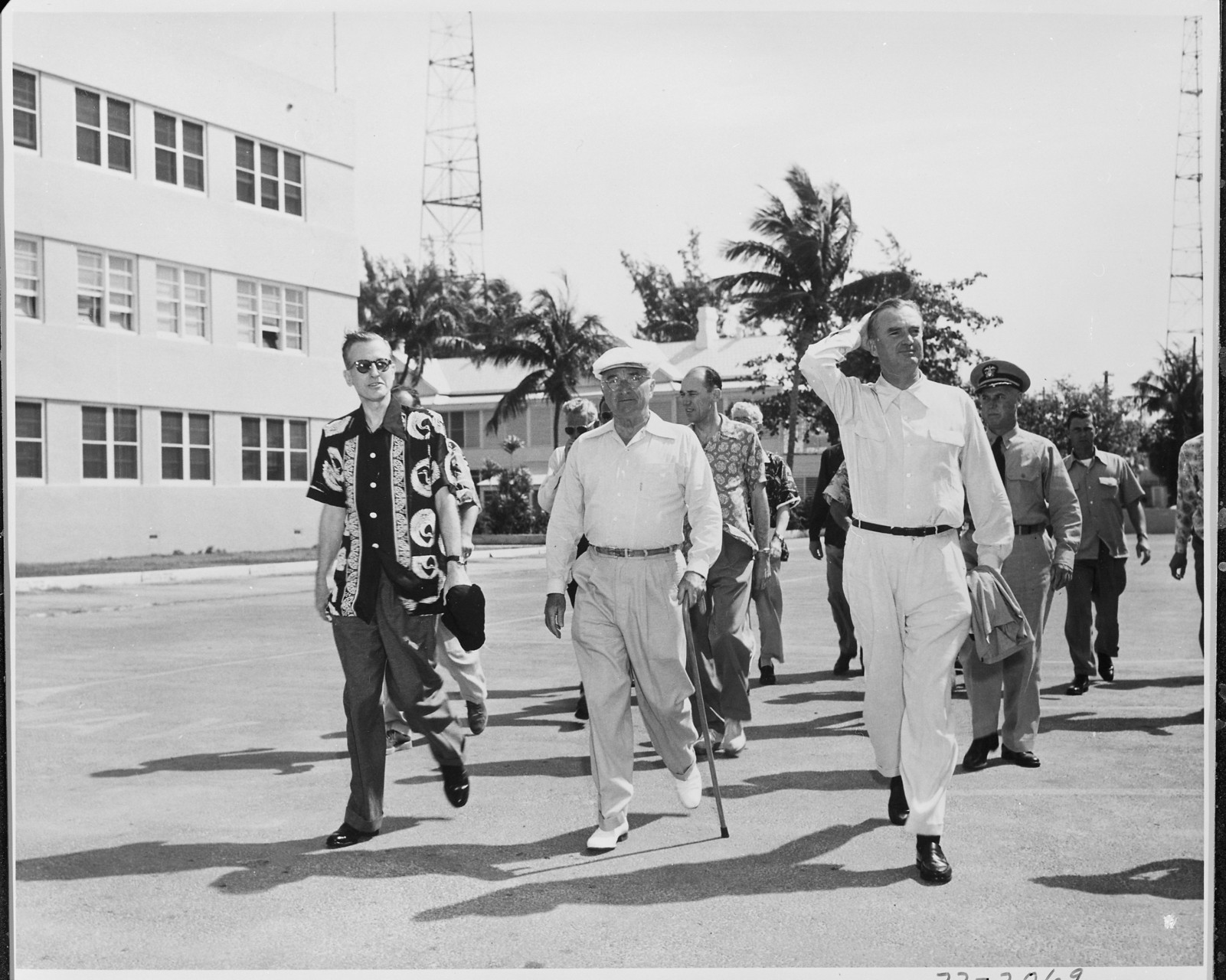
President Truman walks to the beach in the morning during a vacation at Key West, Florida, with Economic Stabilization Administrator Eric Johnston (left), Chairman W. Stuart Symington of the National Security Resources Board (right), and other members of his entourage. (Wikimedia Commons/Truman Library)

Over the past century, Pulitzer Prize-winning and nominated work has been intertwined with aspects of the presidency, from Don Whitehead's postmortem on the security plan for President-elect Eisenhower's visit to wartime Korea to Bob Woodward and Carl Bernstein's Public Service Prize-winning Watergate coverage. One of the most prominent interlocks between the presidency and the Pulitzer rests in the series of presidential biographies and memoirs associated with the award. Discover winning and nominated works that illuminate a range of presidencies, from Jimmy Carter's boyhood memoir to David McCullough's pathbreaking assessment of Harry Truman.


'Truman,' by David McCullough (Biography, 1993)

For decades, public perceptions of Harry Truman centered around him as a figure who preferred bourbon-fueled morning walks and Key West poker games to the intricacies of governance during his "accidental presidency." McCullough dispels this mythology in his first Pulitzer-winning book, which re-contextualized the 33rd president as a paragon of moderation in an epoch that saw the New Deal coalition challenged by a panoply of forces, including vice presidential predecessor Henry Wallace's leftist Popular Front, Strom Thurmond's white-nationalist Dixiecrat faction and the Old Right's adulation of General Douglas MacArthur, whose dismissal by Truman arguably forestalled any chance of the president being elected to a second term in his own right. Leaving office amid record employment and corporate dividends, Truman resigned himself to the fact that "his most important accomplishments [...] were in world affairs," a legacy cultivated under the aegis of Secretary of State (and 1971 History winner) Dean Acheson that manifested in earnest following the fall of the Soviet Union nearly 40 years later.

'Richard Nixon: The Life,' by John A. Farrell (Biography finalist, 2018)

A finalist for the 2018 Biography Prize, Farrell's opus centers on a unique life of "complexity and contradiction" that has spawned a range of other work, from Fawn Brodie's early psychobiographical work to 2012 History finalist Anthony Summer's "The Arrogance of Power" (1999), which delineates Nixon's alleged drug and domestic abuse. Academically talented and socially maladroit, Nixon's inability to secure a Wall Street white-shoe position after graduating near the top of his class at Duke Law School in 1937 proved a foundational experience, ostracizing him from the era's WASP establishment and fueling the racist and anti-Semitic invectives that suffused the Watergate tapes. Farrell described how a key comeback in American political history — Nixon's divisive 1968 presidential campaign — was fueled by his approval of a plan undertaken by Anna Chenault, a pro-Taiwanese society hostess and the widow of Flying Tigers hero Claire Chennault, to sabotage Vietnam War peace talks. Ultimately, the author concluded that Watergate "was part of a continuum" of executive overreach in the interest of the national security apparatus that extended through several presidencies. But "frustrated by the aging J. Edgar Hoover's aversion to risk," he decided to "bring the black back boys" (including former CIA agent E. Howard Hunt) "in-house." There was "no deniability," and Nixon's legacy would become entwined with the shocking sequence of events that precipitated his resignation in August 1974.

'Abraham Lincoln: The War Years,' by Carl Sandburg (History, 1940)

An eclectic force in American literature until his death in 1967, Carl Sandburg's oeuvre ran from poetry to journalism and a formative role in the American folk music revival, earning plaudits from such disparate figures as four-time Pulitzer winner Robert Frost and 2008 Special Citation recipient Bob Dylan. In the midst of his more conventional work, he undertook a six-volume biography of Abraham Lincoln that spanned nearly two decades of research and writing. With the 16th president still excluded as "too obvious a subject" for the Biography Prize, the final four volumes (corresponding to his presidency) were instead awarded the 1940 History Prize. Amid the emergence of increasingly sophisticated historiography, Sandburg's poetic depiction of Lincoln bemused such professional luminaries as Charles Beard and Milo Milton Quaife, with the latter condemning the writer's "naive conception of what constitutes evidence." Yet various editions of Sandburg's work remained in print for six decades, and most subsequent cultural depictions have drawn upon the wellspring of his singular legendarium.

'Master of the Senate,' by Robert A. Caro (Biography, 2003)
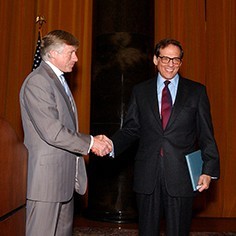
Lee Bollinger and Robert Caro
After receiving the 1975 Biography Prize for "The Power Broker," a labyrinthine biography of New York political figure Robert Moses, Robert Caro raised the stakes with his life of Lyndon Johnson. Due to an unanticipated surfeit of information obtained in the research process, it expanded into a five-volume series. Today, the 84-year-old Caro continues to work on the final book, which will explore the antipodes of the War on Poverty and Vietnam. Caro received his second Pulitzer in 2003 for "Master of the Senate," which primarily covers the period that stands as Johnson's professional apogee: his 1953-1961 tenure as Senate Majority Leader. As Caro writes, the key to Johnson's success was a kind of code-switching: Coupled with frequent and invasive psychological tactics, he cultivated key relationships with the liberal wing of the party (which remained suspicious of his motives) while retaining the fealty of the Southern Democrats who had revolted in 1948.

'Theodore Roosevelt, by Henry F. Pringle (Biography, 1932)

Journalist Henry Pringle was a key member of the Columbia Journalism School's faculty as the institution solidified its reputation in the 1930s and early 1940s. His life of Theodore Roosevelt (which received the 1932 Biography Prize) is a watershed in political journalism, anticipating the irreverence of later figures (including Hunter S. Thompson, Alexander Cockburn and Matt Welch) in its rakish skewering of the beloved 26th president. Pringle (writing as the early Great Depression unfurled) takes relatively little umbrage at Roosevelt's clarion record — but his persona and temperament are different matters. "Roosevelt was not finished with his role as the Conscience of Big Business and he was still to chastise the railroads and the Standard Oil Company," he wrote of the beginning of Roosevelt's foreign policy-heavy second term. "A vaster stage was being prepared, however." It is a testament to Pringle's style (alongside Roosevelt's Progressive Era transparency) that the biography remains in print through a major publisher to this day, and Edmund Morris' Pulitzer-winning "The Rise of Theodore Roosevelt" offers a more nuanced assessment of the complex class dynamics that undergirded Roosevelt's public persona. Despite this caveat, "Theodore Roosevelt" is a classic worth rediscovering.

'An Hour Before Daylight: Memories of a Rural Boyhood,' by Jimmy Carter (Biography finalist, 2002)

Although most former presidents since Gerald Ford have earned much of their income through paid public appearances, Jimmy Carter took a different route, focusing his efforts on teaching (through a professorship at Emory University), book writing and humanitarian work. The latter would earn Carter the 2002 Nobel Peace Prize, and he also received the nominated finalist distinction in the Biography category that year for a memoir, "An Hour Before Daylight." While political junkies would be better served by his "White House Diary" (2010), "Daylight" explores the profound tensions of Carter's boyhood in Archery, Georgia, which was at once privileged (his father was a businessman in nearby Plains) and filled with depredations, including a dearth of electricity and indoor plumbing. Jim Crow-era segregation was normalized, and the elder Carter remained complicit in the social order. But in local A.M.E. Bishop William Decker Johnson, the future president found a mesmerizing figure "whose character seemed to change during his sermon," a signpost to an almost unimaginable future. For those interested in the history and the culture of the United States, "An Hour Before Daylight" is a microcosm of one person's remarkable experience.