
Pulitzer Journalism to Read as Election Day Approaches

From David Broder's coverage of the 1972 presidential election to Anthony Leviero's bombshell reporting on the Truman-MacArthur feud, discover these Pulitzer winners and finalists in the days leading up to the election.
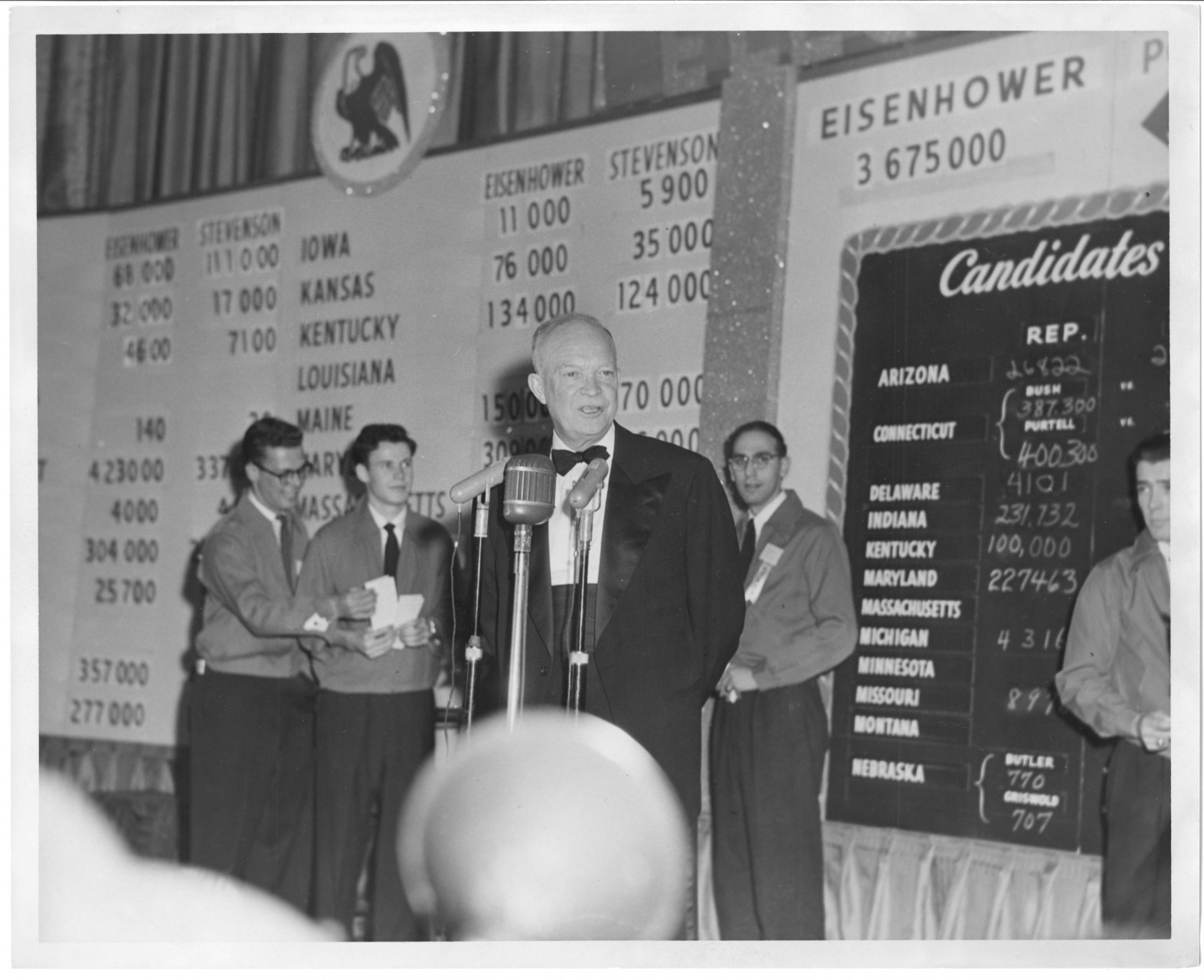
Then-Columbia University President Dwight D. Eisenhower on Election Day, 1952. (Scan #0401. Historical Photograph Collection, Columbia University Archives.)

Over the last century, Pulitzer Prize-winning and nominated journalism has been fundamentally intertwined with American political life, from Damon Winter's 2008 Feature Photography Prize-winning coverage of Barack Obama's presidential campaign to James "Scotty" Reston's 1957 National Reporting Prize-winning columns on Dwight Eisenhower's frail health. As the 2021 election approaches, discover winning works that illuminate the milieu, from Anthony Leviero's reporting on the conflict between Harry S. Truman and Douglas MacArthur to David S. Broder's conventional wisdom-bending columns on the 1972 presidential election.


1.

Damon Winter of The New York Times (Feature Photography, 2009)
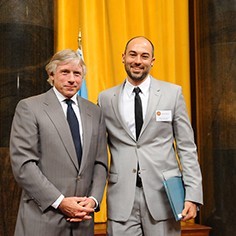
Lee Bollinger and Damon Winter
Damon Winter's 2009 Feature Photography Prize-winning coverage of Barack Obama's historic 2008 presidential campaign offered some of the most indelible images of the time, from the jubilant sight of Malia Obama running toward her mother onstage at a rally in Springfield, Mo., to a lone, silhouetted law enforcement officer standing guard as the then-junior senator from Illinois spoke to a crowd of 10,000 supporters at the University of Alabama. In a 2009 interview with Alexandra Fenwick of the Columbia Journalism Review, Winter reflected on his process, saying, "The challenge is to find those real moments within the context of the staged events. So it involves a lot of just waiting and watching and walking and searching and looking for these little moments and paying attention to the details about what’s going on." The presidency and Pulitzer-winning photojournalism intersected at other points as well. Notably, 1972 Feature Photography winner David Hume Kennerly went on to serve as President Ford's White House photographer. In 1993, Associated Press staff coverage earned the Feature Photography Prize.

2.

Jo Becker and Barton Gellman of The Washington Post (National Reporting, 2008)
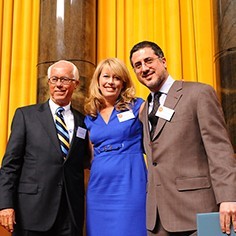
Richard Oppel, Jo Becker and Barton Gellman
An insignificant and ill-defined office in early American history, the vice presidency enjoyed a resurgence in the second half of the 20th century. During the 2001-2009 presidency of George W. Bush, the nature of the role shifted again under the vice presidency of Dick Cheney, as explored by Jo Becker and Barton Gellman in their 2008 National Reporting Prize-winning chronicle of his incumbency. A longtime insider with unprecedented executive and legislative experience (including stints as White House Chief of Staff, Secretary of Defense and House Minority Whip), Cheney conceptualized the office as an integral part of both branches, serving as an all-purpose counsel to the president (Becker and Gellman hastened to mention in the first article of the series that he was not a "shadow president," contrary to popular belief) while overseeing "an operational world in which means are matched with ends and some of the most important choices are made," effectively acting as a chief operating officer to President Bush's chief executive. When predecessor Dan Quayle warned Cheney that he would be "going to funerals," the newly inaugurated vice president offered a rejoinder: "I have a different understanding with the president." The reporters noted that Cheney's interpretation of the position was largely derived from an aborted 1980 "dream ticket" venture to install President Ford as Ronald Reagan's running mate; this would have been contingent on the presumptive nominee relinquishing certain duties (including personnel management and "influence over the budget") to the former president. The series would serve as the basis of Gellman's 2008 biography "Angler."

3.

David S. Broder of The Washington Post (Commentary, 1973)

Long regarded as the "chairman of the board" of the Washington press corps and a familiar face to millions of Americans by virtue of his regular appearances on NBC's "Meet the Press" and PBS' "Washington Week," 1973 Commentary winner David S. Broder brought a learned mien (including a master's degree in political science from the University of Chicago) to the realm of political opinion journalism. Flanked by the dual specters of Watergate and the gonzo journalism of Hunter S. Thompson, Broder offered a circumspect middle ground with the benefit of 50 years of experience. As the Democratic convention neared, he noted that "a shudder of apprehension" analogous to the similar backlash to Barry Goldwater's installation as the 1964 Republican nominee had followed the campaign's "organized invasion of the delegate-selection process," building upon its novel arbitrage of the primary and caucus processes. Campaigning as if he did not enjoy the benefits of incumbency due to his divisive reputation among younger voters — and mindful of his earlier missteps — Richard Nixon cast a "wall" between himself and the campaign press corps, seldom convening press conferences and often "[traveling] in isolation — in his private compartment on Air Force One, in his helicopter or his limousine." Broder surmised that Nixon's landslide (encompassing 49 states and 520 electoral votes) amid continued Democratic majorities in the House and Senate would "deprive the Republicans of most of the coattail benefits" of Nixon's victory; lacking an intuitive connection with his base, much of his support hinged perilously on "grievance voters" who were galvanized by the president's leadership in the culture wars of the era but not necessarily contemptuous of the post-New Deal safety net.

4.

Don Whitehead of the Associated Press (National Reporting, 1953)

In many ways, the election of Columbia University President and General of the Army Dwight D. Eisenhower to the White House in November 1952 was a direct byproduct of the chasm between Truman and MacArthur that permeated media coverage throughout the long campaign season, with Americans seeking a centrist who bridged interventionism with concern for the social justice of the New and Fair Deals. A four-pack-a-day smoker who retained a taste for scotch, gin and wine well into his dotage, Eisenhower's aged visage was deepened by a litany of maladies throughout his administration, including a serious heart attack (the first of seven) in September 1955, Crohn's disease-related bowel obstruction surgery less than a year later and a mild stroke in November 1957. While his administration spanned the birth pangs of desegregation, the opening salvos of the space race and the beginnings of American involvement in the Middle East, Eisenhower frequently was subordinated in the popular consciousness as a semi-retired figurehead by the media-savvy likes of White House Chief of Staff Sherman Adams, Director of Central Intelligence Allen Dulles and erstwhile Nazi rocket engineer Wernher von Braun, who ensured public support for the fledgling American space program by participating in lavish Disney-produced docudramas for the emerging medium of television. For all of the hand-wringing concerning Eisenhower's health and presumed inertia, venerable Associated Press journalist Don Whitehead earned the 1953 National Reporting Prize for "The Great Deception," a dispatch that presented the then-President-elect in all of his wartime gregariousness during a surprise December 1952 trip from Columbia (where much of his presidency had been devoted to concurrent military assignments) to wartime Korea. While detailing the requisite security precautions and relative amenities (including "special cooks and waiters"), Whitehead's portrayal of Eisenhower is in line with the laconic, unpretentious hero who emerged as an inspirational avatar for the U.S. during World War II. As Wayne Melvin, an Army captain from Los Angeles, recalled to Whitehead: "I rang No. 10 and after while somebody answered and I asked if Major Weldon was there. This guy said, 'No, Weldon wasn't there,' and I asked if he knew where I could reach Weldon. He said: 'No, I'm just a visitor here.' And then I knew I was talking to Eisenhower."

5.

Anthony Leviero of The New York Times (National Reporting, 1952)

A Brooklyn-reared reporter who ended his formal education after junior high school (save for intermittent courses at the City College of New York and Columbia), Leviero rose to the rank of lieutenant colonel as an Army officer in World War II and subsequently emerged as one of the leading Washington correspondents of his era. He received the 1952 National Reporting Prize for a single article revealing the earliest dissension between President Harry S. Truman and General of the Army Douglas MacArthur at the Wake Island Conference of October 1950, presaging Truman's relief of MacArthur's Korean War commands in April 1951. A watershed moment in civil-military affairs that resonated in the later presidential removals of Major General John K. Singlaub (who opposed President Carter's South Korean strategy) and General Stanley McChrystal (who made disparaging comments about President Obama's administration in a Rolling Stone profile), the Truman-MacArthur dispute cast the United States' senior-most military officer — widely regarded as the living paragon of soldierly rectitude after he received the Medal of Honor for his leadership in the Battle of Bataan — against an unlikely (and often unpopular) president. Capturing the general in the immediate aftermath of his strategic apotheosis at the Battle of Inchon in September, Leviero's reportage revealed MacArthur doubted the prospect of Chinese intervention in Korea at Wake Island and offered the reassignment of his “best troops” (the Second Division) to Europe by January. However, within a month of the conference, more than 180,000 Chinese troops had crossed the border into North Korea, prompting MacArthur to send American troops in an ambiguous interpretation of standing orders from the Joint Chiefs while also briefly contemplating 34 tactical nuclear strikes against North Korea. While nuclear escalation was soon off the table amid the outcry, the five-star general's continued vociferousness toward China — exemplified by intercepted diplomatic communiques in which he informed Spanish and Portuguese diplomats of his intention to soon dispose of the "Chinese Communist question" and Task Force 77's "aerial parade" alongside the mainland Chinese coast on April 11, 1951, potentially jeopardizing the crew of the nearby USS John A. Bole — prompted Truman to relieve him that day. Shortly before his death, Truman offered a caustic assessment: "I fired him because he wouldn't respect the authority of the President. I didn't fire him because he was a dumb son of a bitch, although he was, but that's not against the law for generals. If it was, half to three-quarters of them would be in jail." The historical undercurrents of the imbroglio would extend far beyond the Korean War. Indeed, Leviero's article did little to engender public circumspection against MacArthur, who became chairman of Remington Rand in addition to remaining on nominal active duty until his death in 1964. Meanwhile, Truman's approval ratings reached an ebb only rivaled by Richard Nixon in 1974 and George W. Bush in 2008, as his administration faced allegations of Soviet espionage and an investigation of alleged corruption among senior administration officials by gadfly Tennessee Senator Estes Kefauver, all but ensuring the diminution of his reputation until the publication of David McCullough's Pulitzer-winning biography in 1992.