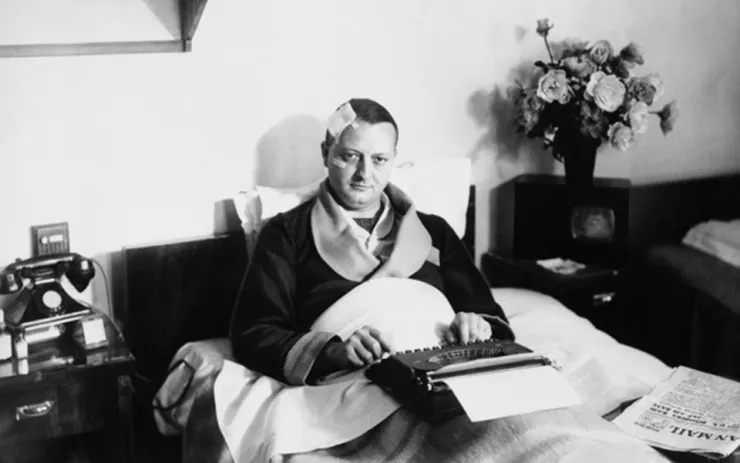
Larry Allen of the Associated Press had been assigned to Europe to cover the war. In November of 1941, shortly before Pearl Harbor, he boarded the light cruiser HMS Galatea, which by then was part of the British Mediterranean Fleet. In formation it traveled as the last ship of the 15th Cruiser Squadron.
On Dec. 14, the Germans dive-bombed the squadron off Libya, but the Galatea withstood the attack. At midnight the ship’s speaker system blared yet another attack warming. Within two minutes the first torpedo hit the ship. A German submarine, U-557, patrolling between Alexandria and Tobruk, scored one and possibly two more direct hits. The Galatea sank within minutes.
Possibly for wartime censorship reasons, Larry Allen’s story about this night ran on Jan. 10, 1942, almost a month after the disaster. Although Allen could not swim and nearly drowned several times, he was one of about 100 men who were eventually picked up by the destroyer HMS Griffin and a second rescue ship. But 449 men were killed, including the Galatea’s captain, a World War I veteran named Edward William Boyd Sim.
Among the dead was also Alexander Massey Anderson, the Reuters correspondent who had run along the deck with Allen as the torpedoes rocked the ship.
On Dec. 16, the same day the captain of U-557 reported sinking the Galatea, an Italian torpedo boat detected a submarine near Crete. Its captain assumed it was British and rammed it. In fact, it was the U-boat of Italy’s ally, Germany, the U-557.
Allen’s harrowing personal account of his survival was part of a package of stories on the British Mediterranean Fleet that were awarded the 1942 Pulitzer Prize in Telegraphic Reporting (International).
The waves seemed to carry me farther away as I screamed for help
Alexandria, Egypt, Jan. 10 (AP) – The British light cruiser Galatea, struck by three torpedoes from an Axis submarine, flopped over like a stabbed turtle and went down within three minutes off Egypt’s Mediterranean coast in the inky darkness just after midnight on the morning of December 16.
The torpedoes, launched from close range, smashed in swift succession against the Galatea’s after-portside, amidships and forward, tearing into her interior with loud blasts and spurting flame.
On the dying cruiser’s quarterdeck I clung tenaciously to the starboard rail until the list of the ship flung me into the cold, choppy sea. Then I battled through thick, oily scum for forty-five minutes before being rescued.
We had been dive-bombed for more than seven hours on December 14, while patrolling with a squadron of cruisers and destroyers off Libya, but the Galatea successfully beat off those attacks and headed eastward.
At midnight on December 15, the cruiser’s announcer system warned: “First-degree readiness heavy armament.” Gunners thus were ordered to stand by for expected action.
A Marine sentry aroused me from a nap in the captain’s cabin, and I ran to the commander’s cabin and informed the Reuters naval correspondent, Alexander Massey Anderson. Adjusting life belts, we stepped out into the inky blackness of the quarter-deck and raced toward the bridge.
We had barely started when the first torpedo smashed into the after-portside with a burst of flame, heavily rocking the Galatea. The time was 12:02 AM.
Torpedoes seemed to chase us along the deck, for the second crashed through amidships with a blinding flash and a third struck forward, just under a six-inch gun turret. The ship shuddered all over.
Then as it dipped quickly and deeply into the sea on the portside I caught hold of the deck rail, dropped my tin helmet, bomb anti-flash gear and raincoat, and with one hand unscrewed the nozzle on the life belt hose hung around my neck. I blew into it with all the breath I could summon, inflating it just as the cruiser flopped completely over.
The sharp keeling over of the ship flung me sliding down the starboard side into the sea. Hundreds of officers and seamen plunged into the water along with me.
Anderson had reached the railing a little to the right of me. I heard him shout something to an officer as I slid into the sea. I never saw him again.
I could not swim and was fearful lest the pressure of a deep submersion collapse the old life belt which I had retrieved after the bombing of the Illustrious just one year ago today.
As I slipped under the water the cruiser disappeared with a tremendous suction, leaving a huge lake of oil. There was one muffled blast as she took her death plunge.
I swallowed large quantities of oil scum and water before I bobbed to the surface. The sea all around was dotted with heads of hundreds of sailors.
Several sailors had succeeded in getting a small motor lifeboat launched. Trying to splash toward it I went under again. My lungs felt as if they were bursting, but I came up, and a sailor helped me aboard the boat.
But a score of others had the same idea. The boat’s stern rapidly filled with water as the weight of more and more men pushed it down. Finally it tipped over, hurling us all into the sea.
I managed to reach the boat and pull myself into the front cockpit again. Then the boat sank.
With a lone sailor I hung to the very tip of the bow until it slipped beneath the waves. I even hung on until it pulled me under and I got another large dose of oil and water. I strained every muscle to force my head above the surface. From beneath the waves a pair of hands reached up and pawed at my shoulders, then slipped away.
I collided with a small floating spar. Desperately I tried and succeeded in tucking it under my left arm, still carefully holding up the life belt with the right.
I joined with scores of others in crying for help, hoping in the pitch darkness to attract the attention of the destroyers. No one had a flashlight, so it was difficult for the rescue ships to find us.
At that moment I saw a huge black silhouette of a destroyer about seventy-five yards ahead.
“Help, I’m drowning,” gasped a sailor in the water near me.
“Keep going,” I called weakly. “Look, there’s a destroyer ahead.”
That seemed to give him new energy. He swam toward the destroyer. I tried, but couldn’t get any closer. The waves seemed to carry me farther away as I screamed for help.
A big wave swamped me again with a mouthful of oil. Then, as if miraculously, another wave pushed me forward almost directly under the propellers of the destroyer Griffin.
I called for help until my throat felt burned out. Suddenly a long oily rope was flung over the side. I grasped it but there was no strength left in my hands.
“Hang on!” an officer on the ship shouted. “We’ll pull you up.”
“Can’t!” I called as the rope slipped from my fingers.
“Try to get a little forward,” the officer shouted. “We are putting over a rope ladder.”
Somehow I managed to propel myself forward and hang onto the ladder, safe, but so spent that I couldn’t pull myself up even the first rung unaided.
At that moment a life raft drifted against the destroyer’s side. I repeatedly banged my head against the warship and cried out time and again, “Stop it! You’re killing me!”
Sailors on the raft grasped the rope ladder and clambered up to safety while I fought desperately to keep from drowning. Several stepped upon my head, pushing me down into the water.
Only half conscious, I hooked my right arm through the rung of the ladder, which helped keep my head above water occasionally, and again I called out for help. A young British sailor aboard the raft saved my life.
“I’ll help you!” he shouted. “Get this rope under your arms!”
He passed a thick, heavy rope under my arms, tied it, and flung the end to the quarter-deck of the destroyer. Three sailors slowly pulled me out of the oily mass.
“This fellow’s an American,” I dimly heard someone say as they read the words “American naval correspondent” on the sleeve of my oil-soaked coat while pressing the water from my lungs.
They cut off all my clothes and carried me to the mess deck below, where nearly one hundred other survivors were getting medical attention.