For the Record


Trump’s TikTok restrictions ‘likely exceed’ his legal authority

Trump’s TikTok Restrictions 'Likely Exceeded' Legal Authority:


The Trump administration likely exceeded "its legal authority with its order to ban TikTok downloads in the U.S. and impose other restrictions on the video-sharing platform," U.S. District Court Judge Carl Nichols wrote in a previously sealed opinion disclosed Monday, according to Cristiano Lima of Politico. Nichols was nominated by President Trump and took office last year. Lima added that "legal teams for TikTok and the Trump administration are expected to meet by no later than Wednesday to propose next steps in the case, which will weigh whether the administration violated the company’s rights through its executive orders."

We’re Resigning from WSN. Here’s Why.

NYU Student Newspaper Staff Resigns:


The fall 2020 editorial staff of New York University's student newspaper resigned en masse Monday after the publication's editor-in-chief was fired by the publication's new editorial adviser, Kenna Griffin. In a letter published by the Washington Square News, the staff cited "numerous challenges in publication and cohesion" after Griffin began to advise the publication remotely from Oklahoma. "If there is a way that the university can help, we would; however, we would want to do so in a manner that ensures that such assistance does not impinge upon or raise any specter of doubt about the paper’s editorial independence," NYU spokesperson John Beckman told Katie Robertson of The New York Times.

Ohio’s Whitest Home Newspaper

Race and Coverage at the Columbus Dispatch:


In a piece for the Columbia Journalism Review, Marion Renault explores how The Columbus Dispatch "has consistently failed to reflect, and therefore serve, Columbus’s residents of color," citing longtime hiring disparities and a recent editorial that "editorial that warned municipal efforts to promote city contracts for minority- and women-owned businesses during the pandemic should ensure that 'anyone whose work is funded by taxpayers is first and foremost capable of doing the job,'" eliciting criticism from Michael B. Coleman, the first Black mayor of the city. "When something's out-of-touch and no longer needed, it goes away. I want the paper to stay relevant and I want it to stay alive,” said Columbus councilmember Shayla Favor. “It’s up to the Dispatch to really have that conversation with itself."

Judge rules TikTok can avoid a ban in the US, for now

Judge Grants Partial TikTok Injunction:


D.C. Circuit Judge Carl J. Nichols "partially granted TikTok's request for a temporary injunction against a push by the Trump administration to ban the app in the United States" Sunday, blocking a "U.S. government ban on downloads of the app mere hours before the policy was to take effect," according to Brian Fung of CNN. Although Nichols' "opinion was issued under seal, so his exact reasoning for the order is not public," the judge indicated that the Trump administration's "ban, as structured, could be considered a 'fairly significant deprivation' of the company's due process rights" during an emergency hearing. 

How The Sacramento Bee built strong community partnerships to serve audiences it had long neglected

Sacramento Bee Builds Community Partnerships:


The Sacramento Bee has seen an increase in subscriptions after partnering with the arts and social justice organization Sol Collective for its Community Voices project and the independent media company Black Zebra on coverage of the 2020 social justice protests, Assistant Managing Editor Ryan Lillis discussed in a conversation with Better News. "Most notably, [Sol Collective] urged us to bring on an editor of color to conduct the first edits of stories," Lillis added. "As a white middle-aged male, I agreed that I did not have the life experience or proper perspective to edit stories submitted to the project. That editor-at-large is funded through our grant from Facebook and is a key point of contact for new writers, poets and photographers." As part of these endeavors, the newspaper also has placed relevant content outside of its paywall to ensure access by "long underserved" readers.

WGA East Supports ‘Future Of Local News Commission Act’ To Save Struggling News Outlets

Future of Local News Commission Act Introduced in Senate:


Senators Brian Schatz (D-Hawaii), Michael Bennet (D-Colo.), and Amy Klobuchar (D-Minn.) introduced the Future of Local News Commission Act Thursday. According to David Robb of Deadline, the bill would "would create a commission of 13 members to examine the implications to America’s democracy if the public does not have access to local newspapers, digital sites and broadcasting outlets in every state and territory; in rural, urban, suburban and tribal communities; and those serving Black and non-English-speaking communities." The commission also would "assess the effectiveness of existing federal laws, institutions and programs in support of the production of local news and provide recommendations on whether the federal government should create and implement a program that would be structured and financed in such a way to ensure the editorial integrity of local news outlets, while keeping them free from governmental or political control."

A Note on our Print Schedule

Washington City Paper Moves to Monthly Publication Schedule:


The Washington City Paper announced that it will move to a temporary monthly publication schedule Thursday "in an effort to protect staff and salaries as best we can" amid "plummeting ad sales and lost event revenue in the face of the pandemic." The note continued: "City Paper started as a bi-weekly paper in 1981. If becoming a monthly for a little while will keep us around for the next four decades, that’s a sacrifice we’re compelled to make." Notable former contributors to the alternative weekly include Pulitzer Prize Board member Katherine Boo, 2016 General Nonfiction finalist Ta-Nehisi Coates and 2018 Commentary finalist Jelani Cobb.

Journalists Are Leaving the Noisy Internet for Your Email Inbox

The Substack Exodus:


Technology journalist Casey Newton "recently announced that he was leaving The Verge, the website where he has covered the tech industry since 2013, to write a subscription newsletter hosted by Substack, a three-year-old platform that is growing in popularity," according to Marc Tracy of The New York Times. But while co-founder Hamish McKenzie maintains that writers can gross $100,000 a year if they can draw as few as 2,000 subscribers "who spend $5 a month on a subscription," the Discourse Blog (a descendant of Gawker and Splinter News) has abandoned the platform for rival Lede, citing a lack of user data and search engine optimization. "We're making money, because we didn’t have start-up costs,” said Publisher Aleksander Chan. "But if we're going to grow into a full-fledged publication, we’re going to need a more robust product."

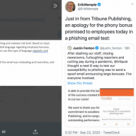
Just in from Tribune Publishing, an apology for the phony bonus promised to employees today in a phishing email test

Tribune Apologizes for Phishing Test:


Tribune Publishing apologized Wednesday for sending a test phishing email that indicated employees would receive bonuses of up to $10,000, according to an internal email obtained by Erik Wemple of The Washington Post. "The company had no intention of offending any of its employees," the email concluded. "In retrospect, the email was misleading and insensitive, and the company apologies for its use."

Why the student newspaper at Syracuse University launched a membership program

Syracuse University Student Newspaper Launches Membership Program:


Syracuse University's student newspaper has launched a membership program, "hoping to connect more deeply with its community and create a sustainable revenue model for the future" amid shortfall stemming from the COVID-19 pandemic, according to Taylor Blatchford of Poynter. "We started researching nonprofit news outlets who do this really well, particularly The 19th*, The Texas Tribune and ProPublica," said former Daily Orange Editor-in-Chief Haley Robertson, who serves as fundraising coordinator for the newspaper. "We couldn’t really model anything off a subscription-based site, because we want our content to always be free to all of our readers. We needed to frame this in a way that people know being a member means supporting the DO, but non-members can still read our content."