For the Record


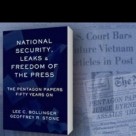
National Security, Leaks and Freedom of the Press: The Pentagon Papers Fifty Years On
Columbia President Edits Pentagon Papers Collection:


Columbia University President Lee Bollinger and University of Chicago legal scholar Geoffrey R. Srone have co-edited "National Security, Leaks and Freedom of the Press: The Pentagon Papers Fifty Years On," a new Oxford University Press collection featuring essays on the seminal press freedom case by such figures as former CIA Director John Brennan, former Attorney General Eric Holder and former Administrator of the Office of Information and Regulatory Affairs Cass R. Sunstein. The authors "reflect on the balance between the government’s legitimate need to conduct operations — particularly those related to national security — in secret and the public's right and responsibility to know what the government is doing." Bollinger has served on the Pulitzer Prize Board since assuming the Columbia presidency in 2002. The New York Times received the 1972 Public Service Prize for publishing the classified study, which was leaked to 1989 General Nonfiction winner Neil Sheehan by former RAND Corporation economist Daniel Ellsberg. 

The New Republic Makes an Uneasy Peace With Staff Over D.C. Move

New Republic Backs Away From D.C. Move Following Union Pressure:


Following "public pressure from [its] NewsGuild-affiliated union and a Defector story outlining the staff’s displeasure with the announcement," The New Republic's management "has agreed that no employee currently working in New York City will be asked to relocate" as the magazine cultivates a renewed presence in its traditional home of Washington, D.C., Jack Crosbie and Paul Blest of Discourse Blog reported Thursday. Crosbie and Blest added that the new plan "is to slowly shift operations to D.C. as people leave the company naturally," with several staffers continuing to express concerns about the role of outgoing Editor Chris Lehmann and the magazine's orientation under his successor, Democracy Editor in Chief Michael Tomasky.

Supreme Court Allows FCC to Move Forward With Changes to Media Ownership Rules

Supreme Court Upholds Pai-Era FCC Ownership Policy:


In a unanimous decision written by Associate Justice Brett Kavanaugh, the Supreme Court upheld former FCC Chairman Ajit Pai's policy removing "longstanding restrictions prohibiting ownership of a both daily newspaper and TV station in any given market, limiting the number of radio stations and TV stations that can be owned, and requiring at least eight independently owned local TV stations remain in the market before a company can own two stations," according to Ashley Cullins of The Hollywood Reporter. The order was vacated by the Court of Appeals for the Third Circuit in 2019, which found that the agency "did not adequately consider" the effect its rule changes would have on media ownership by women and people of color. "[T]he FCC did not have perfect empirical or statistical data. Far from it," said Kavanaugh. "But that is not unusual in day to-day agency decisionmaking within the Executive Branch. The APA imposes no general obligation on agencies to conduct or commission their own empirical or statistical studies." 

Chronicle Executive Editor Steve Riley to retire

Chronicle Executive Editor Riley Retires:


Houston Chronicle Executive Editor Steve Riley "said Wednesday that he will retire after a 41-year career in journalism, including more than three years at the Chronicle," according to Business Reporter Paul Takahashi. "Steve's leadership of the Chronicle's newsroom is reflected in the outstanding coverage and investigative work done under his reign," Hearst Newspaper President Jeff Johnson said in a statement. "This work has been recognized both statewide and nationwide, and most importantly, by our readers." Prior to joining the newspaper as senior editor for investigations in 2017, Riley "spent more than 30 years at The News & Observer in Raleigh, N.C., where he served as investigations editor for a decade."

Former intelligence analyst Daniel Hale pleads guilty to leaking classified information

Hale Pleads Guilty in Espionage Act Case:


Former National Geospatial-Intelligence Agency contractor Daniel Hale pleaded guilty to one count of the Espionage Act Wednesday after initially arguing that the "charges against him violate the First Amendment," according to Rachel Weiner of The Washington Post. Hale "admitted sharing eight secret and three top-secret documents" about drone warfare in 2013-14 with an unnamed journalist whose "description matches Jeremy Scahill, a founding editor of The Intercept." Scahill is believed to have used the documents as sources in "The Assassination Complex: Inside the Government’s Secret Drone Warfare Program," a 2016 book. Although four other charges remain pending against Hale, Judge Liam O’Grady "indicated that Hale's sentence would probably not change based on the number of convictions and said he would take up that issue at sentencing" on July 13.

Two Texas Tribune leaders announce their departures after a year on the job.

Ishmael, Tran Leave Texas Tribune:


Texas Tribune Editorial Director Stacy-Marie Ishmael and Chief Product Officer Millie Tran announced Tuesday that they plan to leave the digital news organization next month, "a little more than a year after they both started working at the publication," according to Katie Robertson of The New York Times. "It has been impossible for me to separate what’s been happening in the world, which we’ve been covering rigorously and intensely for these 12 months, from what’s happening in my own life and in the lives of my friends, family and communities," said Ishmael. Tran, who had continued working in New York rather than Austin due to the pandemic, "decided she would rather stay put" in the former city. CEO Evan Smith hired Ishmael and Smith after Pulitzer Prize Board member Emily Ramshaw and past Pulitzer juror Amanda Zamora left the publication to start The 19th. "I think that the culture of this place and the degree to which the normal work that we take on has an adverse effect on the lives and well-being of people is something that we have to confront as an organization," he said. "Not just us as an organization, but us as an industry."

Four years into a subscription strategy, Medium still doesn’t spend money to acquire subscribers

Medium's Advertising Lags Behind Competitors:


After spending "just over $1 million" on advertising in 2018, the digital publishing platform Medium spent less than $500,000 in 2020, "preferring instead to let its platform and the organic reach of its content drive subscriber growth," Max Willens of Digiday reported Tuesday. Although current and former employees told Willens that "the platform would drive its own success on the subscriber acquisition front," subscriber growth began to slow in the second half of 2020, leading the company to scale back its investment in several publications earlier this month. 

Google Is Ending Cookies and the Ad Industry Has an Alternative

Advertisers Propose Cookie Alternative:


A group of advertising executives and lawyers "detailed an anonymous identifier on Wednesday that lets people control what ads they see on the web" as Google prepares to phase out third-party cookies, according to Aoife White of Bloomberg. The technology, known as SWAN, is designed to compete with the platform's FLoC system and supported by a variety of ad-tech companies, including PubMatic Inc., OpenX and Zeta Global Corp. "When people first visit a website in the SWAN network, they will be asked to give consent for all publishers that use SWAN to show them ads," added White. "Personalized ads is one option, but not required. User preferences are then stored in the SWAN network registry and shared with other SWAN participants so individuals’ access to online content continues uninterrupted. People can change preferences anytime on any of the websites and that will be automatically updated for all sites in the network."

Scoop: Substack is raising $65 million amid newsletter boom

Substack Raises $65 Million in Venture Round:


Substack "is raising $65 million in new venture capital funding that would value the company at around $650 million," Kia Kokalitcheva and Dan Primack of Axios reported Monday. Andreessen Horowitz, an existing investor, is leading the round. Although both companies declined comment, the newsletter platform "could have tough competition from Big Tech companies like Twitter and Facebook, plus rival online publishers like Medium."


From public to publics: News orgs need ombudsmen to push for more diverse representation, inside and out

Public Editors and Media Trust:


Initially conceived by Pulitzer Prize Advisory Board member Barry Bingham Sr. in response to a common European governmental position in 1967, the role of ombudsman (or public editor) has emerged as "an easy target for budget cuts" since newspaper revenues began to decline, according to Joshua Benton of NiemanLab. However, in a new paper from the Reuters Institute for the Study of Journalism, former Toronto Star Public Editor Kathy English has called for a revival of the role. "Public editors do the work of overseeing accuracy and fairness and other imperatives of ethical journalism," she said. "But public editors could — and should — also do more. Here, I call on our 'journalistic imagination' to envision a greater role for the public editor in holding journalists to account for diverse, inclusive journalism that is aligned with its moral mission for equality in a liberal democracy."