For the Record


With No Baseball, FanGraphs Is in Peril. It Won’t Be the Last Sports Media Operation to Face Hard Times.

Sports Journalism and COVID-19:


According to Bryan Curtis of The Ringer, the suspension of professional sports amid the COVID-19 pandemic has upended sports journalism, forcing data-oriented baseball site FanGraphs to impose layoffs for the first time in its 15-year history. "If baseball starts in July, things can potentially start to ramp back up," said CEO David Appelman. "But from a yearly budget standpoint, I have to essentially find hundreds of thousands of dollars that are not there. That’s the problem. I mean, they’re not there." Other publications, including the soccer-oriented First Touch, have suspended their print editions, while sportswriters have been among the first to be laid off from such newspapers as the Pittsburgh Tribune-Review and the Imperial Valley Press.


‘Emergency’ Online Library Draws Ire of Some Authors

Internet Archive National Emergency Library Elicits Criticism:


According to Alexandra Alter of The New York Times, prominent writers (including 2017 Fiction winner Colson Whitehead) and trade groups have criticized the Internet Archive's online library (partially reconfigured as the National Emergency Library following COVID-19 pandemic) for "[depriving] authors and publishers of royalty payments — at a moment when sales are declining and many writers are struggling." Unlike traditional libraries, which utilize licensed, royalty-supported digital editions, the Archive has lifted user restrictions in the National Emergency collection, which employs copies scanned through collaborations with physical libraries alongside donated editions. Internet Archive founder Brewster Kahle said the group "decided to make its scanned books more widely available after hearing from teachers who were looking for more resources to teach remotely after schools closed," while authors who don’t want their work to be available through the site (such as Whitehead) can opt out.

Letter to President Trump: Help Sustain Local News

Media Trade Organizations Send Open Letter to President, Congress:


News Media Alliance President/CEO David Chavern and America's Newspapers CEO Dean Ridings called for a "discussion of options for actions the federal government could take to help sustain our local news ecosystem" amid the COVID-19 pandemic in an open letter sent to President Trump, Senate Majority Leader Mitch McConnell and House Speaker Nancy Pelosi. "While many publishers have seen increases in online traffic and digital subscriptions, the additional revenue has in no way made-up for the sharp losses in ad revenue," they said. "[T]he online environment, generally, does not adequately reward the production and distribution of quality journalism. While that is bad in every circumstance, in the current environment it could prove fatal — both to publishers and the public."

A Q&A with Tampa Bay Times chairman and CEO Paul Tash about the Times’ print reduction

Tampa Bay Times Announces Print Reduction, Furloughs:


Tampa Bay Times Chairman/CEO and former Pulitzer Prize Board member Paul Tash announced Monday that the newspaper will temporarily suspend all print publication save for Wednesday and Sunday and furlough non-newsroom staff effective next week as a result of the COVID-19 pandemic. "Ad sales are running down about 50%," he said to Poynter's Rick Edmonds. "We expect this plan to make up roughly half of that gap. At that rate, we can tough things out for a few months. If things get worse, or if the crisis goes on indefinitely, we'll have to reconsider our approach."

Gannett Announces Pay Cuts and Furloughs Across Entire Media Company

Gannett Announces Companywide Pay Cuts and Furloughs:


Gannett CEO Paul Bascobert announced in an internal email Monday that the media company will "ask staff to make a 'collective sacrifice' to keep [it] intact amid the crisis by cutting pay 'as soon as this week,'" according to Maxwell Tani of The Daily Beast. Many staffers will be furloughed for five days a week until June, while executives will take a 25% pay reduction. Bascobert will not take a salary until the measures are reversed. "Everyone will be touched by these changes in some form," Bascobert said. "For some it will be economic, for others it will mean covering the work of a colleague on furlough, for many it will be both."

Florida reporter says she was blocked from Gov. DeSantis's coronavirus press briefing

Klas Denied Entry to Press Briefing:


Miami Herald Tallahassee Bureau Chief Mary Ellen Klas was "was refused entry into" the state Capitol to attend a Saturday press briefing "by the governor, lieutenant governor, director of emergency management and state surgeon general regarding COVID-19 testing, access to medicine and efforts to prevent New Yorkers from flying into the state," according to colleague David Smiley. Klas also asserted that a reporter for the News Service of Florida "was told that he would be shut out as well if he insisted that Klas be allowed to cover the press conference in person." State spokesperson Meredith Beatrice said that Klas was not admitted due to social distancing measures. The decision was condemned by the Miami Herald, the Tampa Bay Times and First Amendment Foundation President Pamela Marsh, who "questioned why the governor’s office would freeze out a reporter for a newspaper serving readers in the epicenter of the state’s coronavirus outbreak."

TIME is pledging no layoffs for 90 days

Time: No Layoffs for 90 Days


In a Sunday memo and tweet, Time Editor in Chief/CEO Edward Felsenthal confirmed that co-owner Marc Benioff's 90-day layoff reprieve at Salesforce will extend to the magazine. "We will also continue to ensure our hourly workers are paid while our offices are closed," he added. "Grateful for our immensely dedicated employees and the support of our owners Marc and Lynne Benioff in our mission, especially at this moment."

Can a fragile media ecosystem survive the pandemic?

Media in the Age of COVID-19:


According to Michael Luo of The New Yorker, the recent departures of Ben Smith from BuzzFeed News and Lydia Polgreen from HuffPost mark an "inflection point for the industry" as the COVID-19 pandemic threatens to upend the revenue streams of most for-profit news organizations and hasten the stratification of consumers along socioeconomic lines. "One of the biggest reasons that I left the Times and came to HuffPost was, in the aftermath of Trump’s victory, thinking that the kind of inequality that we see expressed in so many parts of society was also being expressed in media," said Polgreen. "These legacy news organizations — their core audience are the wealthiest, best-informed, most educated, most spoiled-for-choice news consumers."

Bail Out Journalists. Let Newspaper Chains Die.

The Nonprofit Revolution:


Citing a desire to "abandon most for-profit local newspapers, whose business model no longer works, and move as fast as possible to a national network of nimble new online newsrooms," Ben Smith of The New York Times profiled several journalists who have made the transition, including Elizabeth Green of the education news site Chalkbeat. "We need to keep the values, keep the people, keep the lessons learned — and get rid of the shareholders and get a better business model," she said.

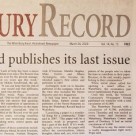
Media Note: Waterbury Record to Close

COVID-19 Leads to Local Media Crisis in Vermont:


According to Paul Heintz of Seven Days, the COVID-19 pandemic has had a decimating impact on local news organizations in Vermont, with newspapers forced to close (Waterbury Record), suspend print operations (Milton Independent, Essex Reporter, Colchester Sun), reduce frequency of print editions (Addison County Independent, Rutland Herald, Barre-Montpelier Times Argus) or implement furloughs and layoffs (Seven Days, the Valley News, Brattleboro Reformer, Bennington Banner, Manchester Journal). "Clearly, this decision is precipitated by the coronavirus crisis, but it's also about economics," said Greg Popa, former publisher of the Record. "The Record has never been profitable, but we were in this for the long haul." Despite its relative proximity to the New York, Boston and Montreal metropolitan areas, the rural state has struggled to attract residents since the turn of the century; an initiative offering prospective residents $10,000 grants to telecommute from the state was enacted by Gov. Phil Scott in 2018.